China Scissor Lift Manufacturer Guide (2026): Top 10 Diesel and Electric Models Compared
Finding a China scissor lift manufacturer that will still answer the phone in year three is the real procurement problem. The machine is the easy part. Ten suppliers quote you the same 12 m platform with the same 320 kg deck, and eight attach the same stock photograph.
So this is not a price list. It is a list of factories that can be checked: what each one publishes about its scissor range, which power options it actually builds, and which buyer it fits. Where a company publishes no number, we say so rather than fill the gap.
Disclosure: Chenlift publishes this site and appears on this list. It is marked and was held to the same three tests. If that is a reason to distrust entry six, apply the tests to us first.
How this list was built
Every China scissor lift manufacturer below passed three checks.
- Does it build the structure? A scissor lift is a welded box section, a hydraulic power unit and a control system. A factory has a cutting line, a welding line and a paint line; a trader has a price list and a factory visit it schedules for you.
- Is the scissor range documented? Not the whole catalogue — the scissor range, with working height and capacity per model. A company that publishes boom ranges but leaves scissors vague is telling you where its volume sits.
- Can the machine be supported after delivery? CE documentation per model, a spare parts list with part numbers, a manual that can be translated.
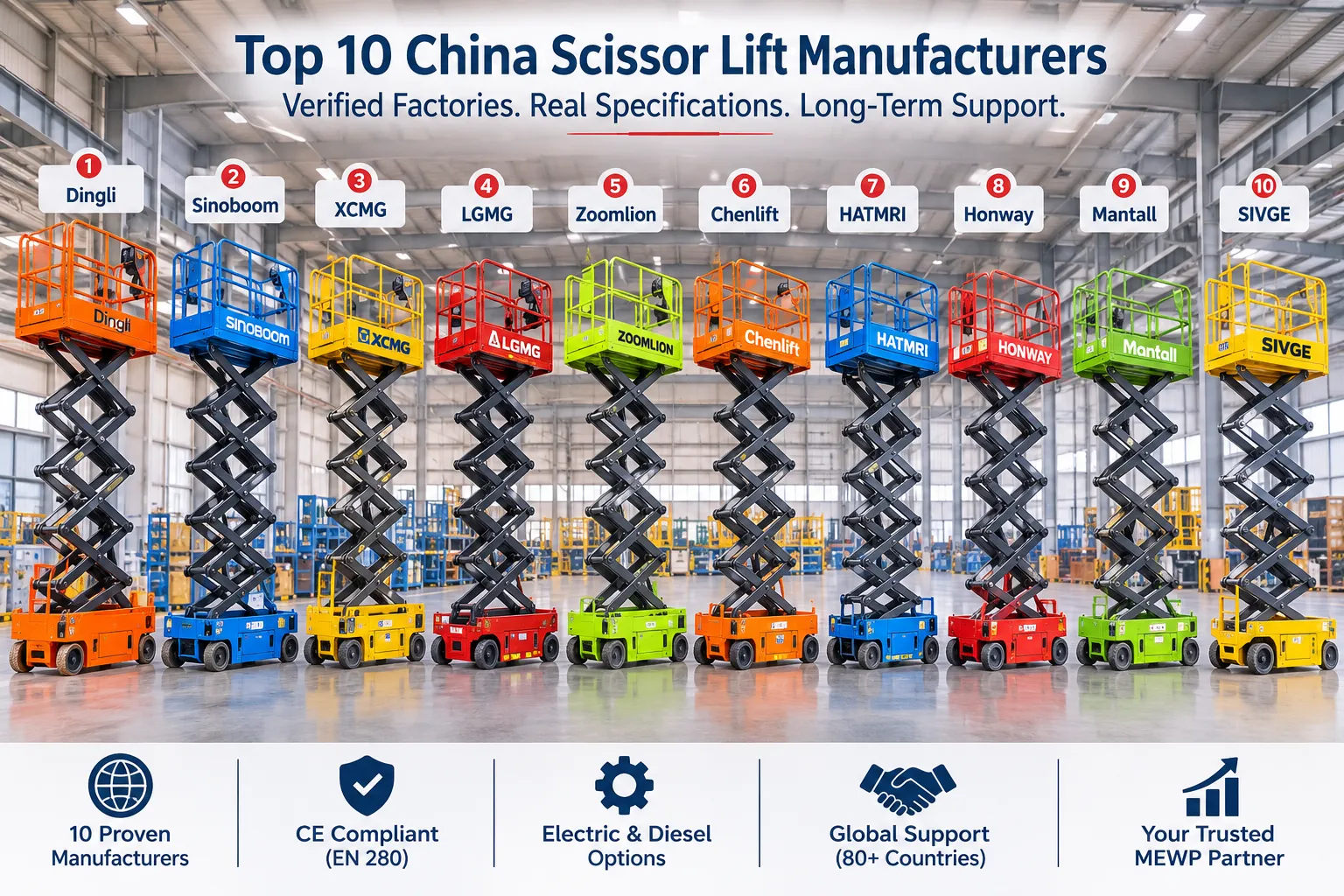
The first five are the highest-volume MEWP producers in China; the order inside that group is approximate and shifts year to year. The last five are mid-size and specialist factories, listed alphabetically, because ranking them by revenue says nothing about whether the machine fits your site.
1. Dingli — the volume benchmark
Zhejiang Dingli Machinery (Deqing, Zhejiang) started in 2005, has been listed in Shanghai since 2015, and positions itself in the global top three for MEWP and 40th in global construction machinery, with more than 200 models sold in over 80 countries.
The scissor line is organised the way a rental fleet buys: mini electric for mezzanine work, small dual-AC electric for indoor volume, large rough-terrain for outdoor sites. Electrification runs across the range rather than sitting as an option, which is the practical difference when a European customer asks for a zero-emission fleet.
Suits: fleet orders where one spec sheet per class and a dealer network matter more than a bespoke build.
2. Sinoboom — the multi-certificate exporter
Hunan Sinoboom Intelligent Equipment (Changsha) was founded in 2008 and runs seven families covering platform heights from 4 to 58 m, with scissors in electric, hydraulic and rough-terrain versions. It reports CE, ANSI, CSA, AS, KC and EAC certification, sales in over 80 countries, and a place in the global MEWP top ten.
For a distributor the certificate portfolio matters more than the model count. A machine that already carries ANSI and CSA paperwork can be resold into a second market without a new conformity exercise.
Suits: rental groups selling into several regulatory regimes.
3. XCMG — the tender-safe option
XCMG’s MEWP business sits under XCMG Fire-fighting Safety Equipment in Xuzhou and publishes 35 platform types: 6–16 m scissor lifts, 15–18 m rough-terrain scissors, 16–26 m articulated booms, 22–58 m telescopic booms.
The features that decide a scissor’s real working life are the automatic pothole protection, the folding fence and the zero inner turning radius. Those three separate a machine that works in an occupied building from one that only works on a cleared slab.
Suits: public tenders, framework agreements, buyers who want one dealer for MEWP and earthmoving.
4. LGMG — the rough-terrain specialist
LGMG (Jinan) belongs to Lingong Group, founded in 1972, and publishes unusually complete scissor figures: platform heights 3.6–20 m, working heights 5.6–22 m, capacity 230–750 kg; rough-terrain models 8–20 m platform, 9.8–21.7 m working, 365–1,100 kg, in electric and diesel.
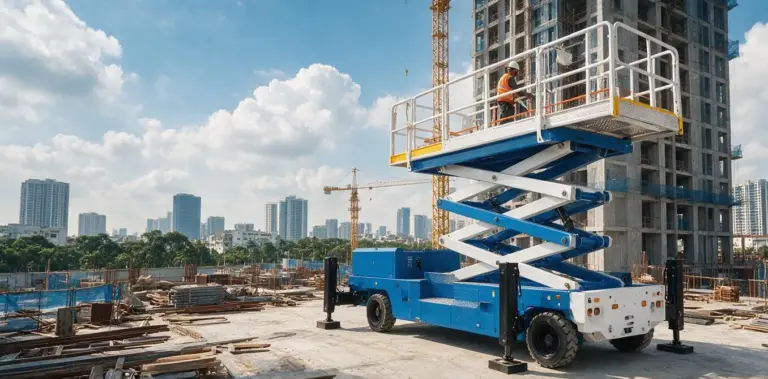
That diesel rough-terrain band is where most export enquiries land. A 4WD machine at 12–18 m with a 1,000 kg-class deck is the workhorse of a rental yard, and LGMG builds that band as a core product rather than a special order.
Suits: fleets that are mostly diesel rough-terrain, bought in volume.
5. Zoomlion — lithium and telematics as standard
Zoomlion (Changsha) builds the ZS series with platform heights from 4 to 14 m and a 350 kg-class deck, in lead-acid, lithium (HDS-Li) and AC-driven (AC-L) versions. Its sheets list battery management, remote monitoring and rental management as standard.
That is a fleet-management decision, not a lifting one. For twenty rental units, the telematics layer and the battery chemistry set your service cost per machine per year far more than the lift height does.
Suits: rental fleets at scale and lithium-first policies.
6. Chenlift — the full-line factory with a diesel core
Chenlift (Suzhou, Jiangsu) has built lifting equipment for over 20 years in Xiangcheng District and exports to more than 80 countries. Its scissor line splits into four sub-families that cover the whole buying decision:
| Sub-family | Type | Working height | Capacity |
|---|---|---|---|
| MX | Electric self-propelled | 5–17.8 m | 227–320 kg |
| MK | Manual push-around | 5–18 m (MK 8–18 m) | 500 kg standard, 1,000 kg T-series |
| MRT | Rough-terrain, diesel or electric, 4WD | 10–18 m | — |
| MC | Tracked, rubber or steel with outriggers | 6.4–15.8 m | — |
Three examples, because a range hides the details buyers argue about. The MX580S is 0.76 m wide at 7.8 m working height and 230 kg — the width is the specification, not the height. The MK900T reaches 11 m with a 1,000 kg deck on AC 380 V, with DC available: the manual machine for plant rooms and mezzanine loading. The MRT range runs to 18 m in 4WD, diesel or electric, for sites where the ground is the problem.
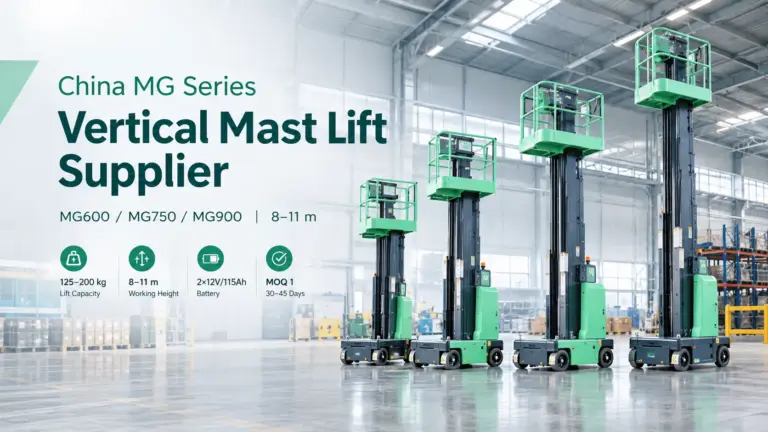
The same factory builds booms from 12 to 48 m and vertical mast lifts, so a mixed order — six diesel rough-terrain scissors, two electric booms, a mast lift for the warehouse — leaves on one bill of lading.
Suits: mixed fleets from one factory, OEM branding, and buyers who need diesel rough-terrain and indoor electric under one CE file.
7. HATMRI — research institute first, scissor second
High Access Technology Machinery Research Institute (Wuxi, Jiangsu) was established in 2013 with provincial approval and describes itself as research-based: 30-plus patents, CE and ISO 9001, participation in more than 30 industry standards, sales in over 80 countries.
Its core products are building maintenance units and mast climbing platforms, not scissors. That matters before you shortlist it. A company whose engineering attention sits in facade access will still build you a scissor lift, but you are not buying its main line.
Suits: BMU and facade projects where a scissor lift is one line in a larger package.
8. Honway — the cost-led single container
Honway (Jinan) runs six product series with more than 100 specifications, publishes a scissor range of 3–18 m at 230, 320 and 450 kg, and reports CE, ISO 9001 and ISO 14001 with exports to over 80 countries.
Its own FAQ states a team of 50 and capacity above 5,000 units a year. Both can be true only if much of the output is standard models built to stock — which is the point. This is a supplier for the standard 6–12 m electric scissor in a single container, not for a spec you invented.
Suits: first orders, cost-led tenders, standard electric machines on a fast build slot.
9. Mantall — mixed scissor and boom ranges
Mantall (美通重工) was founded in 2001 and manufactures in Qidong, Nantong, on a site of about 76,666 m² with 45,000 m² of buildings, exporting to over 80 countries.
The scissor side covers mini electric, self-propelled, rough-terrain and tracked machines, alongside booms and vertical mast lifts. It also runs a European sales operation, which matters when you want a spare parts conversation in a European time zone rather than a chat group.
Suits: distributors buying scissor and boom from one brand.
10. SIVGE — the mast specialist that also builds scissors
Hangzhou SIVGE dates to 1995, is listed on the NEEQ (833084), and has held CE certification since 2002, with nine series certified to EN 280 in 2010. It exports to more than 70 countries and has taken part in drafting the Chinese JG/T and GB standards for elevating work platforms.
Its centre of gravity is the mast-type platform — single, double, multi-mast — with scissors and order pickers alongside. If the requirement is a 6 m indoor machine that fits a passenger lift, this is a company that has been solving that exact problem for thirty years.
Suits: compact indoor access and small scissor quantities added to a mast order.
The ten, side by side
| # | Manufacturer | Base | Published scissor range | Capacity | Power | Best for |
|---|---|---|---|---|---|---|
| 1 | Dingli | Deqing, Zhejiang | Mini / small / RT families (200+ models overall) | — | Electric, diesel, hybrid | Fleet volume, full-electric line |
| 2 | Sinoboom | Changsha, Hunan | 4–58 m platform height across MEWP families | — | Electric, diesel | Multi-certificate export |
| 3 | XCMG | Xuzhou, Jiangsu | 6–16 m; RT 15–18 m | — | Electric, diesel | Tenders, dealer coverage |
| 4 | LGMG | Jinan, Shandong | 5.6–22 m working; RT 9.8–21.7 m | 230–750 kg; RT 365–1,100 kg | Electric, diesel | Diesel rough-terrain |
| 5 | Zoomlion | Changsha, Hunan | 4–14 m platform height | 350 kg class | Electric (lead-acid, Li, AC) | Lithium fleets, telematics |
| 6 | Chenlift | Suzhou, Jiangsu | 5–18 m (MX 5–17.8, MK 8–18, MRT/MC 6.4–18) | 230–1,000 kg | Electric, diesel | Mixed fleet, one CE file |
| 7 | HATMRI | Wuxi, Jiangsu | Not published as a single range | — | Electric | BMU / facade packages |
| 8 | Honway | Jinan, Shandong | 3–18 m | 230 / 320 / 450 kg | Electric | Cost-led standard models |
| 9 | Mantall | Nantong, Jiangsu | Not published as a single range | — | Electric, diesel | Scissor + boom, EU support |
| 10 | SIVGE | Hangzhou, Zhejiang | Not published as a single range | — | Electric | Compact indoor, mast-first |
A dash means the manufacturer does not publish that figure in the material we could verify. It is not a judgement about the machine.
What the table does not tell you
Working height is not platform height. The convention is working height = platform height + 2 m, and suppliers do not all label the column the same way. A “12 m” machine can mean a 10 m platform or a 12 m platform. Get both numbers in writing; the difference decides whether you clear a 10.5 m truss.
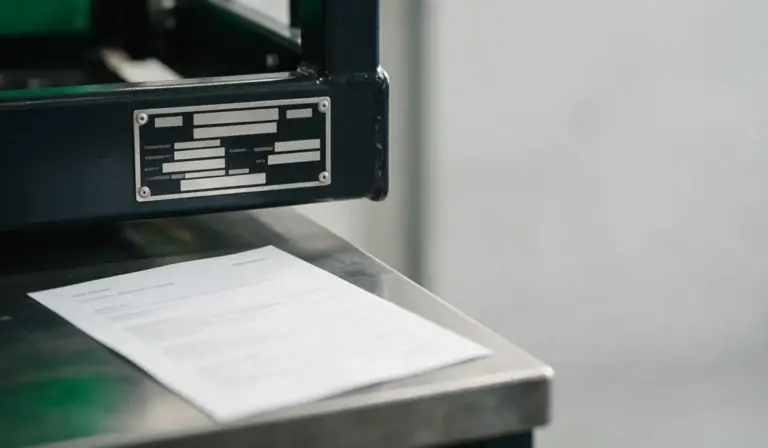
Capacity is measured at the deck, not at the extension. A 320 kg machine typically rates its extension deck at roughly a third of that, and the plate on the machine says so. If two workers and a genie lift are going up, the extension rating is the number you need.
Diesel or electric is a duty-cycle question. Diesel rough-terrain earns its cost outdoors, on unimproved ground, over long shifts. Electric earns its cost indoors, where exhaust and noise are the problem and an overnight charge fits the shift. A rental fleet usually needs both — which is why the mixed-line factories here deserve a second look.
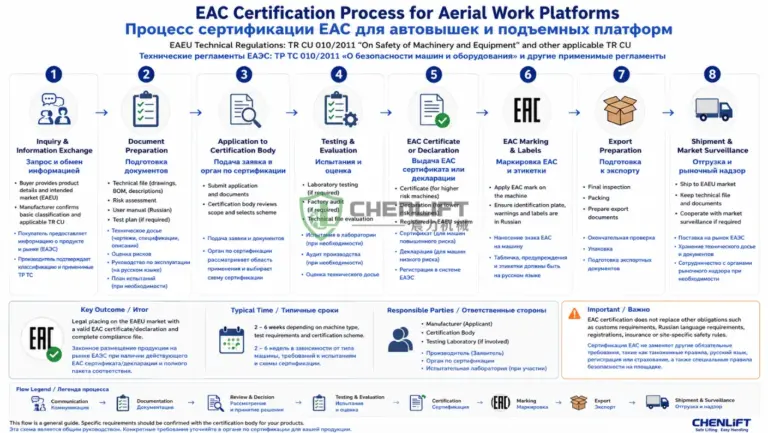
Ask which model is on the declaration of conformity. A CE certificate covering a family is not a DoC naming your model with your options. The CE article covers the document chain; the Poland and Türkiye guide covers what happens after the container lands.
FAQ
What should I ask a China scissor lift manufacturer before the first order?
Four questions. What is the registered scope on the business licence? Can you send a video of the paint line running? Who signs the declaration of conformity, and for which model? And what is the part number for the hydraulic power unit? A trader answers the first two with a partner’s name and the third with silence.
Is a Chinese scissor lift CE compliant for import into the EU?
CE marking is a self-declaration against EN 280, backed by a technical file and a DoC naming the model. The marking is not the question — whether the DoC matches the machine in the crate, including the options you ordered, is. Request it before the deposit and check the model designation against the nameplate on delivery.
Diesel or electric for a rental fleet?
Both, eventually. Diesel rough-terrain for outdoor and unimproved ground, electric for indoor and occupied buildings. The split follows your customers, not the price list. If you must start with one, start with the machine your largest account asks for twice a year.
What should arrive with the machine?
A manual in the language of the destination market, the CE declaration of conformity, a factory test report, a spare parts list with part numbers, and the electrical and hydraulic diagrams. For Poland or Türkiye, add an inspection book and a maintenance log — operational documents from day one, not paperwork for later.
What MOQ and lead time should I expect?
On standard models most factories above quote a single unit. The constraint is the build slot and the paint line, not the minimum order. Custom RAL colours and OEM decals move a machine into a batch, so ask whether your date is held by a stock unit or a production slot.
Why only ten?
Because these ten could be verified against their own published material and a longer list would be padding. There are several hundred scissor lift assemblers in China, many around Jining and Jinan, and most publish no verifiable range at all.
Next step
Send four numbers and get a model recommendation instead of a catalogue: working height, capacity, the narrowest door or aisle on site, and whether the machine works indoors, outdoors or both. Add the destination country if you know it — the certification route changes with it.
Send the four numbers and we will reply with a model, a power option and the documents that go with it. The scissor lift range lists every model, the data sheets are downloadable, and the full model catalogue covers booms and mast lifts if the site needs more than one type.
As a China scissor lift manufacturer working with distributors in more than 80 countries, we would rather you shortlist three factories from this list than one — including us.
Sources
Company facts were taken from each manufacturer’s own published material, checked 6 November 2026. No specification was inferred.
- Dingli — cndingli.com (company profile, product centre, scissor families)
- Sinoboom — sinoboom.com / sinoboom.com.cn (company story, product families, certifications)
- XCMG — xcmgglobal.com (aerial working machinery page, MEWP range)
- LGMG — lgmglifts.com (scissor and RT scissor ranges, company profile)
- Zoomlion — en-product.zoomlion.com (ZS series product page and AC-L series sheet)
- Chenlift — internal product database and catalogue, chinaliftplatform.com
- HATMRI — hatmri.com/company-profile (establishment, patents, certifications, standards work)
- Honway — honwaylifts.com (about, FAQ, self-propelled scissor lift page)
- Mantall — mantall.com/about (founding year, plant area, product families)
- SIVGE — sivge.com (about, development timeline, standards participation)
*Published 6 November 2026. Specifications and ranges change; confirm the current data sheet with the manufacturer before a purchase order.