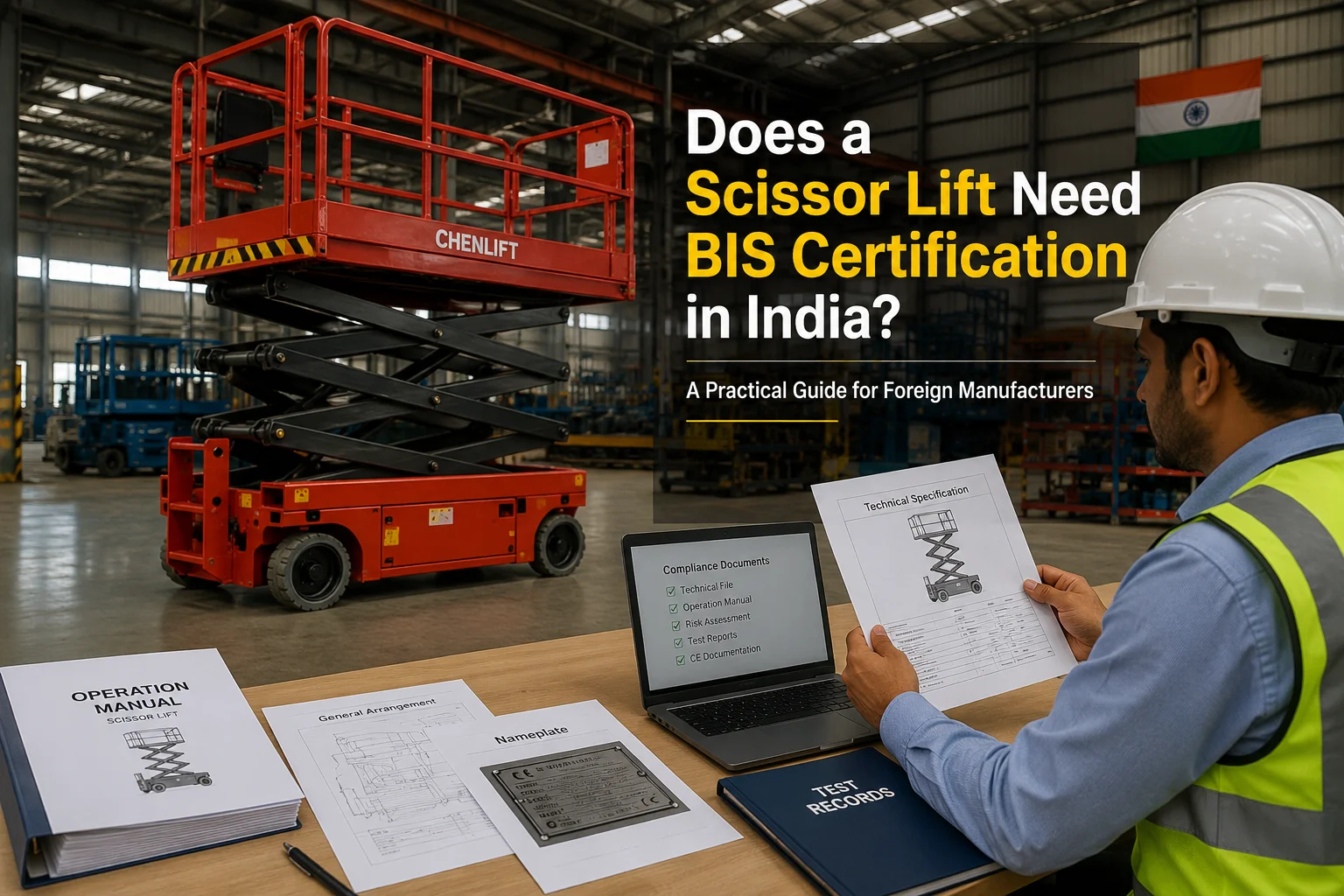
Does a Scissor Lift Need BIS Certification in India? A Practical Guide for Foreign Manufacturers
Does a scissor lift currently need BIS certification in India?
Do not assume that a self-propelled scissor lift is automatically subject to a universal BIS certification requirement simply because it is lifting machinery. Under the current framework, the answer depends on the exact machine, the applicable Indian Standard, any active Quality Control Order (QCO), and the product-specific certification or registration route in force at the time of shipment.
For an Indian buyer or foreign manufacturer, the practical question is not simply “Do you have BIS?” It is:
Which current Indian requirement applies to this exact machine, model range, component configuration and intended use?
That distinction is commercially important. A product may require a BIS licence and Standard Mark, a foreign-manufacturer licence, a product-specific certificate, a test report, or no mandatory BIS product certification at all. These are not interchangeable documents.
For a self-propelled scissor lift, the review should begin with three questions:
- Is the complete machine covered by a current mandatory Indian product regulation?
- Is there an applicable Indian Standard and a defined certification route for this product category?
- Do any installed electrical products require a separate product-level review?
This article explains how Indian importers and foreign lifting-equipment manufacturers should answer those questions before production or shipment. It also addresses the 2026 regulatory change that makes older machinery-compliance plans unreliable without a current check.
Four questions that come up in an India lifting-equipment project
1. The buyer says: “We need BIS. Send the certificate.”
Do not start by sending a generic certificate from another product family. First ask what the buyer means by “BIS.” In Indian tenders and import projects, that phrase may refer to a BIS licence, an ISI Mark, a Certificate of Conformity, a Scheme X route, a test report or an importer’s internal document checklist.
The useful reply is:
Please identify the Indian Standard, active QCO or product-specific regulation that applies to this model, and confirm which BIS conformity route and documents are required for our shipment.
This question separates a legal requirement from a procurement preference. It also prevents a certificate for a different model, factory or product category from being treated as evidence for the quoted lift.
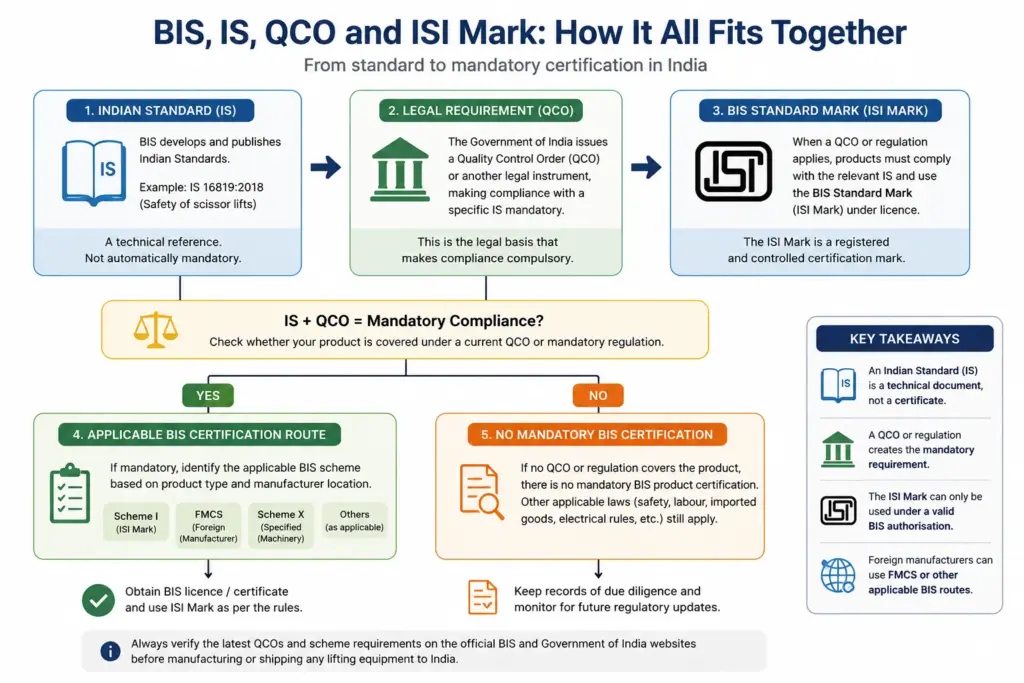
BIS is India’s national standards body. An IS number identifies a technical standard, but the existence of that standard does not by itself make certification compulsory. BIS states that product certification is basically voluntary; the Central Government can make it mandatory for selected products through a QCO or another legal instrument.
2. The certificate exists, but the quoted model is not clearly covered
A BIS document is only useful if its scope matches the equipment being purchased. Check four items before attaching it to a quotation:
- The exact model or approved model range
- Rated capacity, working height and other relevant ratings
- The manufacturing site named in the authorisation
- The standard, licence or certificate validity and marking scope
A self-propelled scissor lift, a manual-push mast lift and a loading dock leveler should not be assumed to share the same Indian Standard or certification route. The same caution applies when a standard model is customised with a different platform, power system, control cabinet or safety configuration.
The terms also need to stay separate: an Indian Standard is a technical reference; a QCO is the legal instrument that can make compliance compulsory; an ISI Mark is controlled marking under the relevant BIS authorisation. “BIS standard,” “BIS registration,” “ISI certification” and “BIS test report” should not be used as interchangeable descriptions in a contract.
3. The buyer asks whether CE is enough
The short answer is no. CE and BIS are separate market-conformity systems. CE marking follows applicable European Union legislation, while BIS requirements arise from Indian standards, Indian legislation, QCOs and product-specific certification or registration schemes.
That does not make the existing CE file irrelevant. For an aerial work platform, it may contain useful technical evidence such as:
- Machinery risk assessment and safety-related design decisions
- Structural and functional testing
- Electrical safety controls and emergency-stop arrangements
- Guarding, warnings and operator instructions
- Factory quality and traceability records
The right commercial explanation is:
Our CE technical file can support the Indian conformity review, but it does not replace a BIS document where Indian law or the project requires one.
This is also why the manufacturer should not answer “We have CE” when the buyer is asking for a specific Indian document. The two files serve different market requirements, even though they may use related technical evidence.
4. The equipment is electric, so does every component need BIS?
Not necessarily. An electric scissor lift may contain batteries, chargers, power supplies, control equipment, switchgear or other products that are covered by separate Indian rules. Those components should be screened to determine whether any separate requirement applies. Screening does not mean that every component needs its own BIS certificate.
CRS, for example, is primarily associated with notified electronics and IT products; it is not the default BIS path for a complete scissor lift or boom lift. Component status depends on the product function, ratings and applicable Indian product list.
The practical file review should record the component manufacturer, model, voltage or rating, existing test evidence and the reason a separate Indian requirement does or does not apply. That record is more useful than placing a general “BIS compliant” statement on a quotation.
What changed with India’s machinery OTR?
Scheme X may apply where a specified machinery or electrical-equipment category has been brought within its scope. It is not a single certification rule for every machine. BIS publishes product-specific information and guidelines by standard or category, so the relevant product scope must be identified before testing or marking plans are prepared.
In 2025, government information concerning the Machinery and Electrical Equipment Safety (Omnibus Technical Regulation) Order, 2024 described a structure based on Type A, Type B and Type C Indian Standards. The cited Type A standard was IS 16819:2018 / ISO 12100:2010, covering general principles for machinery safety, risk assessment and risk reduction. The announcement stated that the regulation was planned to apply from 1 September 2026 to machines and electrical equipment listed in the relevant schedule.
The 2024 Omnibus Technical Regulation notification was later rescinded with immediate effect in January 2026. Its former implementation timeline should not be used as a current universal rule for machinery entering India.
Product-specific QCOs, existing compulsory schemes and other Indian regulations were not eliminated by that change. For a live project, the current BIS product information and Ministry of Heavy Industries notification are more important than an old OTR presentation or a certificate prepared for a previous shipment.
Before production: agree the document list with the importer
The compliance conversation should happen before the machine enters production, especially when the lift is customised for an Indian site. Confirm the following information with the buyer:
| Project information | Why it matters |
|---|---|
| Product type and model | Determines the possible Indian product category |
| Rated capacity and working height | May affect the applicable scope or test configuration |
| Drive and power configuration | Separates diesel, AC, DC and battery-related review points |
| Platform and safety configuration | Identifies changes from a standard model or existing test file |
| Destination and end use | A tender, government project or industrial site may add documents |
| Manufacturing site | Certification scope may be tied to the actual factory |
| Required marking and manuals | Labels and instructions may need project-specific review |
| Shipment date | QCOs, amendments and implementation status can change |
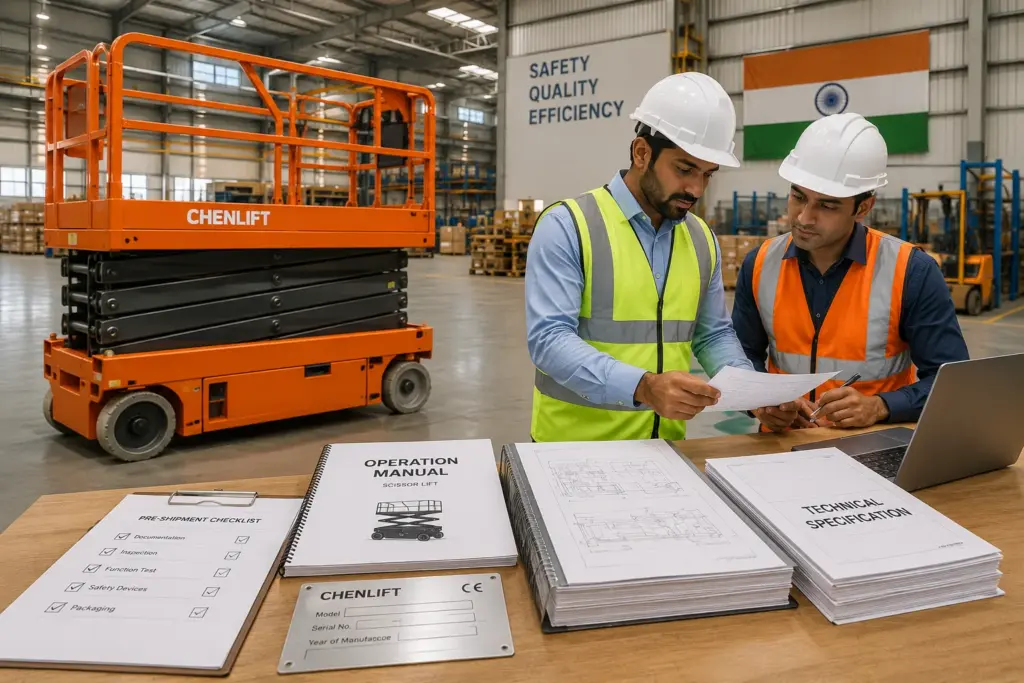
The manufacturer should maintain a model-specific file linking the nameplate and serialised model to the drawings, calculations, test records, safety functions, manuals and certificates supplied with the order. Existing CE documentation can be useful evidence, but the importer should confirm whether the shipment also needs an Indian licence, registration, Certificate of Conformity, test report or another document.
For a foreign-manufacturer route such as FMCS, preparation may include drawings, manufacturing and quality-control information, test reports, calibration records, product labels, manuals, factory details and an Indian representative or local contact arrangement. Depending on the product, BIS may also require laboratory testing, a factory visit or continuing surveillance. The final checklist must come from the applicable BIS product guidelines.
A practical quotation should therefore state the document basis clearly. Instead of writing “BIS compliant” without a defined scope, identify the model, the available technical file and the document responsibilities of CHENLIFT, the Indian importer and any local conformity professional.
What CHENLIFT can prepare for an India project
If you are planning to import a CHENLIFT scissor lift into India, send the model, rated capacity, working height, power configuration, destination and intended use. CHENLIFT can prepare the relevant technical documentation for the importer or local conformity review, including specifications, manuals, drawings, test records and existing CE documentation.
The Indian importer or qualified local conformity professional should confirm the applicable BIS route and final document list before shipment. This gives the project a defined responsibility split: the manufacturer supplies model-specific technical evidence, while the Indian side confirms the market requirement and any local filing or certification obligation.
Frequently Asked Questions
Can a Chinese manufacturer apply for BIS certification?
Yes, eligible foreign manufacturers can use FMCS for products that have an applicable Indian Standard and are amenable to certification. The process may involve product testing, factory assessment, quality-control documentation, marking controls and an Indian representative or local contact arrangement. Whether FMCS is the right route depends on the product standard and current scheme. It should be confirmed before testing begins.
Can an Indian importer apply on behalf of a foreign manufacturer?
The importer can coordinate the project, but the applicable scheme determines who holds the licence or registration and who is responsible for manufacturing controls. Under a foreign-manufacturer route, the overseas factory, product scope and local representative arrangements may be part of the application. An Indian trading company’s documents should not be assumed to cover an unrelated foreign factory or model.
Does a BIS licence cover every model made by a factory?
Not automatically. Authorisation is normally linked to a defined product scope, Indian Standard, factory location and approved model or rating range. A new model, customised machine, different production site or major component change may require an update or separate assessment. Check the licence scope against the actual nameplate and configuration being shipped.
Official References
- BIS Product Certification Overview — voluntary nature of BIS certification and mandatory certification through government orders.
- BIS Products under FMCS — foreign-manufacturer product scope.
- BIS Scheme X Product-Specific Information — product-specific guidelines and standards listed by BIS.
- BIS Scheme X Certification — Scheme X product and certification information.
- Ministry of Heavy Industries: Machinery and Electrical Equipment Safety notifications — government notification source for current machinery requirements and changes.
- Press Information Bureau, Government of India: Machinery and Electrical Equipment Safety Amendment Order, 2025 — 2025 OTR implementation information and standards structure.
Editorial note: BIS and machinery regulations in India can change through QCOs, amendments, deferments and withdrawal notifications. This article is a practical overview, not a legal opinion. Confirm the applicable requirement with BIS, the Indian importer and a qualified local conformity professional before relying on it for a shipment.