Where the Barriers End: UK Boom Lift Tariffs and the Q4 2026 MEWP Market
The UK boom lift tariff ruling landed three weeks ago, alongside three equipment reports and a record month of Chinese production. Together they redraw the map for aerial work platforms — and they disagree with almost every forecast written in January.
01The number that explains Q4
On 21 October, United Rentals reported record third-quarter results and raised full-year guidance. The revenue revision drew the headlines: $18.0–18.2 billion, up from $17.5–17.8 billion. The more telling revision was capital expenditure. Gross rental capex guidance moved from $4.85–5.25 billion to $5.2–5.5 billion — a $300 million increase at the midpoint, proportionally larger than the revenue upgrade.
Third-quarter rental revenue reached $4.316 billion, up 17.8% year on year. Fleet productivity rose 6.5%. Adjusted EBITDA margin came in at 47.6%, 160 basis points higher. Used equipment sold at a 51.4% OEC recovery rate, with roughly $2.8 billion of original equipment cost expected to be sold across the full year.
Two things follow. First, the used market is absorbing volume at stable residuals, which means rental companies are not under pressure to dump fleet — and new machine pricing is not being dragged down by a distressed secondary market. Second, management told analysts the additional spend reflects “work in front of them right now,” while also calling 2027 a growth year and indicating fleet purchases would continue late in Q4.
For manufacturers and distributors, that is an order-timing signal. The Q4 book is being filled ahead of the calendar, not behind it.
02Three companies, one quarter
The same quarter produced three different stories, and the difference is geography, not product quality.
| Company | Q3 2026 result | YoY | Margin signal |
|---|---|---|---|
| United Rentals (rental) | $4.316bn rental revenue | +17.8% | EBITDA 47.6%, +160bp |
| Terex / Genie (Aerials) | $709m segment sales | +32% | Adj. EBITDA 8.7%, −180bp |
| Haulotte (group) | €121m revenue | −1% | Targeting positive op. margin for FY26 |
Source: company releases, 21–28 October 2026.
Genie’s order book tells the more interesting story: $852 million at the end of September, against $397 million a year earlier. Quarterly order intake rose 20% to $646 million. Terex attributed the segment’s margin decline to an unfavourable customer mix, inflation and tariff pressure — the classic pattern of this cycle, where volume rises while margin is consumed by duty and price competition.
Haulotte shows the other side. Nine-month revenue reached €398 million, up 4% at constant exchange rates, with Europe up 16% and North America up 1%. Asia-Pacific fell 18%, Latin America fell 25%. Equipment sales grew 7%, while rental revenue fell 19% and service fell 3%.
Read together: European volume is recovering even with EU duties in force since 2025, but the recovery is not producing healthy margins. Demand is regional and project-driven, not a uniform cycle. Anyone planning 2027 on the assumption of a synchronised global upswing is planning on the wrong model.
03The UK boom lift tariff, and two walls beside it
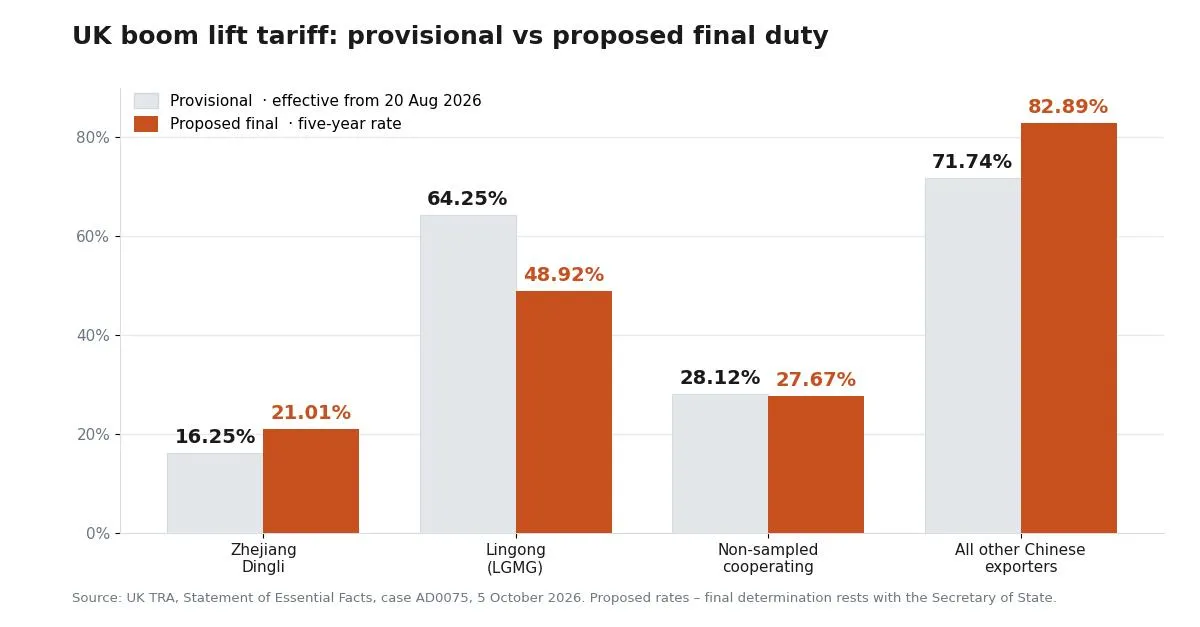
On 5 October, the UK Trade Remedies Authority published its Statement of Essential Facts in the anti-dumping investigation into boom lifts from China, case AD0075. It proposes five-year duties of 21.01% to 82.89%.
| Exporter category | Provisional (from 20 Aug) | Proposed final |
|---|---|---|
| Zhejiang Dingli | 16.25% | 21.01% |
| Lingong Heavy Machinery (LGMG) | 64.25% | 48.92% |
| Non-sampled cooperating producers | 28.12% | 27.67% |
| All other Chinese exporters | 71.74% | 82.89% |
Source: UK TRA statement of essential facts, 5 October 2026, as reported by Access Briefing and Scaffmag. Final rates rest with the Secretary of State.
Three details matter more than the headline rates.
It follows the machine, not the brand. Duties apply according to where a unit is manufactured. A boom built by the same company in Europe or the United States sits outside the measure. The cooperating group includes the Chinese plants of JLG, Terex and Haulotte alongside XCMG, Zoomlion, Sinoboom, LiuGong and Sunward.
It covers booms only. The measure targets self-propelled articulated and telescopic booms, trailer-mounted and insulated booms, including spider lifts, at 6 metres working height and above. Scissor lifts are not within this case — see our scissor and vertical mast range for what stays outside the scope. That is a meaningful difference from the EU regime, which covers self-propelled MEWPs at 6 metres and above — scissors included — at combined rates of 20.6% to 66.7% following the 2025 determinations.
The authority found Chinese imports undercut UK industry pricing by more than 25%. UK final rates have historically landed below the proposed ceiling — in the excavator case, the authority recommended up to 83.5% and the final range was 18.81% to 40.08%. Planning on 82.89% as a certainty is as wrong as planning on it disappearing.
04China’s +65% and the price signal behind it
Chinese manufacturers shipped 20,493 aerial work platforms in September, up 65.1% year on year, according to the China Construction Machinery Association. Exports reached 10,664 units, up 50.6%. Domestic sales reached 9,829 units, up 84.3%. For January to September, total sales were 171,083 units, up 29.7%, with exports at 108,517 units, up 34.4%.
Now put the rental data beside it. In August 2026, China’s domestic rental rate index for lifting platforms was down 8.7% year on year; the utilisation index was down 5.8%.
Shipments are not demand. The domestic surge is better explained by concentrated purchasing from large rental groups and compliance-driven fleet replacement than by a broad recovery in end-user construction activity. A single month is also distorted by delivery timing — October and November will decide whether the domestic recovery is real.
The strategic conclusion is uncomfortable but clear: Chinese production capacity is still growing faster than the markets that can absorb it at current prices, and the three largest export destinations are all now covered by trade measures.
05Beyond the tariff line
The most useful signal of the month came from product launches, not policy.
On 23 October, LGMG introduced the SP0307 push-around low-level access platform in the UK — 4.95 metres working height, 240 kg platform capacity, 400 kg total weight. The first 150 units went to a single customer in mid-October, followed by an order for another 100. In the same month, LGMG launched the S3232E electric slab scissor in Canada: 10 metres platform height, 0.83 metres wide, aimed explicitly at data centre fit-out and tight indoor work.
Both machines sit outside the UK’s 6-metre boom scope. That is not a coincidence.
The demand side supports the same conclusion. According to US Census construction spending data cited in an Orient Securities research note on 22 October, US private non-residential construction fell 1.5% year on year in January–August 2026 — but office spending rose 22.6%, and within office, data centre spending rose 58.4%, accounting for 58.1% of office outlays. Energy spending rose 9.3%.
The fastest-growing applications want electric slab scissors, compact chassis and mast lifts. They do not want 40-metre diesel booms.
Outside the mature markets, IPAF’s country reports put Saudi Arabia’s 2025 MEWP rental market growth at 49%, with fleet size up 67%, driven by giga-projects. India grew 18% with fleet up 14%. Both remain far below Western fleet density — and India is shifting from pure import to local assembly, with MT&T Group targeting a 15% AWP market share by 2030 from roughly 2% today.
One more data point deserves attention. IPAF’s Global Safety Report 2026, covering 2025, recorded 170 fatal and major incident reports, down from 201, and 76 fatalities, down 24%. Electrocution and electric shock were the leading cause for the first time: 28 reports and 20 deaths, with 71% of all reports originating in the United States. For suppliers bidding into power, utility and municipal work, the compliance file is becoming part of the commercial offer.
06The next four weeks: five calls
- North American orders are front-loaded. United Rentals raised capex by more than it raised revenue guidance and said it would buy late in Q4 to support 2027. Expect November OEM order data to run above normal seasonality. Risk: if data centre financing or grid connection timelines slip, the 2027 first-half pipeline thins quickly.
- Expect a ship-then-wait swing around the UK boom lift tariff decision. Importers have carried guarantee costs since 20 August; raising the residual rate from 71.74% to 82.89% sharpens the incentive to clear shipments before the final measure applies. Risk: the Secretary of State can and often does set rates below the proposal, so contracts should carry a duty-adjustment clause rather than a fixed landed cost.
- Chinese export growth peaks in Q4 and flattens in 2027. The +50.6% export figure rests on a weak 2025 base, and all three major developed markets now carry measures. Risk: Middle East and Southeast Asian volume could offset more of the gap than expected — Saudi Arabia is the most certain single source of incremental demand, but project concentration and payment cycles are real constraints.
- Product mix migrates outside the tariff range. Low-level access, compact electric scissors and mast lifts will see intensified competition through 2027. Risk: once that segment becomes consensus, the price war that ran in Chinese scissors in 2023–2024 repeats there. Early entrants get channel; late entrants get price.
- Safety compliance becomes a bid qualifier, not a differentiator. Electrocution overtaking falls as the leading fatality cause changes what utilities and contractors ask for. Risk: enforcement is uneven across markets and will surface first in tender terms rather than regulation.
07What buyers should do now
- Do not price from the residual rate. Model landed cost at the cooperating-producer rate and treat the residual as a downside scenario under the UK boom lift tariff. The difference between 27.67% and 82.89% is a commercial decision about participating in proceedings, not a market price.
- Check the scope line, not the headline. Six metres, boom versus scissor, self-propelled versus trailer-mounted, and country of manufacture. A machine assembled in a third country is not automatically outside the measure — origin rules are being tested case by case, including through US EAPA evasion inquiries.
- Build the compliance file before the tender. Insulation ratings, rescue plans, familiarisation records, documented pre-delivery inspection. IPAF’s 2025 data makes electrical risk the first question a utility client will ask.
- Use the used market as a pricing anchor. A 51.4% recovery rate on three-year-old fleet is a stable number. Trade-in maths work; residual-value assumptions built on the 2021–2022 spike do not.
The barriers are not going away, and neither is the demand. The distance between the two is where the next twelve months of margin will be decided.
Specifying for a tariff-constrained market?
CHENLIFT builds scissor lifts, vertical mast lifts and boom lifts for rental fleets and distributors. Current specifications, load charts and option lists are available on request. View the product catalogue →
Sources: United Rentals Q3 2026 results and earnings call (21 Oct 2026); Terex Corporation Q3 2026 results (28 Oct 2026); Haulotte Group Q3 2026 sales (27 Oct 2026); UK Trade Remedies Authority, Statement of Essential Facts, case AD0075 (5 Oct 2026), reported by Access Briefing and Scaffmag; China Construction Machinery Association, September 2026 monthly sales bulletin; IPAF Global Safety Report 2026 and country market reports (Saudi Arabia, India, Oct 2026); US Census construction spending data cited in Orient Securities research (22 Oct 2026). EU and US duty rates are drawn from published determinations and industry compilations; verify against official notices before contractual use.