40m Articulating Boom Lift in One 40HQ Container: A Steel Plant Delivery Case Study in Türkiye
The project
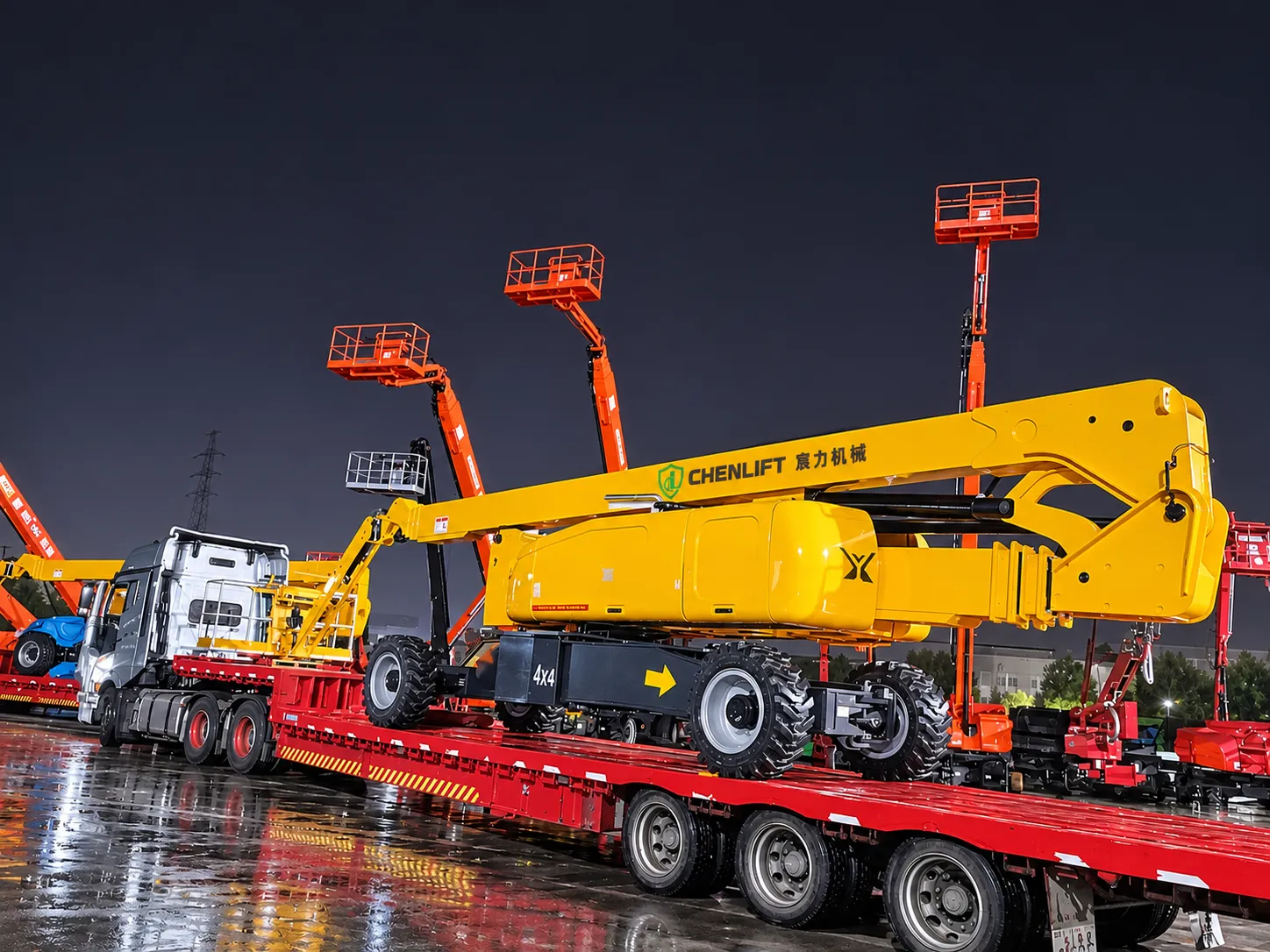
A CHENLIFT distributor in Türkiye was supporting a maintenance and inspection programme at one of the country’s major steel plants. The site’s maintenance teams work at heights approaching 40 metres — crane gantries, roof steel, high-level pipework, lighting masts — and much of that work happens above or around live plant structures, where straight telescopic reach is not enough. The machine specified for the job was the HA38JD, a 40m articulating boom lift with a diesel powertrain.
This article is about the second half of that purchase: not which machine was chosen, but how it was delivered — because in Türkiye in 2026, delivery decisions moved the project budget more than the equipment price did.
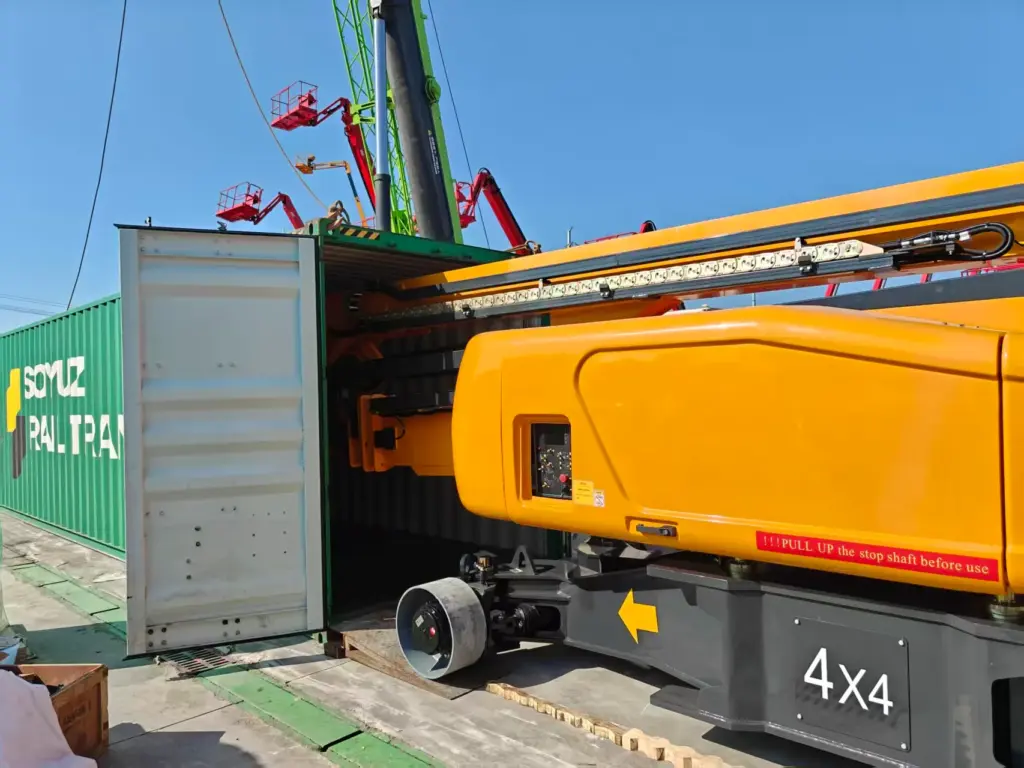
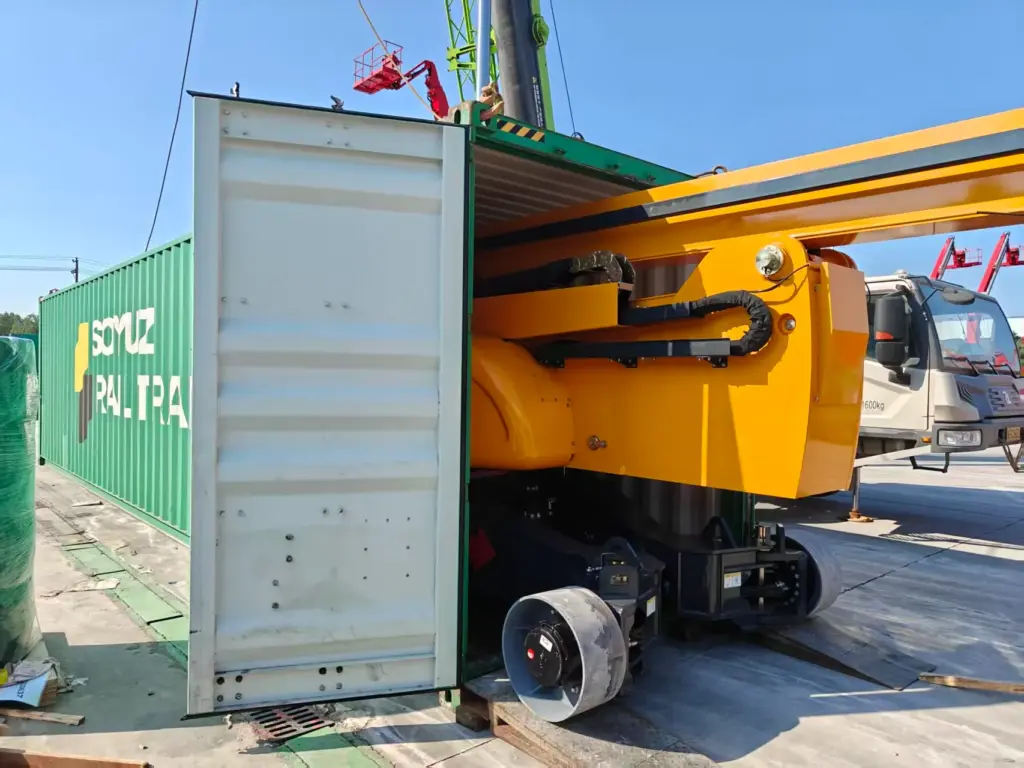
HA38JD 40m articulating boom lift entering a 40HQ container on transport wheels
The market the buyer was buying into
Any importer of industrial machinery in Türkiye in 2026 is working against three headwinds, and each one shaped this project.
Currency and financing
In late 2026 the Turkish lira traded near record lows against the US dollar, with annual inflation close to 30%. Few buyers fund an equipment purchase outright — most rely on bank financing or leasing. For a distributor preparing a proposal for a steel plant end user, every dollar in the total project cost is scrutinised, and the equipment price is only the first of several.
Import compliance
Türkiye sits in a customs union with the EU for industrial goods, but duty-free treatment applies to EU-origin products. A machine shipped from China pays import duty plus 20% VAT assessed on the CIF value. On top of the tax base sits a documentation regime that has tightened recently: CE marking is a legal requirement under Türkiye’s Machine Safety Regulation, and since January 2025 the Product Safety and Inspection Communiqué No. 2025/9 has strengthened CE verification at customs, with the TAREKS risk-based control system screening shipments electronically. Customs officers can and do ask for the Declaration of Conformity, test reports and technical documentation — not just the CE plate on the machine. An importer whose supplier sends incomplete paperwork faces clearance delays that a steel plant maintenance schedule cannot absorb.
Competition
The Turkish MEWP market is served almost entirely by imports: established Western brands at premium prices and long lead times, and Chinese brands competing hard — often at the same price. When quotations land in a narrow band, the winner is the supplier who lowers the total landed cost, not just the FOB number.
The application: what a steel plant needs from a 40 m boom
For context on the end user: Türkiye is Europe’s largest crude steel producer — 38.1 million tonnes in 2025, ahead of Germany, according to World Steel Association data — and its plants run continuous maintenance and modernisation programmes. The work points read like a list of everything that is awkward to reach: overhead crane rails and gantries, rolling-mill building steel, dedusting systems, conveyor galleries, high-level pipework, lighting towers.
Work at height in a steel plant has a specific shape:
- Work points sit above and beyond obstructions — crane rails, pipe racks, building steel — which favours an articulating jib over straight reach. The HA38JD’s upper boom articulates, giving 19.5 m crossing height and a 21.6 m working radius, with a 360° continuously rotating turntable to square up to the structure.
- Ground conditions are industrial, not landscaped: yard surfaces, rail crossings, gradients between workshops. The machine runs 4WD with four-wheel steering and 40% gradeability on 445/65-24 solid tires.
- Much of the site has no external power for a mobile platform. The work is outdoors and off-grid, which is why the specification called for a diesel powertrain — Kubota or Cummins — rather than a battery platform tied to charging infrastructure.
- Loads are two workers plus tools: 230 kg platform capacity on a 2.44 × 0.91 m platform, with automatic levelling and ±90° platform rotation.
There is also a time dimension. Major maintenance on these structures is planned into shutdown windows, when a production line or a bay is stopped and every crew on site is working against the same deadline. Equipment that arrives ready to work protects that window. Equipment that needs days of reassembly eats into it — which is why delivery configuration, not just machine specification, ends up on the buyer’s checklist.
None of this is unusual for a steel plant buyer. The unusual part was the delivery.
The delivery problem
The HA38JD is a 23,000 kg machine, 11.46 m long, 2.48 m wide and 3.08 m high in the stowed configuration. A 40HQ container offers roughly 12.03 × 2.35 × 2.70 m of internal space. The length fits. The other two dimensions do not: the machine stands 38 cm over the container’s internal height and 13 cm over its usable width. In standard configuration, container shipping is not an option — which is why 40 m-class booms traditionally move on Ro-Ro vessels as break-bulk cargo.
Ro-Ro works, and for decades it has been the default. But for a single-unit import into Türkiye it carries costs beyond the freight line:
- Freight. Break-bulk rates depend on vessel schedules and out-of-gauge dimensions; for one machine, they are rarely the economical option.
- On-site assembly. If the boom is dismantled to fit a transport envelope, someone at destination has to reassemble it — with the cranes, tools and labour that implies.
- Commissioning support. Where structural assembly is involved, overseas projects typically budget for an on-site engineer, with international travel added on.
- Schedule and routing. Break-bulk Ro-Ro sailings on the China–Türkiye trade are less frequent than container services, and the machine’s route depends on the vessel’s port rotation rather than the buyer’s logistics plan. A container, by contrast, moves on scheduled liner services through the ports the distributor already uses.
This is not a problem unique to this project. 40 m-class booms sit at the top of the articulating range; relatively few manufacturers build them, and in most cases they ship by Ro-Ro or partially dismantled. Buyers have largely accepted that as the cost of 40 metres of reach. The question we put to our engineering team was whether that assumption still needed to hold: can this machine travel in a standard container, fully assembled?
Transport wheel configuration under the HA38JD chassis before container loading
The engineering answer
The solution developed for this project was a dedicated transport wheel set, combined with a reviewed shipping configuration for the machine. The transport wheels are smaller in diameter than the 445/65-24 operating tires and drop the chassis below the container’s internal height line; the complete loading envelope — length, width and height with the wheel set fitted — is measured on the assembled machine and confirmed with the loading plan for each order.
With the wheels fitted, the complete unit — boom structure fully assembled — rolls into a single 40HQ container, where it is lashed to the floor at designated securing points following the lashing plan issued with the documentation pack.
Nothing structural is dismantled for shipping. Nothing structural needs reassembly on arrival.
The photographs in this article are from the actual loading: the transport wheel configuration under the chassis, and the machine entering the 40HQ container.
Standard vs. shipping configuration
| Item | Standard configuration | Shipping configuration |
|---|---|---|
| Machine width | 2.48 m | Confirmed per unit at quotation stage |
| Machine height | 3.08 m | Confirmed per unit at quotation stage |
| Wheel set | Standard operating wheels | Dedicated transport wheel set |
| Main boom structure | Fully assembled | Fully assembled — not dismantled |
| Container requirement | — | 1 × 40HQ |
The transport wheel set changes the machine’s height and footprint for loading. Because the shipping dimensions are measured and confirmed for each unit at quotation stage, we do not publish generic figures — the values above are confirmed with the loading plan for the configuration ordered.
From container to service: the recovery procedure
A container-shipped machine is only a saving if the work at destination is predictable. For this configuration, the recovery procedure is documented and supplied with the machine: the wheel-change sequence, the inspections required before the machine returns to service, and the pre-use checks that follow any transport cycle.
Because no structural assembly is involved, the procedure is well suited to remote support. The documentation pack includes the technical documentation and installation video, and our technical team provides live guidance through the wheel change and commissioning — a level of support that covers what an on-site engineer visit would otherwise handle for most customers.
What this changed for the buyer
Freight
One standard 40HQ container instead of Ro-Ro break-bulk. On the China–Türkiye lane, container freight for a single unit is typically the more economical option, and it books through the same forwarders and ports the distributor already uses. We provide a route-specific freight comparison with every quotation rather than quoting a generic saving.
Installation
On-site work is limited to swapping the transport wheels back to the standard operating wheels and completing the prescribed inspections before the machine returns to service.
Commissioning
With no structural assembly involved, remote technical guidance covers preparation and commissioning: technical documentation, an installation video, and live support from our technical team through the wheel change and pre-use checks. The cost and scheduling burden of flying an engineer to site comes off the project entirely — and in a lira environment, that saving is felt in the distributor’s margin, not just the end user’s budget.
Schedule certainty
Steel plant maintenance runs on planned shutdown windows. A container booking rides on scheduled liner services through regular ports, and the machine arrives ready for the wheel change — protecting the window rather than consuming it.
Compliance
The CE Declaration of Conformity and technical documentation travel with the machine, prepared for the checks Turkish customs and TAREKS can apply — so the freight saving is not offset by weeks in a customs yard.
Technical snapshot
| Item | Specification |
|---|---|
| Model | HA38JD diesel articulating boom lift |
| Max working height | 40 m |
| Max platform height | 38 m |
| Working radius | 21.6 m |
| Crossing height | 19.5 m |
| Platform capacity | 230 kg |
| Platform size | 2.44 × 0.91 m |
| Drive & steering | 4WD / 4WS |
| Gradeability | 40% |
| Engine | Kubota / Cummins diesel |
| Turntable rotation | 360° continuous |
| Machine weight | 23,000 kg |
| Stowed dimensions (L×W×H) | 11.46 × 2.48 × 3.08 m |
| Container requirement | 1 × 40HQ |
| Shipping configuration | Dedicated transport wheel set |
| Main boom disassembly | Not required |
| Commissioning support | Remote technical guidance |
Packed shipping dimensions and weight are confirmed per unit at quotation stage.
Frequently asked questions
Can the HA38JD really ship in a single 40HQ container?
Yes. With the dedicated transport wheel set and reviewed shipping configuration, the complete machine — boom structure fully assembled — fits into one standard 40HQ container. The loading photographs in this article show the actual configuration.
Does the boom need to be disassembled for shipping?
No. The main boom structure remains assembled during transport. Nothing structural is dismantled for shipping, and nothing structural needs reassembly at destination.
What work is required after the machine arrives?
On-site preparation is limited to swapping the transport wheels back to the standard operating wheels and completing the prescribed inspections and commissioning checks — the machine is ready for service once these are signed off.
Is remote technical support sufficient for commissioning?
For this delivery configuration, yes. Because no structural assembly is involved, remote guidance — technical documentation, installation video and live support — covers preparation, the wheel change and pre-use checks. On-site engineer visits remain available as an option where a customer prefers them.
What documentation is provided for customs clearance in Türkiye?
The machine travels with its CE Declaration of Conformity and technical documentation, prepared for the CE verification and TAREKS risk-based checks that Turkish customs apply to machinery imports.
How does container shipping compare with Ro-Ro on cost?
For a single unit on the China–Türkiye lane, 40HQ container freight is typically more economical than Ro-Ro break-bulk. The exact difference depends on the route and freight rates at the time of booking, so we provide a route-specific comparison with every quotation.
Is this shipping option available for other models and destinations?
Yes — the transport wheel set and loading plan are a standard shipping option across our 40 m-class boom line, for any destination port.
What are the packed shipping dimensions and weight?
Packed dimensions and shipping weight are confirmed per unit at quotation stage, together with the loading plan for the specific configuration ordered.
What this means for your next enquiry
Most 40 m-class quotations arrive with an FOB price and a note that shipping is the buyer’s problem. This project took a different approach: the delivery plan — container configuration, freight comparison and on-site preparation steps — was part of the quotation itself. The result for the distributor was a proposal the steel plant could evaluate end to end: one machine, one container, one predictable landed cost.
Planning a similar project?
Send us your working height requirement and destination port. We will return a delivery plan covering the container configuration, a freight comparison against conventional transport, and the on-site preparation steps your team should expect.