CE Marking After Substantial Modification: Why a Factory-Wide CE Claim Does Not Cover Your Model
A 12 m scissor lift shipped in 2022 came back to a rental yard in 2026 with a replacement control system and ballast weights the factory never supplied. The CE plate was still bolted to the chassis. The declaration of conformity in the office file named the original model, the original serial range and the original control hardware. When an investigator asked which document covered the machine as it stood that day, nobody could produce one.
The CE mark was not forged. It was attached to a machine the paperwork no longer described. That gap is the subject here: where a model-level declaration stops covering the unit in front of you, and which documents to request when the line is crossed.
CE marking after substantial modification becomes a defined question on 20 January 2027. Before that date the same question sits in the identification requirements of the Machinery Directive. Both lead to the same buyer-side test. The declaration describes one machine, identified by model and serial number. A factory name carries no conformity of its own.
1. What a declaration is issued against
Under Directive 2006/42/EC, the EC declaration of conformity is not a company certificate. Annex II, Part 1, Section A, point 3 requires it to contain a “description and identification of the machinery, including generic denomination, function, model, type, serial number and commercial name”. All six items appear in one sentence, with no “where appropriate” qualifier attached to them.
Table 1. Identification fields required on an EC declaration of conformity, and the corresponding check on the machine.
| Field the declaration must carry | What the buyer checks on the machine |
| Generic denomination and function | The equipment matches the category described, not a neighbouring product type |
| Model | Matches the identification plate exactly, including suffix letters |
| Type | Matches the configuration code on the order |
| Serial number | Falls inside the serial range the declaration covers |
| Commercial name | Matches the invoice and the manual |
The technical file behind that declaration is compiled per model under Annex VII, and Annex II Part 2 requires the manufacturer or its authorised representative to keep the original declaration for at least 10 years from the last date of manufacture of the machinery. There is no provision in the Directive for a factory-wide declaration. A supplier saying “we are CE certified” has described a quality system or a marketing position; the document a market surveillance authority will ask for names one machine.
We went through the field-by-field reading of a declaration in our CE compliance guide. This article picks up where that one stops: what happens when the machine changes.
2. The conformity route, and where a notified body actually enters
Annex IV of the Directive lists categories of machinery subject to the procedures in Article 12(3) and (4). Item 17 reads: “Devices for the lifting of persons involving a risk of falling from a vertical height of more than three metres.” The wording is functional. It does not name MEWPs, and whether a particular machine falls inside it is an assessment against that wording rather than a product label.
A common misreading follows from the item. Inclusion in Annex IV does not by itself require a notified body. Article 12(3) says that where the machinery is in Annex IV and has been manufactured in accordance with harmonised standards covering all the relevant essential health and safety requirements, the manufacturer may choose one of three procedures. The first is Annex VIII, “Assessment of conformity with internal checks on the manufacture of machinery”. Annex VIII is a procedure the manufacturer carries out itself and declares under its own responsibility. No third party attests it.
Article 12(4) is the branch that brings in a notified body. Machinery not built to those standards, built only partly to them, or where the standards do not cover all the relevant requirements, goes to EC type-examination under Annex IX or full quality assurance under Annex X. An Annex IX certificate is issued for a representative model, which is why the model list on a certificate matters.
Two consequences for a buyer. A supplier that can say which route it used, and why, can usually also say where its model boundaries sit. A certificate described as “Annex VIII certification” is using the wrong word for the procedure, and it is worth asking what document actually exists. Our certifications page lists what we hold per series.
3. Where the model boundary sits before shipment
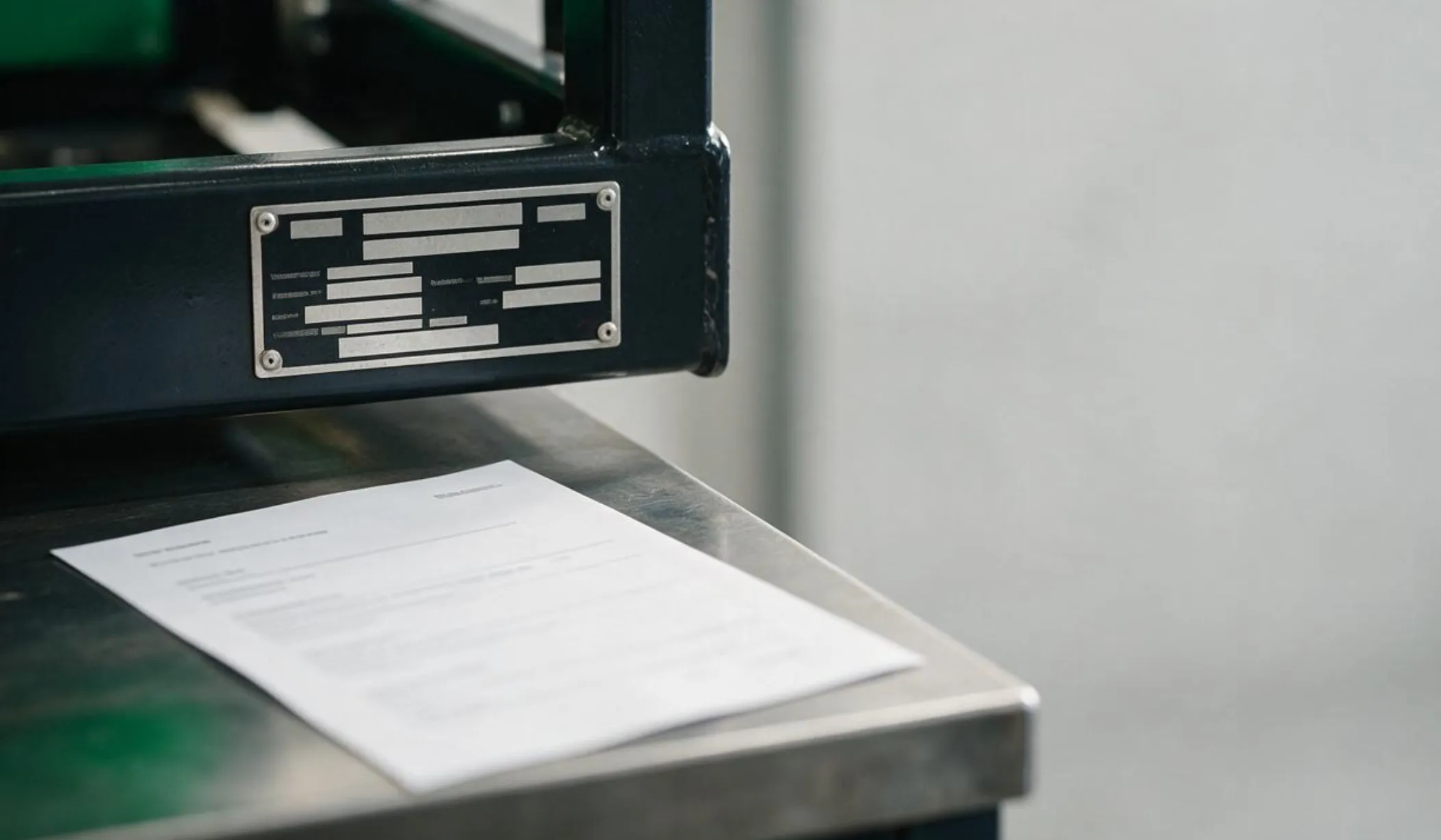
Most disputes about model coverage are not about forged documents. They are about a machine ordered with a configuration the declaration does not name. The check is mechanical: compare the identification plate, the configuration code on the order, and the model and serial range on the declaration. Any mismatch is a question for the supplier before the container is booked.
Table 2. Configuration changes and the document each one puts in question.
| Change on the order | Why it can move the model boundary | What to request |
| Different working height or mast height | Changes stability calculations and load charts | Declaration naming that height, and the corresponding test evidence |
| Different rated capacity or platform extension | Changes the load case the declaration was built on | Confirmation the configuration sits inside the declared model |
| Power change — AC, DC, lithium, diesel | Changes the electrical assessment and, for combustion drives, ventilation and EMC | Declaration and manual for that power variant |
| Chassis change — 2WD, 4WD, tracked, outriggers | Changes stability and ground-bearing assumptions | Model-specific identification and, where relevant, a separate assessment |
| Control hardware or firmware revision | Can change the safety-related control system | Revision-controlled manual and confirmation of whether a new assessment was required |
| Optional equipment — explosion-proof package, gate, pipe rack | Adds components to the assessed configuration | Written statement of which declared model covers the option |
| OEM rebranding with a new model code | The declaration still carries the original manufacturer’s model identity | Confirmation of how the rebranded unit is identified in the file |
The last row is the one that catches own-brand distributors. Changing the nameplate does not by itself create a new machine, but it does create a second model identity. Ask which one appears on the declaration and on the technical file, and get the answer in writing before the first order. Where a configuration is still being defined, we treat the file as project fit and confirm the model identity at quotation rather than assign a code that has not been assessed.
A serial range earns the same attention. A declaration covering a production batch does not describe a unit built outside that batch. Ask for the range, then check the plate against it.
4. CE marking after substantial modification: what changes on 20 January 2027
Regulation (EU) 2023/1230 applies from 20 January 2027 and repeals Directive 2006/42/EC with effect from the same date (Articles 54 and 51(2)). One detail is worth getting right. The text as first published in OJ L 165 said “14 January 2027”. Corrigendum (OJ L 169, 4.7.2023, p. 35, CELEX 32023R1230R(01)) replaced it with “20 January 2027” in Articles 51, 52 and 54. Use the consolidated text (CELEX 02023R1230-20260727) when citing the Regulation. A supplier document quoting 14 January 2027 is working from the uncorrected OJ text.
The Regulation gives “substantial modification” a definition. Article 3(16) describes a modification by physical or digital means, after the machinery has been placed on the market or put into service, not foreseen or planned by the manufacturer, which affects safety by creating a new hazard or increasing an existing risk, and which requires either added guards or protective devices whose processing necessitates modification of the existing safety control system, or additional protective measures for stability or mechanical strength.
Article 18 sets out the consequence. A person carrying out a substantial modification is considered the manufacturer for that machinery, becomes subject to the obligations in Article 10, and must “ensure and declare on its sole responsibility” that the machine conforms, applying the relevant conformity assessment procedure in Article 25(2), (3) and (4). A non-professional user modifying a machine for their own use is excluded. Under Article 10(2) a manufacturer draws up the EU declaration of conformity and affixes the CE marking. Article 10(3) requires the technical documentation and the declaration to be kept at the disposal of market surveillance authorities for at least 10 years after the machinery is placed on the market or put into service. The starting point is no longer the last date of manufacture.
Table 3. The dates that change which documents are current.
| Date | What happens | What the buyer does |
| Until 19 January 2027 | Directive 2006/42/EC governs conformity assessment | Check model and serial identification against the EC declaration |
| 20 January 2027 | Regulation (EU) 2023/1230 applies; Directive 2006/42/EC is repealed (Arts. 54, 51(2)) | Check the legal basis cited on the EU declaration matches the placing-on-market date |
| Same date | Implementing Decision (EU) 2023/1586, which published the harmonised standards list in support of 2006/42/EC, is repealed by Implementing Decision (EU) 2026/2015, Article 2 | Check which OJ harmonised standards list is in force on the placing-on-market date when a declaration cites a standard and version |
Article 52(1) adds a transition. Member states shall not impede the making available on the market of products placed on the market in conformity with Directive 2006/42/EC before 20 January 2027, while Chapter VI of the Regulation applies to such products instead of Article 11 of the Directive. Article 52(2) keeps EC type-examination certificates and approval decisions issued under Article 12 of the Directive valid until they expire. The Regulation does not say in those words that an EC declaration of conformity issued under the Directive remains valid, so do not treat that as a given. The safe position is to check the declaration’s legal basis against the date the specific unit was placed on the market.
If a declaration cites EN 280-1:2022, note which decision published the list it sits on. A citation that was correct in 2026 needs the same check in 2027, because the decision publishing the old list is repealed on that date.
CE marking after substantial modification therefore moves from an inference drawn from document identification to an explicit manufacturer obligation. In 2027, a rental company that fits a new control system and adds ballast becomes the manufacturer of the modified machine. It carries its own conformity assessment and its own declaration. That belongs in fleet modification procedures rather than in a supplier audit.
5. What to ask for, and when
Table 4. Which document, from whom, at each stage.
| Situation | Who issues the document | Document to request | Acceptance test |
| New machine, standard configuration | Manufacturer | EC/EU declaration of conformity naming the model, type and serial range; technical file index; manual at the correct revision | Plate, order configuration and declaration agree word for word |
| New machine, non-standard configuration | Manufacturer | Written confirmation of which declared model covers the configuration, or a declaration for it | The answer names a model that exists in the file |
| Machine modified after delivery, before 20 January 2027 | Party responsible for the modification | Assessment of whether the change alters the declared model identity; updated documentation where it does | Evidence, not an email assurance |
| Machine substantially modified on or after 20 January 2027 | The modifier, as manufacturer under Article 18 | New conformity assessment under Article 25 and the modifier’s own EU declaration of conformity | Declaration names the modifier as manufacturer |
| Own-brand / rebranded unit | Manufacturer of record | Declaration showing the model identity used for the unit under the buyer’s brand | Brand name and model identity appear consistently across plate, manual and declaration |
Six questions belong in the purchase order or its technical annex:
- Which model, type and serial range does the declaration cover?
- Which conformity assessment procedure was applied, and under which Article 12 branch?
- Which revision of the manual and of the safety-related control software ships with this unit?
- If the configuration changes before production, who confirms whether the declared model still covers it, and in what form?
- For units placed on the market after 19 January 2027, which legal basis and which OJ harmonised standards list does the declaration cite?
- Who holds the technical file, and how quickly can it be produced for a market surveillance authority?
The last question has an unglamorous answer in practice. A trading company can pass on a declaration but cannot always produce the technical file behind it. Ask before the PO.
6. Red flags in the documents you receive
- A certificate headed “all models” or “CE certified” with no model, type or serial range on it.
- A model code on the certificate that does not match the identification plate, including suffix letters and configuration codes.
- An ISO 9001 certificate presented as CE evidence. It covers a quality system.
- “Annex VIII certification” used to describe a third-party attestation. Annex VIII is the manufacturer’s own internal-checks procedure.
- A declaration citing Directive 2006/42/EC for a unit placed on the market after 19 January 2027.
- A date of 14 January 2027 in a supplier document, which points to the uncorrected OJ text.
- A modified machine supplied with nothing but a photocopy of the original factory declaration.
Some of these are clerical. The effect at an inspection is the same: the file does not describe the machine.
Questions about CE marking after substantial modification, or about which model a file is issued under, are easier to settle at quotation than after delivery. Send us the configuration list and a photograph of the identification plate before you place the order. We will confirm which model identity the documentation is issued under and what the file for that configuration contains. Where the configuration is still open, we confirm it at quotation rather than assign a model code that has not been assessed.
Sources
- Directive 2006/42/EC (consolidated) — Annex II, IV, VII, VIII and Article 12
- Regulation (EU) 2023/1230 (consolidated) — Articles 3, 10, 18, 25, 51, 52, 54
- Corrigendum to Regulation (EU) 2023/1230 — OJ L 169, 4.7.2023, p. 35
- Commission Implementing Decision (EU) 2023/1586 — OJ L 194, 2.8.2023
- Commission Implementing Decision (EU) 2026/2015 — Article 2
- Chenlift — CE certified aerial work platform: buyer’s compliance guide
- Chenlift — certifications
- Chenlift — MEWP import requirements in Poland and Türkiye