Vietnam Conformity Declaration Aerial Work Platform: What Changed in July 2026
Yes — the Vietnam conformity declaration aerial work platform route applies before the machine is placed on the market, not at the border.
Aerial work platforms for lifting people fall within Vietnam’s list of products subject to a conformity declaration (công bố hợp quy). The controlling technical regulation for this equipment is QCVN 20:2015/BLĐTBXH — occupational safety for lifting platforms used to raise people. The declaration is made by a Vietnamese entity before the equipment is put into circulation.
What changed is where the requirement is enforced. Under the circular that took effect on 28 July 2026, equipment in this risk category no longer undergoes state quality inspection at the port of entry; the declaration is what matters. Buyers working from older checklists still expect a border inspection, and suppliers who last shipped in 2025 may still describe the process that way.
The short answer
For aerial work platforms entering Vietnam:
- The product is classified in the medium-risk group, listed by name — bàn nâng người, sàn nâng người (platforms for lifting people).
- A Vietnam conformity declaration aerial work platform filing is required before the equipment is circulated.
- No state quality inspection at the border applies to this group. That is the substantive change introduced in 2026.
- The applicable technical regulation is QCVN 20:2015/BLĐTBXH. The other commonly cited regulation in this field, QCVN 12:2013/BLĐTBXH, governs suspended access equipment such as rope-suspended platforms — it does not apply to a self-propelled aerial work platform.
- The declaring party must be an organisation in Vietnam. The foreign manufacturer supplies the technical basis.
What actually changed in July 2026
Vietnam replaced the instrument governing this area. The circular dated 28 July 2026, issued by the Ministry of Home Affairs (Thông tư 16/2026/TT-BNV), took effect on the date of signing and superseded a series of earlier instruments, including the labour-ministry circulars that had covered lifting equipment for years.
The border inspection obligation disappeared for this category. Under the previous framework, lifting platforms for people were named on the list of goods requiring state quality inspection on import. The new circular reorganises products by risk level, and the items subject to border inspection form a much shorter list — protective equipment, passenger lifts and their safety components, and escalators and moving walks. Aerial work platforms are not on it. They sit in the medium-risk group handled by declaration instead.
This is worth stating precisely, because the two changes cut in opposite directions and it is easy to draw the wrong conclusion from either. The requirement did not disappear. It changed from an inspection event at the border to a declaration by a domestic party.
The responsible authority changed as well. The relevant functions moved to the Ministry of Home Affairs from 1 March 2025, administered through the employment authority at central level and implemented by provincial authorities. If your importer’s paperwork still names the former labour ministry, it is not current.
Which technical regulation applies
Two regulations in this field get cited interchangeably, and they cover different equipment.
| Regulation | What it governs | Applies to a self-propelled aerial work platform? |
|---|---|---|
| QCVN 20:2015/BLĐTBXH | Occupational safety for lifting platforms used to raise people | Yes — this is the controlling regulation |
| QCVN 12:2013/BLĐTBXH | Suspended access equipment, such as rope-suspended working platforms | No |
Both remain in force. Where a supplier or agent cites QCVN 12 for a self-propelled lift, the citation is wrong — and it matters, because the declaration has to be supported against the correct regulation.
Who files, and on what basis
The declaring party is a Vietnamese organisation — the importer or the entity placing the equipment on the market. The framework is written around domestic and foreign organisations and individuals operating in Vietnam; it does not provide a route for a foreign manufacturer to file directly from outside the country. That is why the technical material the manufacturer supplies is the part that actually determines how long the process takes.
The declaration rests on one of two bases:
- A conformity certification result from a recognised certification body, or
- A self-assessment supported by test results from a recognised or designated laboratory.
The assessment method to be used is specified in the implementing circular on conformity declaration procedures (Thông tư 14/2026/TT-BKHCN), which assigns particular methods to particular product groups. Which method applies to aerial work platforms is a question for the declaring entity and the body they use — but asking which method applies is a much better question than asking “do we need certification?”, because it produces a specific answer.
Declarations are submitted to the employment authority under the Ministry of Home Affairs at central level, or to the provincial people’s committee at local level, through the national public service portal.
How a Vietnamese importer verifies a supplier’s claim
“The machine is certified” is not a useful statement, because the obligation is domestic. Check for:
- The conformity declaration itself — issued in Vietnam, naming the declaring organisation and the product.
- The basis it rests on — a certification result or a test report from a recognised body, and that body’s name.
- The regulation it was assessed against. It should be QCVN 20:2015/BLĐTBXH for this equipment. A declaration built on QCVN 12 is a signal worth questioning.
- Whether the declared model matches the machine. The declaration, the invoice and the nameplate should describe the same product.
- Vietnamese-language material, where the applicable requirements call for it.
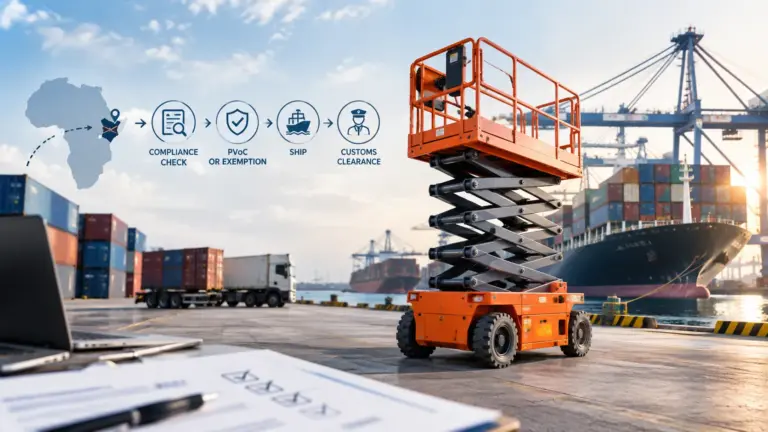
The same logic applies in other markets that run their own conformity regimes. Kenya requires a PVoC certificate of conformity obtained before shipment, and Nigeria handles both a product certificate and a per-shipment certificate under SONCAP certification for aerial work platforms.
One classification point worth settling early
Aerial work platforms sit in customs headings that can also contain lifting machinery of other kinds. The annexes to the framework list categories by product group and customs heading, and one of the headings commonly used for these machines also falls within the group covering cranes. Where that overlap applies, a consignment can attract declaration requirements under more than one technical regulation.
That is not a reason to avoid the market. It is a reason to have the customs classification settled by the declaring entity and the customs broker before the paperwork is drafted, rather than assuming a single heading produces a single obligation.
What to settle with your supplier before you order
- Who the declaring entity is — your own company, or another Vietnamese organisation.
- Which technical regulation applies, confirmed as QCVN 20:2015/BLĐTBXH by that entity rather than assumed from a supplier’s document.
- Which assessment method applies under the implementing circular, and whether testing is required.
- Timing. The declaration is completed before the equipment is circulated, so it runs after arrival — but the technical basis it depends on has to be ready before shipment.
- HS classification, confirmed with the customs broker, including whether a second product group is engaged.
- The exact model designation used consistently across the declaration, the invoice and the nameplate.
Frequently Asked Questions
Is a conformity declaration mandatory for aerial work platforms in Vietnam?
Yes. The Vietnam conformity declaration aerial work platform obligation applies to machines in the medium-risk group, before the equipment is circulated in Vietnam. It applies whether the machine is imported for resale, for a rental fleet or for an end user’s own operations.
Is the equipment inspected at the port of entry?
No, not for this category. Under the circular effective 28 July 2026, the goods requiring state quality inspection at the border form a short list — protective equipment, passenger lifts and their safety components, and escalators and moving walks. Aerial work platforms are not on it; they are handled through the declaration route.
Which technical regulation applies to an aerial work platform?
QCVN 20:2015/BLĐTBXH, the national technical regulation on occupational safety for lifting platforms used to raise people. QCVN 12:2013/BLĐTBXH, which is sometimes cited in this context, covers suspended access equipment and does not apply to a self-propelled aerial work platform.
Who makes the declaration — the manufacturer or the importer?
The declaring party is an organisation in Vietnam, in practice the importer or the entity placing the equipment on the market. A foreign manufacturer cannot file from outside the country, but has to supply the technical documentation and test evidence the declaration rests on.
Can the declaration be based on our own test reports?
It can rest either on a conformity certification result from a recognised body or on a self-assessment supported by test results from a recognised or designated laboratory. Which route is available depends on the assessment method assigned to the product group in the implementing circular, so confirm it with your declaring entity.
What is the penalty if the declaration is not made?
Vietnam’s administrative penalty framework for product quality sets a fine in the range of VND 30,000,000 to VND 40,000,000 for circulating goods that are subject to a declaration without one. Remedial measures can include recalling the goods or completing the declaration before they may be circulated. The exposure sits with the domestic party placing the equipment on the market.
Did the requirement get weaker in 2026?
It changed shape rather than disappearing. Removing border inspection for the medium-risk group shifts timing and logistics, but the declaration itself is still required — and it is now enforced at the point where the equipment enters circulation.
Which HS code applies to aerial work platforms into Vietnam?
The headings commonly used are 8425.41, 8425.42, 8426.12 and 8425.49, but classification depends on the machine and self-propelled and vehicle-mounted platforms do not necessarily fall in the same heading. Confirm it with your declaring entity and customs broker — including whether the heading also brings the goods into the crane group, which can trigger a second declaration obligation.
Before the equipment enters circulation in Vietnam, confirm the applicable national technical regulation, the assessment method and the declaring entity for the exact machine. If you are purchasing an aerial work platform from Chenlift, we can provide the machine’s technical documentation and test evidence that the declaration will rest on — our Vietnam market page sets out the ranges we supply to the market.
Official References
- Vietnam Ministry of Home Affairs — Circular 16/2026/TT-BNV (28 July 2026), official signed text (PDF): https://datafiles.chinhphu.vn/cpp/files/vbpq/2026/7/16-bnv.signed.pdf
- Vietnam Government legal document portal — searchable source for the implementing circular on conformity declaration procedures (Thông tư 14/2026/TT-BKHCN), the national technical regulations QCVN 20:2015/BLĐTBXH and QCVN 12:2013/BLĐTBXH, the penalty decree Nghị định 119/2017/NĐ-CP as amended, and Decree 25/2025/NĐ-CP: https://vanban.chinhphu.vn/
*Editorial note: Vietnam’s requirements in this area were restructured in July 2026, and the list of goods subject to border inspection changed at the same time. This article describes how the current framework is organised and is not a legal opinion. Confirm the applicable regulation, assessment method and declaration route with the competent Vietnamese authority and your own conformity professional before relying on it for a shipment.