CE Is Not the Last Checkpoint: MEWP Import Requirements in Poland and Türkiye
A container of scissor lifts clears customs in Gdańsk and sits in a yard for three weeks. The machines are fine. What is missing is a decision from the Office of Technical Inspection — UDT — without which a MEWP in Poland may not be put into service, and nobody applied for one.
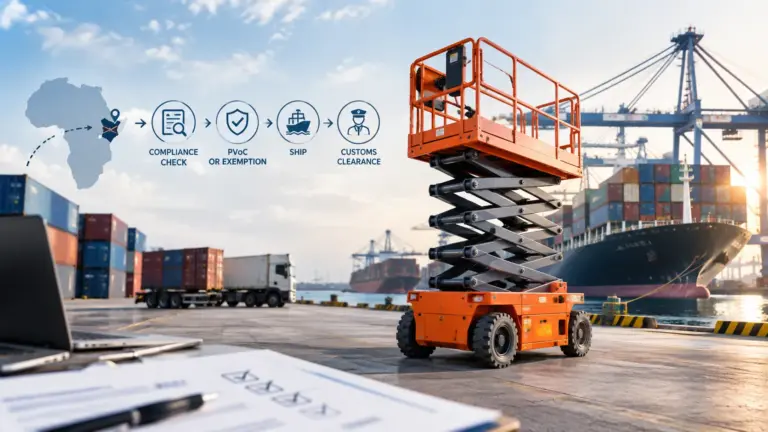
The same container going to Istanbul stops earlier. There the check starts before the vessel is booked, when the Turkish importer files through TAREKS. Two markets, two procedures, and the CE certificate covers neither. This article goes through what each one asks for, in the order an importer meets it.
1. Two layers, and CE only answers the first
Product compliance and market access are separate things. Product compliance is the CE route: technical file, risk assessment against EN 280-1, declaration of conformity, marking. It is issued against a model, by the manufacturer, before any unit is built. We wrote about that layer in our CE article.
MEWP import requirements sit in the second layer. They decide whether a compliant machine can be sold, registered, inspected and operated in a particular country. Different authority, different documents, different moment. Poland puts most of its requirements after delivery. Türkiye puts some of them before shipment, and then adds a use-phase regime on top.
2. Poland: the check comes after delivery
2.1 Who supervises, and what is covered
Technical supervision in Poland runs on the Act of 21 December 2000 on technical inspection. The body executing it is UDT (Urząd Dozoru Technicznego), and the operating rules for handling equipment are in the Regulation of 30 October 2018, Dz.U. 2018 poz. 2176.
UDT states on its own site that all mobile access platforms are covered — the Polish term is podesty ruchome przejezdne, and it takes in scissor lifts, vertical mast lifts and booms. There is no height threshold and no exemption for compact machines. If it lifts people to a work position and it moves, it is inside. Commercial background for the country is on our Poland market page.
2.2 The decision, and why new machines still wait
Article 14 of the Act says equipment under supervision may be operated only on the basis of a decision permitting its operation, issued by UDT. It is not a type approval and not a design review; the design questions were settled by CE. It is a decision about one unit at one place of use.
For a machine that has been placed on the market but not yet put into use, §14(4) of the 2018 regulation drops the function tests and load tests from the acceptance inspection. What remains is a file check plus an identification of the machine — its condition and its markings compared against the documents. So the three weeks in the yard were spent waiting for paperwork. In practice the buyer rarely knows what to file, and the supplier rarely tells him, which is why this happens at all.
2.3 The file UDT reads
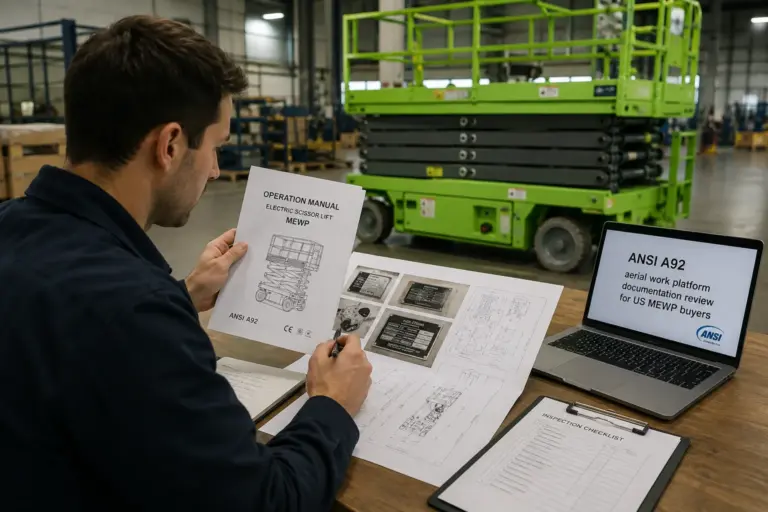
The operator — eksploatujący, normally the Polish buyer or the rental company — submits two copies. Most of the content has to come from the manufacturer:
| Item | What UDT expects |
| Identification and general description | Machine type, model, permitted configurations of use |
| General assembly drawing | The complete machine, not a marketing render |
| Operating instructions | The manual the operator will work from |
| Electrical, hydraulic and pneumatic diagrams | Where applicable to the drive and control system |
| Rope and cable system diagrams | For drive mechanisms that use them |
| Supplementary documentation | Site layout, power supply diagrams, installation confirmation — only where the machine is assembled on site |
One scheduling detail that catches people: registration, the acceptance inspection and every later inspection take place where the machine stands, not at the importer’s registered office. UDT says this in its FAQ. The inspector comes to the unit, so it has to be assembled and identifiable on the day, or the visit is wasted.
2.4 After the decision
- Full inspection every 12 months. Annex 1 of the 2018 regulation, item 18, sets podesty ruchome przejezdne at a full inspection annually. Stationary platforms get two years; these do not.
- Maintenance review every 30 days. Annex 2, item 14. Buyers who budgeted for one inspection a year usually learn about this one at the first annual inspection.
- The paperwork is part of the inspection. §16 requires the inspector to go through the inspection book (księga rewizyjna), the maintenance log (dziennik konserwacji), the measurement protocols, and the qualification certificates of the people operating and maintaining the machine.
- Operator qualification. Operating a self-propelled MEWP in Poland sits inside the UDT qualification system; the certificate comes after a state examination.
Two documents therefore belong in the crate rather than in the buyer’s inbox: an inspection book and a maintenance log. Keeping them is the operator’s duty, but starting them, with the right sections for this model, is work the manufacturer can do in an afternoon and the distributor usually cannot.
2.5 Language
Instructions have to be usable by the operator, and in Poland that means Polish. The rule UDT quotes, §58 of the 2008 machinery regulation, says that where no original instructions exist in the language of the country of use, the translation is provided by the manufacturer, its authorised representative, or the person bringing the machine into that country.
That third option is why some importers translate in-house. It is a question of who pays, not of whether it is required. Someone in the chain owes a Polish manual, and the inspector will ask which of you it was.
3. Türkiye: part of the check comes before shipment
3.1 The system
Product safety in Türkiye rests on Law No. 7223. Border control runs through TAREKS, the Risk-Based Control System in Foreign Trade, which is a filing and risk-scoring platform rather than a certificate. The importer uploads documents, the system decides whether the consignment is physically inspected, and it returns a reference number that goes on the customs declaration.
The machinery communiqué for 2026 is ÜGD 2026/32, Makinaların İthalat Denetimi Tebliği, published in the Official Gazette on 31 December 2025 and in force since 1 January 2026. It divides machinery between two annexes, and the procedures are not similar. Market background sits on our Türkiye market page.
3.2 The tariff code decides which annex
This decision comes first and it is made before anything is packed.
- Ek-2/A, higher risk. Prior import authorisation is required through TAREKS. The CE declaration of conformity, type approval certificates and noise certificates have to be authenticated by the Turkish trade attaché in the country of origin and accompanied by a notarised Turkish translation. Goods manufactured in the EU are exempt from the authentication step; Chinese-origin machinery is not.
- Ek-2/B, standard risk. No prior authorisation and no consular legalisation. The importer registers the consignment, and TAREKS applies risk analysis to decide whether a physical check happens.
Self-propelled trucks with lifting equipment under tariff line 8427.20.90.00.00 are listed in Ek-2/B. That is one line, not the whole category. A scissor lift, a vertical mast lift and a boom lift can be declared under different lines depending on structure and drive, and getting the classification right is the importer’s job, done through the customs broker. A stricter line than necessary means paying for legalisation that was not needed. A looser one means the consignment sits at the port while it is argued.
3.3 What goes into the file
The importer files and receives a 23-digit TAREKS reference number for the customs declaration. The list varies with the annex and the line; these come up repeatedly:
- invoice and transport document
- CE declaration of conformity
- photographs of the machine and of the CE marking plate
- instruction manual in Turkish
- noise measurement reports, and EMC and electrical test reports where the annex calls for them
An English-only manual is a listed document, and files get returned for it regularly. It is not a courtesy.
3.4 After clearance
Türkiye then applies a second regime, closer in shape to the Polish one than to its own border procedure. Under the Regulation on Health and Safety Conditions in the Use of Work Equipment (Official Gazette, 25 April 2013, No. 28628), work equipment is periodically inspected, and where no standard or manufacturer’s interval applies, the interval may not exceed one year.
The amendment published on 23 December 2025 (No. 33116) changed the procedure rather than the interval. Inspections must now be contracted through İSG-KATİP and recorded in EKİPNET, and a report issued without an İSG-KATİP contract is invalid. Mobile equipment working away from the employer’s premises has to carry its most recent inspection report with it — which for rental fleets means a document in the cab, every time the machine leaves the yard.
3.5 The two sets of MEWP import requirements, compared
| Poland | Türkiye | |
| Check before shipment | No | Yes, for Ek-2/A; registration for Ek-2/B |
| Consular legalisation | Not applicable | Ek-2/A only; EU-origin exempt |
| Local-language manual | Polish, required | Turkish, listed TAREKS document |
| Check before first use | UDT decision, per unit | No separate first-use permit |
| Periodic inspection | Full, every 12 months | Max 12 months unless a standard says otherwise |
| Maintenance interval in regulation | 30 days | Manufacturer’s interval |
| Operator qualification | UDT certificate | Employer’s competent-person regime |
| Inspection report travels with machine | Not specified | Required when working off-site |
4. The EU layer, and the January 2027 switch
Neither country’s procedure replaces the product layer, and that layer changes soon.
Machinery Regulation (EU) 2023/1230 applies from 20 January 2027, and Directive 2006/42/EC is repealed on the same date. Machinery placed on the EU market before that date stays under the Directive, so a unit shipped this month and cleared in December is not caught by the change. A unit first placed on the market in February 2027 is.
For a MEWP technical file the consequences are narrower than much of the trade coverage suggests, but they are not cosmetic:
- the declaration of conformity cites the Regulation’s provisions rather than the Directive’s
- instructions may be supplied digitally under conditions, with a paper copy available free on request
- the risk assessment is built against the essential health and safety requirements in Annex III of the Regulation
A technical file written in 2019 with a new cover sheet is unlikely to survive a market surveillance check in 2027. If the 2027 order book is already filling, that work starts now.
5. Six changes to the export pack
In the order they pay back.
- State the HS or GTİP line on the quote. MEWP import requirements in both countries begin with classification and end with a document list, and a quote without the code leaves the customs outcome unsettled.
- Ship Polish and Turkish manuals. Two extra print runs, and one fewer round of rework on both sides.
- Make the §4 pack a standard attachment. Identification sheet, assembly drawing, electrical and hydraulic schematics, rope diagrams where relevant, in one folder, two copies.
- Add an inspection book and a maintenance log. The 30-day interval makes the log operational from week one, and §16 puts it in front of the inspector at the annual inspection.
- Write one page on first use in Poland. Who applies to UDT, which office, which attachments, and what the machine must look like when the inspector arrives. It is one page, and it is usually the difference between a machine that starts work and a machine that waits.
- Start the 2023/1230 file for anything landing after January 2027. Doing it under time pressure is how declarations get signed for machines nobody reassessed.
Most suppliers stop at the CE certificate and leave the buyer to discover the rest. The ones who do not are the ones whose first container works on the day it is delivered.
Sources
- Urząd Dozoru Technicznego, Mobile access platforms — udt.gov.pl
- Regulation of the Minister of Entrepreneurship and Technology of 30 October 2018 on technical inspection conditions for the operation, repair and modernisation of handling equipment, Dz.U. 2018 poz. 2176 — eli.gov.pl
- Act of 21 December 2000 on technical inspection, Dz.U. 2000 nr 122 poz. 1321 — eli.gov.pl
- UDT, FAQ — registration of a technical device — udt.gov.pl
- Regulation (EU) 2023/1230 on machinery — EUR-Lex
- European Commission, Machinery — application date and transition — ec.europa.eu
- Republic of Türkiye Ministry of Trade, Communiqué on Import Inspection of Machinery, ÜGD 2026/32, Official Gazette 31 December 2025, in force 1 January 2026
- Regulation on Health and Safety Conditions in the Use of Work Equipment, Official Gazette 25 April 2013, No. 28628, as amended by the Regulation published 23 December 2025, No. 33116
Regulatory positions stated as at 3 November 2026. Tariff classification and inspection outcomes remain the importing entity’s responsibility; confirm the current communiqué and the applicable GTİP before each shipment.