Aerial Work Platform EAC Certification for Russia: 7 Key Requirements & Export Guide
If you import an aerial work platform into Russia, EAC compliance is one of the first points to confirm before the purchase order is released. The question is not only whether a supplier can show an EAC logo. It is whether the document, machine configuration, Russian manual, identification plate and shipment documents all describe the same unit.
This matters in real orders. A certificate may name a product family while the quoted scissor lift has a different charger or controller. A manual may be in English while the machine is headed to a Russian rental fleet. The serial number in a pre-shipment photo may not be traceable to the final conformity file.
This guide gives Russian importers, distributors, rental companies and procurement managers a practical framework for aerial work platform EAC certification. It explains the EAEU route, the different review points for scissor, mast and boom lifts, the documents buyers should request, and how a Chinese manufacturer should prepare the export file.
Aerial Work Platform EAC Certification: More Than an EAC Mark
EAC stands for Eurasian Conformity. The mark indicates that a product has passed the conformity assessment required by the applicable EAEU technical regulations and may be placed into circulation when the other legal and customs conditions are met.
The mark itself is not the complete compliance file. It does not tell you:
- Which EAEU technical regulation was applied.
- Whether the product required a certificate or a declaration.
- Which conformity assessment scheme was used.
- Which model, options and serial range are covered.
- Who is named as the applicant or authorised representative in the EAEU.
- Whether the technical file and test evidence match the machine shipped.
- Whether the Russian-language manual and labels are the current revision.
- Whether a later design change has made the original document unreliable.
A supplier can show a genuine-looking mark and still leave the importer exposed. A responsible buyer treats the mark as the beginning of a document check. The useful question is not “Is there an EAC logo?” but “Can I trace this unit from the purchase order to the registered conformity document, the plate, the manual and the technical evidence?”
Buyer takeaway: make the EAC document number, applicant, covered models, validity, technical regulation and marking artwork part of supplier qualification. Do not accept a logo image as evidence.
Russia Is an EAEU Market, Not a Standalone Russia Certificate
Russian imports are assessed within the framework of the Eurasian Economic Union. The EAEU includes Armenia, Belarus, Kazakhstan, Kyrgyzstan and Russia. Buyers and manufacturers should always confirm the latest EAEU technical requirements through official regulatory sources or qualified conformity assessment bodies before starting the certification process. EAC conformity is therefore a Union-level concept, even when the shipment is going only to Moscow, Saint Petersburg or another Russian destination.
This matters for contract design. A document prepared for one EAEU destination may be useful across the Union only when its scope, applicant and product coverage support that circulation. It does not remove every national obligation. The importer may still need to address Russian language, customs data, workplace rules, product registration, insurance, service requirements or site-specific industrial-safety procedures.
Do not describe EAC as “Russian CE.” CE and EAC are different conformity systems, administered under different legal frameworks. A CE file can provide useful engineering evidence, but it is not a substitute for the applicable EAEU assessment.
Practical boundary: this article uses “Russia” because that is the import market many buyers mean. The legal route must still be checked against the intended EAEU destination and the entity placing the product into circulation.
TR CU 010/2011: The Usual Starting Point for Machinery
The EAEU technical regulation “On safety of machinery and equipment” is commonly referenced as TR CU 010/2011. For an aerial work platform, it is normally the first regulation a buyer and certification body will investigate because the machine has structural, stability, control and operational safety functions.
For aerial work platform EAC certification, TR CU 010/2011 is usually one of the first regulations reviewed because aerial platforms involve machinery safety requirements related to structural design, lifting mechanisms, stability, control systems and operator protection. The review should then determine whether other applicable EAEU technical regulations also need to be considered.
However, the final conformity route should not be determined only by the commercial name of the equipment. The certification body and EAEU applicant need to confirm the actual machine configuration, intended application, technical parameters and applicable classification before selecting the correct assessment procedure.
The regulation is not a catalogue shortcut. The assessment depends on what the equipment is, how it is powered, how it is used and how it is classified.
The classification discussion should cover:
- Self-propelled electric scissor lift.
- Push-around or manually moved platform.
- Vertical mast lift or aluminium mast lift.
- Articulating or telescopic boom lift.
- Rough-terrain or crawler platform.
- Rail-mounted or dual-mode equipment.
- Complete machine or partly completed machinery.
- The exact TN VED/HS code proposed for customs entry.
The same commercial description, “aerial work platform,” can hide different technical and customs classifications. A buyer should send the full product definition to the certification body rather than asking for a certificate against a marketing name.
TR CU 010/2011 also does not automatically settle every electrical, electromagnetic, pressure, radio or workplace question. Depending on the configuration, the assessment may need to examine other EAEU technical regulations or confirm that their scope is excluded because the machine is already governed by another regulation.
Buyer takeaway: put the machine type, drive system, lifting system, power source, options and TN VED/HS code in the route-confirmation request. A one-line product name is not enough.
Do Different Aerial Work Platforms Need the Same EAC Review?
No. An aerial platform is not one uniform certification object. The final route must be confirmed by the accredited body for the exact model, configuration and TN VED/HS classification, but the engineering questions change with the machine type.
| Machine type | Typical EAC review focus | What the buyer should identify |
|---|---|---|
| Electric scissor lift | Machinery safety, platform capacity, guardrails, stability, drive and electrical configuration | Battery, charger, controller, extension deck, pothole protection and rated load |
| Self-propelled vertical mast lift | Drive and lifting controls, stability, emergency descent and indoor electrical equipment | Wheelbase, mast configuration, battery/charger set, tilt limits and platform dimensions |
| Push-around or manual lift | Manual movement, outriggers where fitted, lifting arrangement and intended operating conditions | Push-around versus powered travel, AC/DC supply, outrigger package and platform height |
| Articulating or telescopic boom lift | Structural and stability evidence, outreach envelope, turntable controls, emergency functions and drive system | Boom geometry, chassis, diesel/electric power, 4WD/4WS option, basket capacity and control system |
| Rough-terrain, crawler or rail-mounted platform | Terrain or rail interface, levelling, travel controls, outrigger/track configuration and application-specific risks | Track or wheel type, gradeability, outrigger system, rail equipment and intended site conditions |
A compact electric scissor lift and a diesel boom lift should not be placed under a generic “aerial platform” description with no configuration detail. Their drive systems, stability characteristics, safety functions and supporting records are different.
For Chenlift product lines, an MX self-propelled scissor lift, MD oil-free vertical mast lift, ME aluminium mast lift and HAJ or HTJ boom lift should each be reviewed according to the actual machine being supplied. Different platform categories require different technical information, configuration records and supporting documents during the EAEU review process. A document cannot be assumed to cover another platform type simply because both products lift people.
For aerial work platform EAC certification, the practical rule is simple: confirm the route against the exact machine, then keep the approved configuration unchanged until shipment.
Certificate or Declaration? Do Not Guess the EAC Route
“EAC certified” is often used as a general sales phrase, but the underlying conformity document may be a certificate or a declaration. These are not interchangeable labels. The applicable form is determined by the technical regulation, its product lists and the exact product classification.
Selecting the correct conformity route is one of the most important steps in aerial work platform EAC certification for Russia. Choosing a certificate or declaration without confirming the product classification may create problems during customs clearance, document review or market inspection.
A professional export process confirms the applicable route before production starts, rather than treating EAC documentation as a document that can be added after the machine has already been manufactured.
The buyer should resolve five questions before shipment:
- Certificate or declaration: the legal route changes the assessment, applicant duties and document trail.
- Applicable technical regulations: TR CU 010/2011 may be central, but electrical or other features can change the review.
- Assessment scheme: testing, factory controls and surveillance depend on the selected scheme.
- Applicant: the responsible EAEU entity must be established before shipment.
- Product scope: a family document may not cover every model or option.
Safe publication wording: depending on the exact platform classification and configuration, conformity may be confirmed by an EAC certificate or an EAC declaration under the applicable EAEU technical regulations. The route must be confirmed before production or shipment.
How Chinese Aerial Lift Manufacturers Prepare an EAC Export File
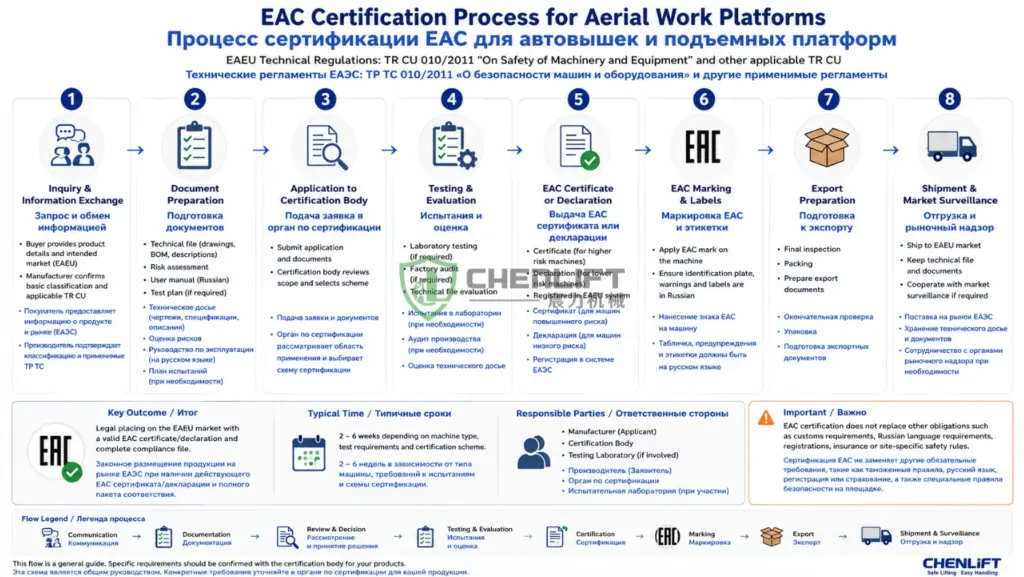
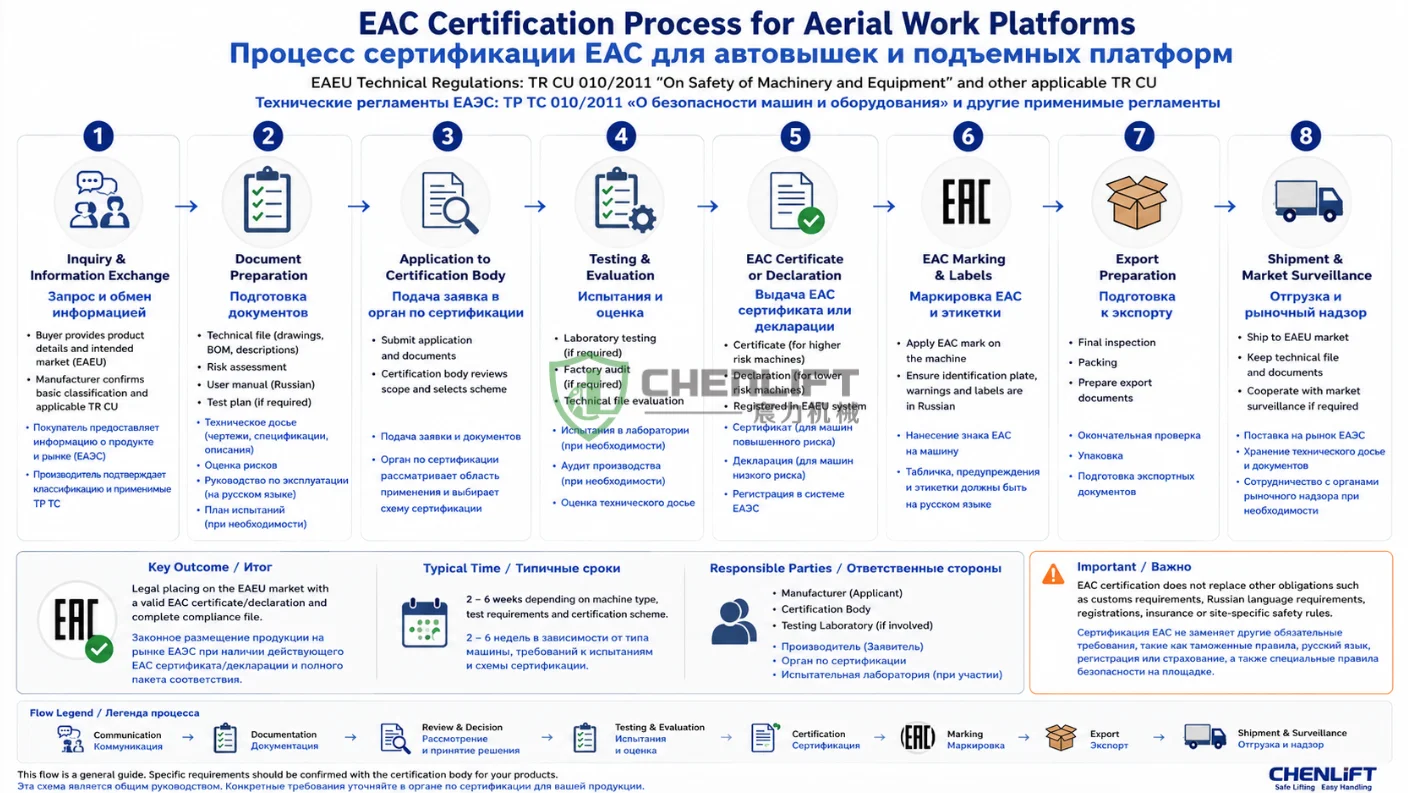
The EAC process requires coordination between machine configuration, technical documentation, conformity assessment, marking and export preparation. A complete compliance file helps ensure that the supplied aerial work platform matches the approved EAEU requirements.
The practical EAC process begins at the factory, before a certificate application or container booking. A capable Chinese manufacturer works from the actual model and creates one controlled file that connects technical review, Russian-market documentation and shipment release.
For aerial work platform EAC certification, the factory preparation stage is especially important because the final compliance file must match the delivered machine. Any later changes to battery systems, controllers, safety components or platform configuration may require additional review.
- Confirm the machine model and buyer configuration. Freeze the model, working height, capacity, drive system, battery or engine, platform option and accessories in the quotation and purchase order.
- Review the route and classification. The EAEU applicant, customs broker and conformity body review the product definition, TN VED/HS code and applicable technical regulations.
- Prepare technical evidence. Assemble drawings, calculations, electrical and hydraulic schematics, risk records, factory test records and the machine specification.
- Complete the required assessment. Follow the certificate or declaration route confirmed for the product, including testing or production evidence where the scheme requires it.
- Prepare Russian documentation and marking. Approve the Russian manual, safety labels, technical passport content and EAC marking only for the verified scope.
- Release the shipment against the final file. Match the serial number, nameplate, manual revision, invoice, packing list and conformity document before loading.
This sequence is more useful than treating EAC as a document that can be added after the machine has been built. It gives the importer a clear point to identify a configuration mismatch before it becomes a customs or site problem.
What Should Be Included in a Russia-Bound Document Package?
For a Russia-bound order, ask the supplier for a buyer-facing document package as well as the conformity document itself. The purpose is to give the importer, customs broker and end user consistent identifiers and operating information.
The package should include:
- EAC certificate or declaration, as applicable.
- Technical passport or product passport.
- Russian-language user manual.
- Electrical schematic and hydraulic diagram where applicable.
- Load, functional and factory test records.
- Product specification sheet.
- Serial-number list.
- Nameplate and marking photographs.
- Russian safety labels and control-panel markings.
- Maintenance, emergency and rescue instructions.
The exact contents and format of a technical passport, manual and supporting records must be confirmed for the final EAEU route and destination. This is a practical import-control list, not a substitute for advice from the applicant, customs broker or accredited conformity body.
Pre-Shipment Checks: Make the Container Match the File
Before final payment and loading, require a documentary release pack.
- Confirm the conformity document is valid and includes the exact model and options.
- Check the applicant name, EAEU address and certification-body or declaration registration details.
- Compare the nameplate photograph with the document and final manual revision.
- Map each serial number to the model, configuration and shipment packing list.
- Confirm Russian-language manuals, safety labels and emergency instructions are packed with the unit.
- Confirm the invoice, packing list, bill of lading description and TN VED code use consistent product information.
- Record the charger, battery, controller and safety-component part numbers.
- Keep dated photographs of the finished machine, plate and marking before dispatch.
For a fleet order, do not rely on one representative photograph when every unit has a different serial number or option package. A serial-to-document matrix is often more useful than another generic certificate scan.
Common Mistakes When Verifying EAC Documentation from Chinese Suppliers
Mistake 1: Asking for an EAC logo instead of the registered document
Fix: request the certificate or declaration, registration details, scope, applicant and validity.
Mistake 2: Assuming every platform needs a certificate
Fix: ask the accredited body to confirm certificate versus declaration against the current regulation, product list and exact classification.
Mistake 3: Accepting a product-family document without model boundaries
Fix: require named models, variants, ratings and configuration limits.
Mistake 4: Leaving the applicant role until shipment is booked
Fix: name the applicant and EAEU representative in the commercial and certification plan before the purchase order is released.
Mistake 5: Treating CE as an EAC substitute
Fix: use CE drawings, risk assessments and test reports as technical background only. Complete the EAEU route separately.
Mistake 6: Sending an English-only manual to a Russian operator
Fix: approve the Russian-language manual and safety-label artwork as part of the same model-specific revision package.
Mistake 7: Ignoring electrical options
Fix: list battery, charger, controller and wireless modules in the product definition, then confirm whether they change the route.
Mistake 8: Applying the mark before assessment is complete
Fix: make EAC marking a documented release step after the applicable conformity document is complete.
Mistake 9: Changing the machine after approval without review
Fix: include design-change notification, re-assessment triggers and document revision control in the purchase terms.
Mistake 10: Confusing EAC with site permission to operate
Fix: confirm separate Russian workplace, inspection, registration, insurance and project requirements with the importer and competent local parties.
Chenlift Support for Russia and EAEU Projects
For Russia and EAEU enquiries, Chenlift starts with the operating requirement and the exact machine configuration. The buyer can provide working height, platform load, access width, indoor or outdoor duty, ground condition, power preference, quantity and destination. That gives the technical team a defined basis for discussing a scissor, vertical mast or boom lift and for preparing the information needed for the EAEU review.
For the model under discussion, Chenlift can provide product specifications, general arrangement drawings, operating manuals, electrical or hydraulic information where applicable, factory inspection and test records, serial-number information and existing CE-related technical evidence. Russian-language documentation, nameplate and marking artwork should be reviewed as part of the same configuration-controlled package.
Chenlift can also discuss OEM configuration, spare-parts identification and third-party inspection options from SGS, Bureau Veritas or TUV when required for the order. These services support the buyer’s technical and export preparation; they do not replace the applicable EAEU conformity assessment.
Final EAC status must be confirmed through the applicable EAEU process for the exact machine supplied. No model should be marketed as EAC-certified until that process is complete and the document scope has been verified.
EAC vs CE: What a Russian Buyer Should Understand
CE and EAC can share useful engineering foundations, but they answer different market-entry questions.
| Topic | CE / EU context | EAC / EAEU context |
|---|---|---|
| Legal framework | EU directives or regulations | EAEU technical regulations, including TR CU 010/2011 where applicable |
| Conformity document | EU Declaration of Conformity and any required third-party route | EAC certificate or declaration according to the applicable route |
| Applicant responsibility | Manufacturer and relevant EU economic operators | Applicant and EAEU legal representative or importer |
| Language | Languages required by the EU destination | Russian or other required EAEU-market operating information |
| Marking | CE marking when legally required | EAC marking after the applicable conformity assessment |
Existing CE documentation may reduce duplicated engineering work, but it does not automatically register an EAC declaration, create an EAEU applicant, satisfy Russian language requirements or authorise EAC marking. Treat it as a technical input to the EAEU review.
Frequently Asked Questions
What does EAC mean for an aerial work platform imported into Russia?
EAC is the Eurasian Conformity mark. It indicates that the product has completed the applicable EAEU conformity assessment and may be released into circulation within the relevant scope. The mark must be supported by the correct certificate or declaration, technical file and responsible applicant.
Can Chinese scissor lifts complete aerial work platform EAC certification before exporting to Russia?
Yes. Chinese manufacturers can prepare the technical documents and complete the required aerial work platform EAC certification process before shipment, provided that the exact machine configuration, EAEU requirements and conformity route are confirmed.
The export process normally requires matching the machine specification, technical documents, Russian-language information, serial numbers and conformity documents before the equipment is released for shipment.
Does every aerial work platform need an EAC certificate?
No. The exact conformity form depends on the current EAEU technical regulation, product list, TN VED/HS classification, machine type and configuration. Depending on the route, conformity may be confirmed by an EAC certificate or an EAC declaration.
Can a CE certificate replace EAC certification?
No. CE documents can support technical review, but they do not replace the EAEU conformity procedure, applicant requirements, Russian-language documentation or EAC marking.
Can one EAC document cover several models?
Sometimes a document can cover a defined family, but only when the scope explicitly names the models and configuration boundaries. Do not assume that a family document covers a different platform, battery, charger, controller or safety option.
Is a Russian-language manual required?
For a machine intended for operation in Russia, Russian-language operating and safety information should be planned as a baseline. Confirm the exact translation, label and passport requirements for the product and assessment route before production.
Can the manufacturer provide documents for Russian customs clearance?
A manufacturer can prepare the product specification, technical passport information, Russian manual, serial-number list, nameplate photographs and applicable conformity evidence for the supplied model. The Russian importer and customs broker should confirm the final TN VED/HS code, applicant responsibilities and customs submission requirements.
How long does aerial work platform EAC certification take?
There is no reliable single timeline. Route confirmation, document quality, testing, translation, factory evidence, applicant setup and certificate-body workload can move the schedule from several weeks to several months. Ask for a written milestone plan and do not book shipment against a best-case estimate.
Does EAC approval replace Russian site or workplace approval?
No. EAC addresses the applicable product conformity requirements. Separate Russian rules for operation, inspection, registration, training, insurance or a specific construction or industrial site may still apply.
Start With the Machine, Then Build the EAC File
The best EAC project is decided before the container is booked. Define the model, freeze the options, confirm the TN VED/HS classification, assign the EAEU applicant, map the applicable technical regulations, approve the Russian documentation and keep every serial number traceable to the final file.
For a Russia enquiry, send the working height, platform load, access width, indoor or outdoor duty, ground conditions, power system, quantity, destination and documents required by the importer. Chenlift can then discuss the suitable scissor lift, vertical lift or boom lift configuration and the technical information needed for the EAEU review.