Scissor Lift EAC Certification for Russia: Documents, Models & Compliance Guide
A Russian buyer orders a self-propelled electric scissor lift. The supplier sends an EAC document covering “lifting machinery,” but the document does not name the ordered model. The rated load on the nameplate is different from the quotation, the charger was changed during production, and the Russian manual describes an earlier control system.
The machine may still carry an EAC mark, but the importer does not have a reliable conformity file for the unit being shipped.
This is the main issue in a scissor lift EAC certification project: the document must cover the actual machine—not merely a similar product family.
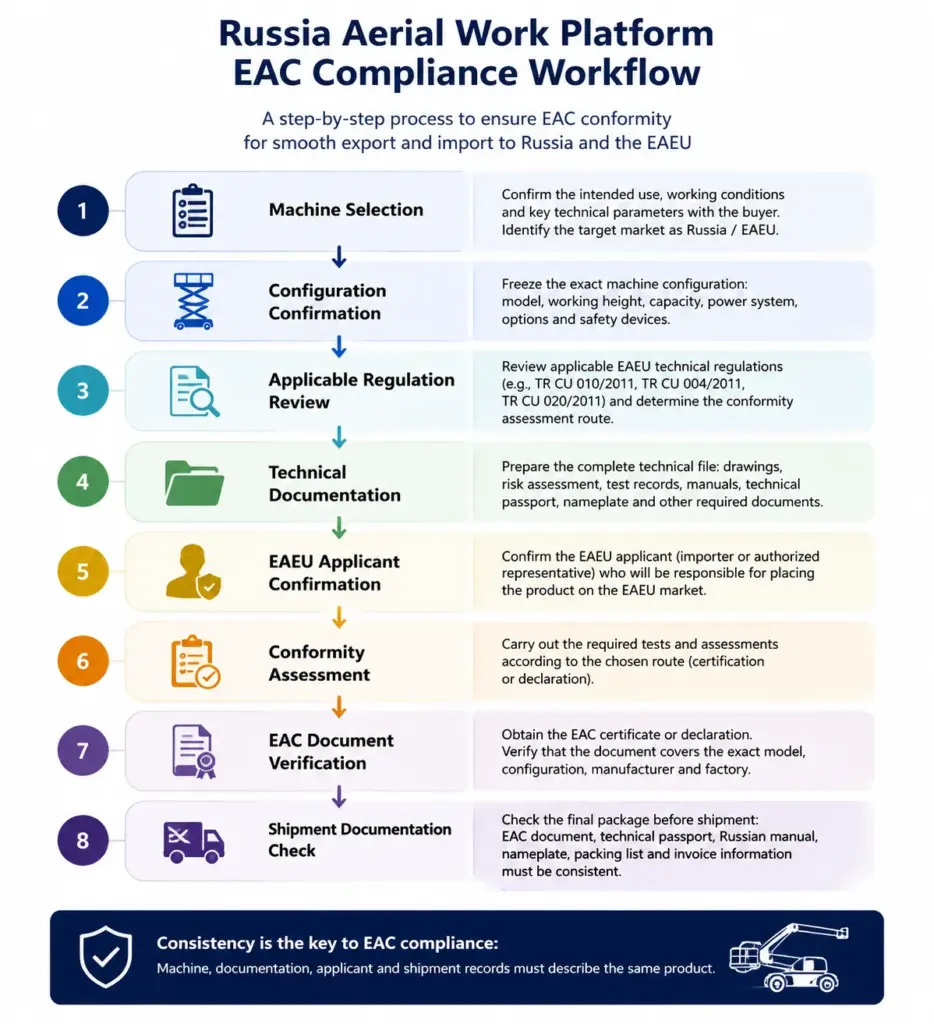
For Russian importers, distributors and rental companies, the practical review should connect six things:
- Scissor lift type
- Exact model and configuration
- Applicable EAEU technical regulations
- Certificate or declaration
- Russian-language technical documents
- Final machine and shipment records
Does a Scissor Lift Need EAC Certification in Russia?
A scissor lift entering the Russian market may be subject to mandatory EAEU conformity assessment. However, the commercial name “scissor lift” does not by itself determine whether the required document is an EAC certificate or an EAC declaration.
The decision depends on factors including:
- Whether the lift is self-propelled or manually moved
- Whether it lifts personnel, goods or both
- Rated platform capacity
- Working and platform height
- Electric, diesel or hybrid power
- Drive and steering system
- Intended operating environment
- Safety and control configuration
- Applicable TN VED/HS classification
- Whether the machine is complete or partly completed
For many complete scissor lifts, TR CU 010/2011, On the Safety of Machinery and Equipment, is an important starting point. Electrically powered machines may also require review against other applicable EAEU technical regulations, depending on their voltage, electrical equipment and electromagnetic characteristics.
The conformity route should be confirmed by the EAEU applicant and an accredited conformity assessment body before production or shipment.
Buyer takeaway: Do not ask only whether the supplier “has EAC.” Ask which conformity document applies to the exact scissor lift model and configuration in the purchase order.
EAC Is Not a Single Russian Standard
EAC means Eurasian Conformity. It is the common conformity mark used for products that meet applicable technical regulations of the Eurasian Economic Union.
The EAEU currently includes:
- Russia
- Belarus
- Kazakhstan
- Armenia
- Kyrgyzstan
The EAC mark is not a technical standard and not a universal certificate. It is applied after the required conformity assessment has been completed.
The underlying requirements may come from:
- TR CU — Technical Regulations of the Customs Union
- TR EAEU — Technical Regulations of the Eurasian Economic Union
- ТР ТС or ТР ЕАЭС in Russian documents
For a Russia-bound scissor lift, the buyer should identify:
- Applicable technical regulation
- Certificate or declaration route
- Assessment scheme
- EAEU applicant
- Covered manufacturer and factory
- Covered models and configurations
- Validity and registration status
- Required marking and Russian documents
A logo image or an unverified certificate scan is not enough to establish that the supplied machine is covered.
TR CU 010/2011 and Scissor Lift Safety
For many complete scissor lifts, the primary machinery regulation to examine is TR CU 010/2011, On the Safety of Machinery and Equipment.
The regulation entered into force on 15 February 2013. Its requirements, amendments and supporting standards should be checked in their current form for each live project.
For a scissor lift, the machinery-safety review may address:
- Scissor structure and load-bearing components
- Platform and extension deck
- Guardrails and access gate
- Stability
- Rated platform load
- Operator capacity
- Chassis and wheel arrangement
- Driving and steering controls
- Braking
- Emergency stop
- Emergency lowering
- Lifting and descent controls
- Tilt detection
- Overload protection
- Pothole protection
- Hydraulic safety
- Electrical safety
- Maintenance access
- Transport and lifting points
- Foreseeable misuse
Working height alone does not determine the conformity route. Two machines with the same working height may have different drive systems, platform capacities, control architectures and safety functions.
A compliance review should therefore use the complete technical specification rather than a catalogue name such as “10 m scissor lift.”
Do Electric Scissor Lifts Also Need TR CU 004/2011 or TR CU 020/2011?
They may require additional review, but this should not be assumed automatically.
TR CU 004/2011: Low-Voltage Equipment
An electric scissor lift may contain equipment such as:
- Battery charger
- Electrical control cabinet
- Power supply
- Contactors and protection devices
- Drive motor controller
- Emergency stop circuit
- Platform and ground control units
Whether TR CU 004/2011, On the Safety of Low-Voltage Equipment, applies depends on the electrical characteristics, scope and exclusions of the regulation.
A separate document for the charger does not automatically establish conformity of the complete scissor lift. The entire machine and its installed electrical system still need to be considered under the applicable route.
TR CU 020/2011: Electromagnetic Compatibility
Electronic controllers, motor drives, chargers, sensors, displays and wireless controls may also create electromagnetic compatibility questions.
Whether TR CU 020/2011, Electromagnetic Compatibility of Technical Equipment, applies should be determined from the final machine configuration.
The manufacturer should provide sufficient information about:
- Controller manufacturer and model
- Charger model and input/output ratings
- Electrical system voltage
- Sensors and safety switches
- Wireless or remote-control equipment
- Motor drive system
- Electronic safety functions
Practical rule: Freeze the battery, charger and controller configuration before the conformity file is finalized. Replacing one of these components after assessment may require additional review.
Self-Propelled, Manual-Push and Rough-Terrain Scissor Lifts Are Not the Same Product
A scissor lift EAC project should begin by defining the machine category.
Self-Propelled Electric Scissor Lifts
A self-propelled electric scissor lift combines lifting, powered travel, steering and an electrical control system.
The review may need to consider:
- Travel controls from the platform
- Ground controls
- Drive motors
- Steering system
- Braking
- Pothole protection
- Tilt sensor
- Platform overload protection
- Emergency lowering
- Battery and charger
- Platform extension
- Drive restrictions at height
- Control-system interlocks
The buyer should identify all optional equipment included in the order. A platform extension, different battery system or alternative controller can affect the final product definition.
For Chenlift, this category includes the MX Series self-propelled electric scissor lifts. The exact model and configuration—not the MX family name alone—should be used for the EAEU review.
Manual-Push Scissor Lifts
A manual-push scissor lift is moved manually between work positions, although the lifting function may be powered.
Its review may focus on:
- Manual movement
- Wheel and brake arrangement
- Stabilizers or outriggers, where fitted
- AC or DC lifting system
- Platform capacity
- Scissor mechanism
- Base stability
- Emergency descent
- Access gate and guardrails
- Transport and handling instructions
A manual-push model should not automatically be included under a document issued for a self-propelled model. Removing powered travel changes the machine’s operating characteristics but does not remove the need for a proper machinery-safety review.
For Chenlift, this category includes the MK Series manual-push scissor lifts. Standard and heavy-capacity models may have different structural and rated-load characteristics that should be reflected in the technical file.
Rough-Terrain Scissor Lifts
Rough-terrain scissor lifts introduce additional review points such as:
- Outdoor operating conditions
- Diesel or electric power
- Four-wheel drive
- Gradeability
- Oscillating axle
- Stabilizers or automatic levelling
- Larger platform capacity
- Extended platform dimensions
- Ground clearance
- Terrain limitations
- Wind exposure
- Emergency and recovery procedures
An indoor slab scissor lift and a rough-terrain model should not be treated as one undifferentiated certification object.
For Chenlift, the MRT Series should be reviewed according to its actual drive, platform, levelling and power configuration.
Can Several Scissor Lift Models Share One EAC Document?
Possibly, but only when the selected conformity route permits grouping and the models fit within a clearly defined product scope.
The conformity assessment body may compare:
- Scissor-arm design
- Chassis structure
- Working-height range
- Rated platform capacity
- Platform dimensions
- Drive system
- Steering and braking
- Hydraulic system
- Electrical architecture
- Battery voltage
- Controller
- Safety functions
- Manufacturing site
Several related models may be covered by one document when their design relationship and scope are properly established. However, a certificate or declaration should make the covered models or product boundaries clear.
Do not assume that one document covers:
- Every working height
- Every rated capacity
- Self-propelled and manual-push machines
- Indoor and rough-terrain machines
- Electric and diesel configurations
- Standard and customized platforms
- Different factories
- Future models introduced after issuance
If a document says only “scissor lift” or “lifting equipment,” ask the conformity body or responsible applicant to confirm whether the ordered model is within scope.
Certificate or Declaration: Which Document Should the Buyer Request?
“EAC certification” is commonly used as an umbrella term, but the actual conformity document may be:
- An EAC certificate of conformity
- An EAC declaration of conformity
- Another document required by the applicable regulations
The correct form depends on the regulation, product classification and assessment scheme.
A certificate and a declaration are not interchangeable.
The buyer should ask the importer or conformity body to confirm:
- Which regulations apply?
- Is certification or declaration required?
- Which assessment scheme applies?
- Who will be the EAEU applicant?
- Which models and configurations will be covered?
- Is testing required?
- Is a factory assessment required?
- How will the document be verified in the EAEU register?
The decision should be made from the legal product classification, not from the supplier’s sales terminology.
Who Can Be the EAEU Applicant?
For equipment manufactured outside the EAEU, the conformity procedure generally requires an eligible applicant established within an EAEU member state.
Depending on the applicable rules and commercial arrangement, this may be:
- Russian importer
- Distributor established in another EAEU country
- Authorized representative
- Another eligible EAEU legal entity
The applicant is not merely a name placed on the certificate. It may hold legal responsibilities connected with the conformity document and placement of the product on the EAEU market.
The applicant should be agreed before the assessment begins because changing it later may require a new filing or document.
Before issuing the purchase order, confirm:
- Applicant’s legal name
- EAEU address
- Relationship to the manufacturer
- Product and model scope
- Duration of the arrangement
- Responsibility for document maintenance
- Process for future shipments
- Process for design changes
A document registered by an unrelated applicant should not be used without confirming that the arrangement lawfully covers the manufacturer and product being imported.
Scissor Lift Technical File: What the Manufacturer Should Prepare
A scissor lift conformity project should be built around one controlled technical package.
1. Product Definition
The product definition should include:
- Product name
- Exact model
- Scissor lift category
- Intended use
- Working height
- Platform height
- Rated platform capacity
- Number of permitted occupants
- Platform dimensions
- Extension-deck size and capacity
- Machine dimensions
- Machine weight
- Power source
- Battery voltage and capacity
- Charger model and rating
- Drive and steering type
- Tyre specification
- Indoor or outdoor use
- Maximum permitted slope
- Wind rating, where applicable
- Operating temperature range
This document provides the baseline against which the drawings, tests, manual and nameplate are checked.
2. Structural and General Arrangement Drawings
The file may include:
- General arrangement drawing
- Scissor-arm assembly
- Platform and extension deck
- Guardrails and gate
- Chassis
- Pin and joint details
- Hydraulic-cylinder arrangement
- Wheel and axle layout
- Stabilizers, where fitted
- Lifting and tie-down points
Supporting calculations or engineering records may be required for load-bearing and stability-related structures.
3. Hydraulic Documentation
Hydraulic information may include:
- Hydraulic circuit
- Cylinder specification
- Pump and motor information
- Pressure settings
- Hose and fitting specifications
- Check and relief valves
- Emergency lowering circuit
- Burst or uncontrolled-descent protection
- Maintenance and inspection points
The hydraulic diagram in the technical file should match the production machine and service manual.
4. Electrical Documentation
For electric models, the file may include:
- Electrical schematic
- Battery specification
- Charger specification
- Ground and platform controls
- Drive controller
- Motor information
- Emergency stop circuit
- Limit switches
- Tilt sensor
- Overload sensor
- Pothole protection interlocks
- Alarm and indicator circuits
- Wiring identification
- Fuse and protection data
Changing the controller or charger during production should trigger document review rather than being treated as a routine substitution.
5. Risk Assessment
The risk assessment should address hazards such as:
- Falling from the platform
- Overload
- Overturning
- Driving at height
- Operation on slopes
- Crushing and shearing
- Entrapment
- Unexpected travel or lifting
- Brake failure
- Hydraulic failure
- Uncontrolled descent
- Electrical shock
- Battery charging
- Access and egress
- Emergency rescue
- Maintenance
- Loading and transport
- Foreseeable misuse
The control measures identified in the risk assessment should be visible in the machine design and operating manual.
6. Testing and Inspection Records
Relevant records may cover:
- Rated-load test
- Stability test
- Structural test
- Brake test
- Travel and steering test
- Emergency stop
- Emergency lowering
- Tilt alarm and cut-out
- Overload system
- Pothole protection
- Platform interlocks
- Limit switches
- Hydraulic leakage
- Electrical safety
- Battery charging
- Functional inspection
- Final factory inspection
Test records should identify the model, tested configuration, conditions, results and responsible personnel.
A report for one height or capacity should not automatically be assumed to cover a substantially different model.
Russian Manual and Technical Passport
Russian-language documentation should be planned during production, not added after the container has been booked.
Russian Operating Manual
The manual should correspond to the supplied model and include:
- Intended use
- Prohibited use
- Operator responsibilities
- Pre-use inspection
- Ground and platform controls
- Driving and steering
- Lifting and lowering
- Platform extension operation
- Rated-load limits
- Slope restrictions
- Indoor and outdoor conditions
- Wind restrictions, where applicable
- Tilt and overload warnings
- Emergency stop
- Emergency lowering
- Rescue procedures
- Battery charging
- Hydraulic maintenance
- Inspection intervals
- Troubleshooting
- Transport and tie-down
- Storage
- Residual risks
Control labels, illustrations and component descriptions should match the final machine.
Technical Passport
Depending on the applicable route and buyer requirements, the technical passport may contain:
- Manufacturer
- Factory address
- Product name
- Model
- Serial number
- Manufacturing date
- Working height
- Rated platform capacity
- Platform dimensions
- Machine weight
- Battery or engine data
- Main component information
- Acceptance records
- Inspection records
- Maintenance history
- Repair records
The importer or conformity specialist should confirm the final format before shipment.
Nameplate and EAC Marking
The machine nameplate should provide traceability between the physical machine and the conformity file.
Typical fields may include:
- Manufacturer name
- Manufacturer address
- Product name
- Model designation
- Serial number
- Year of manufacture
- Rated platform load
- Number of occupants
- Machine weight
- Electrical or engine information
- EAC mark, where required
Before shipment, compare the plate with:
- Certificate or declaration
- Technical passport
- Russian manual
- Product specification
- Commercial invoice
- Packing list
- Serial-number list
The EAC mark should be applied only after the applicable conformity assessment is complete and according to the relevant marking requirements.
What Changes Can Affect the EAC File?
Scissor lift manufacturers often make substitutions during purchasing or production. Some changes may be minor; others may affect the approved product definition or safety evidence.
Changes requiring review may include:
- Rated platform capacity
- Working or platform height
- Platform dimensions
- Extension-deck design
- Guardrail height or gate
- Scissor-arm structure
- Hydraulic cylinder
- Pressure settings
- Chassis or wheelbase
- Battery voltage or type
- Charger
- Drive motor
- Controller
- Brake system
- Tilt sensor
- Overload system
- Pothole protection
- Emergency-lowering system
- Stabilizers
- Indoor/outdoor rating
The manufacturer should maintain a design-change process that asks:
- Does the change affect safety?
- Does it change a value on the nameplate?
- Does it change the manual?
- Does it affect an applicable regulation or test?
- Does the conformity body or applicant need to be notified?
- Does the certificate or declaration scope remain valid?
A buyer should require notification of safety-related configuration changes before shipment.
Buyer Checklist: What to Request Before Production
Before releasing the order, request the following information.
Product and conformity scope
- Exact model designation
- Complete configuration
- Proposed TN VED/HS classification
- Applicable technical regulations
- Certificate or declaration route
- Assessment scheme
- EAEU applicant
- Manufacturer and factory
- Models covered
- Validity conditions
Technical package
- Product specification
- General arrangement drawing
- Hydraulic schematic
- Electrical schematic
- Safety-function description
- Risk assessment reference
- Test-record index
- Russian manual plan
- Technical passport plan
- Nameplate draft
Commercial responsibilities
- Who arranges conformity assessment
- Who provides samples
- Who pays testing and registration costs
- Who supplies translations
- Who approves EAC marking
- Who maintains the registered document
- How design changes are handled
- Which documents ship with the machine
This information should be agreed before the machine configuration is frozen.
Final Pre-Shipment Check for a Russia-Bound Scissor Lift
Before loading the machine, confirm:
- The certificate or declaration is valid and verifiable.
- The document covers the exact model and factory.
- The EAEU applicant information is correct.
- The machine configuration has not changed without review.
- The rated capacity matches the order and nameplate.
- The working height and model designation are consistent.
- The battery, charger and controller match the technical file.
- The serial number is shown on the plate and shipment list.
- The Russian manual matches the controls and safety devices.
- The technical passport is complete where required.
- The EAC mark is correctly applied where required.
- Russian control labels and safety warnings are installed.
- The invoice and packing list use the correct product description.
- Nameplate and finished-machine photographs are archived.
- Emergency-lowering and rescue information is included.
For a fleet order, use a model-and-serial matrix rather than relying on one representative photo or one generic packing list.
Seven Common Scissor Lift EAC Mistakes
1. Asking Only for an EAC Logo
An EAC logo does not show which regulation, applicant, factory or model is covered.
Fix: Request the registered certificate or declaration and verify its scope.
2. Using a Generic Lifting-Equipment Document
A broad product description may not include the supplied scissor lift.
Fix: Confirm the exact model, rated capacity, height, drive type and factory.
3. Assuming CE Replaces EAC
CE and EAC are different market-conformity systems.
Fix: Use CE technical evidence as an input, but complete the applicable EAEU procedure separately.
4. Selecting the Applicant After Production
The EAEU applicant is part of the conformity arrangement and should not be treated as a last-minute customs detail.
Fix: Confirm the applicant before assessment and before the shipment is booked.
5. Changing the Battery, Charger or Controller Without Review
These changes may affect electrical documentation, testing, manual content and product scope.
Fix: Freeze key components or complete a documented change review.
6. Using a Russian Manual for a Different Configuration
A translated generic manual may show the wrong controls, safety systems or emergency procedure.
Fix: Compare the final Russian manual with the finished machine.
7. Treating a Component Certificate as Complete-Machine Conformity
A certificate for a charger, battery or controller does not establish conformity of the assembled scissor lift.
Fix: Keep component documents as supporting evidence within the complete-machine technical file.
CE vs EAC for Scissor Lifts
| Item | CE | EAC |
|---|---|---|
| Main market | European Union and relevant European markets | EAEU member states |
| Legal basis | Applicable EU legislation | Applicable TR CU/TR EAEU regulations |
| Mark | CE | EAC |
| Conformity document | EU Declaration of Conformity and any applicable supporting assessment | EAC certificate or declaration under the applicable route |
| Responsible parties | Manufacturer and relevant EU economic operators | Manufacturer and eligible EAEU applicant |
| Language | Destination-market requirements | Russian or other required EAEU-market languages |
| Can it replace the other system? | No | No |
An existing CE technical file may contain useful evidence such as:
- Risk assessment
- Structural calculations
- Stability and load tests
- Electrical schematic
- Hydraulic diagram
- Safety-function records
- Operating manual
- Final inspection records
This can support EAC preparation, but CE marking does not register an EAC declaration, create an EAEU applicant or authorize EAC marking.
For a broader discussion covering vertical mast lifts, boom lifts, crawler platforms and other equipment, see Chenlift’s complete aerial work platform EAC certification guide for Russia.
How Chenlift Supports Scissor Lift EAC Projects
Chenlift coordinates the manufacturer-side technical package with the confirmed machine configuration before production. This allows the engineering file, Russian documentation, nameplate and shipment records to be reviewed as one controlled package.
For a Russia-bound scissor lift order, Chenlift can prepare available manufacturer-side information such as:
- Product specifications
- Model and configuration records
- General arrangement drawings
- Hydraulic diagrams
- Electrical schematics
- Battery, charger and controller information
- Safety-device descriptions
- Factory test and inspection records
- Operating and maintenance information
- Product and nameplate photographs
- Serial-number records
- Existing CE-related technical evidence
- Technical clarification for customized machines
Chenlift can coordinate these materials with the Russian importer or qualified EAEU conformity specialist. The final certificate or declaration depends on the applicable regulations, assessment route, product classification and responsible EAEU applicant.
To begin a model-specific review, send:
- Scissor lift model
- Working height
- Rated platform capacity
- Quantity
- Self-propelled, manual-push or rough-terrain type
- Battery, charger or engine configuration
- Platform options
- Intended use
- Destination
- Importer information
- Required delivery date
- Tender or site-specific requirements
No model should be described as EAC-certified until the applicable process is complete and the final document scope has been verified.
Frequently Asked Questions
Can a Chinese scissor lift be exported to Russia?
Yes. The applicable EAEU conformity, customs, marking and documentation requirements must be completed for the exact machine and shipment.
The importer and manufacturer should confirm the route before production.
Does every scissor lift need an EAC certificate?
Not necessarily. Depending on the product classification and applicable technical regulations, the required document may be a certificate or a declaration.
The commercial description “scissor lift” does not determine the route by itself.
Is TR CU 010/2011 applicable to scissor lifts?
It is an important starting point for many complete scissor lifts because it addresses machinery and equipment safety.
Final applicability and the conformity form should be confirmed for the exact machine.
Can one EAC document cover several scissor lift models?
Possibly, if the assessment route permits a product family and the document clearly defines the covered models and configuration boundaries.
Do not assume that one document covers every height, capacity or drive type.
Is CE certification enough to import a scissor lift into Russia?
No. CE and EAC are separate systems.
A CE technical file may support the EAEU review but does not replace the required EAC conformity procedure.
Does changing the battery affect EAC conformity?
It may. A battery change can affect voltage, capacity, weight, stability, charger compatibility, electrical documentation and manual information.
The change should be reviewed before shipment.
Is a Russian-language manual required?
Russian-language operating and safety information should be planned for equipment supplied to Russian users.
The exact content and format should be confirmed under the applicable route and buyer requirements.
Who should apply for the EAC document?
For a manufacturer outside the EAEU, an eligible EAEU-established applicant is generally required.
The applicant may be an importer, distributor or another eligible entity, depending on the arrangement and applicable rules.
How long does scissor lift EAC certification take?
There is no universal schedule. Product classification, testing, document completeness, translation, applicant setup and conformity-body workload all affect timing.
Do not book the shipment against an unconfirmed best-case date.
Can certification be completed after the scissor lift is manufactured?
It may be possible, but it increases the risk of document, nameplate or configuration mismatches.
The conformity route should be reviewed before production whenever possible.
Start With the Exact Scissor Lift
A reliable EAC project starts with the machine specification, not a certificate template.
Define the scissor lift type, freeze the configuration, confirm the conformity route and EAEU applicant, prepare the Russian documents, and keep the final serial number traceable across the nameplate, manual, passport and shipment records.
For a Russia-bound quotation, send Chenlift the model, working height, platform capacity, power configuration, quantity, destination and intended use. Chenlift can prepare the relevant manufacturer-side technical package and coordinate the documentation scope with your importer or EAEU conformity specialist before production starts.
Official References
- Eurasian Economic Commission: Technical Regulation
- Eurasian Economic Commission: Conformity Assessment
- TR CU 010/2011: Safety of Machinery and Equipment
- TR CU 004/2011: Safety of Low-Voltage Equipment
- TR CU 020/2011: Electromagnetic Compatibility of Technical Equipment
- EEC explanation of the EAC conformity mark
EAEU requirements and conformity procedures may be amended. Confirm the applicable route with the EAEU applicant, importer and qualified conformity assessment body before relying on this guide for a live shipment.