ANSI A92 Aerial Work Platform: How U.S. Buyers Verify an MEWP Compliance Claim
A container arrives at a U.S. distributor’s warehouse. Inside is a new electric scissor lift. The supplier has sent a brochure stating “ANSI compliant,” an English manual, and a factory test report.
The rental fleet then raises three questions:
- Which ANSI A92 standard and edition applies to this machine?
- Does the manual, identification plate, and safety configuration match the delivered model?
- Who is responsible for operator training, pre-use inspection, and rescue planning after the machine enters service?
This is where many procurement conversations stop being about a label and become about evidence.
This guide is primarily intended for U.S. importers, distributors, rental fleets, and industrial buyers sourcing MEWPs from overseas manufacturers. It is not an operator-training manual or a substitute for project-specific legal advice.
The question is simple: before accepting an “ANSI A92 compliant” claim, what does a buyer actually need to verify?
ANSI A92 Is Not One Certificate
ANSI, the American National Standards Institute, administers and coordinates the U.S. voluntary consensus standard system. It does not manufacture equipment, test individual machines, or issue a universal product certificate.
Buyers should separate three things that are often confused:
| Layer | What it means | What it does not prove |
|---|---|---|
| Consensus standard | ANSI/SAIA A92 requirements for MEWP design, safe use, or training | That a particular machine has been independently certified |
| Third-party conformity assessment | Testing, inspection, certification, or audit by an outside organization | That every later model variant or component change is covered |
| Manufacturer declaration and records | Model-specific manuals, drawings, test records, labels, and technical documents | That the buyer has completed site risk assessment, training, or rescue planning |
In the MEWP sector, the A92 standards are maintained through the ASC A92 consensus process, with the Scaffold & Access Industry Association, or SAIA, acting as secretariat.
The current core ANSI/SAIA MEWP suite includes:
| Standard | Main purpose | Main responsibility |
|---|---|---|
| ANSI/SAIA A92.20-2021 | Design, calculations, safety requirements, and test methods | Manufacturer, remanufacturer, engineer, designer |
| ANSI/SAIA A92.22-2021 | Safe use of MEWPs | Owner, user, employer, supervisor |
| ANSI/SAIA A92.24-2018(R2026) | Training for use, operation, inspection, testing, and maintenance | Employer, trainer, operator, occupant, maintenance personnel |
The practical logic is:
- A92.20: What the machine must be
- A92.22: How the machine must be used
- A92.24: How the people around it must be trained
Vehicle-mounted elevating and rotating aerial devices are addressed separately under ANSI/SAIA A92.2-2021.
The A92 suite was developed with international MEWP practice in view and is broadly aligned in approach with ISO 16368, EN 280, and CSA B354. They are not interchangeable standards. CE documentation or Canadian documentation may help a buyer understand the equipment, but they do not replace an ANSI A92 review for the U.S. market.
Buyer takeaway: one document cannot prove all three layers of machine design, safe use, and training.
Step 1: Confirm the Exact Machine Before Reviewing Any Claim
Do not start with, “Is this lift ANSI compliant?”
Start with the machine definition. The purchase specification should identify:
- Exact model designation and variant suffix
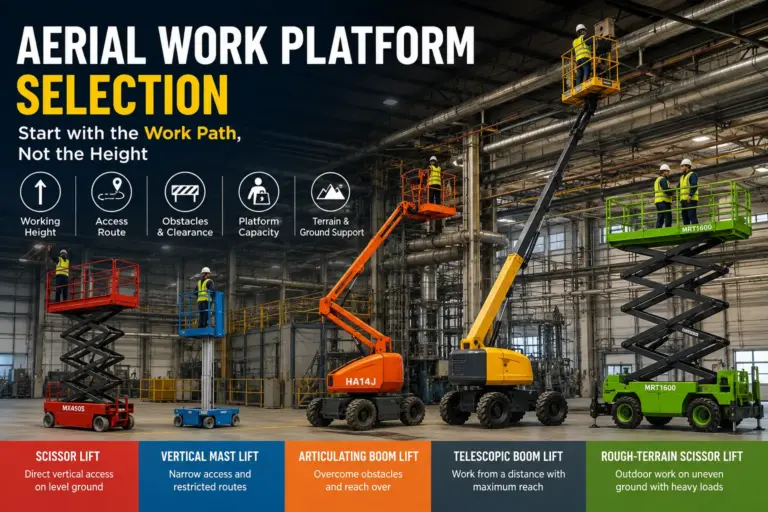
- Machine type: scissor lift, vertical mast lift, articulated boom lift, telescopic boom lift, or vehicle-mounted device
- Working height, platform height, rated platform capacity, and platform dimensions
- Indoor-only or outdoor-rated operating limits
- Drive system, battery type, charger input, controller, and optional electrical equipment
- Tire type, stabilizers, outriggers, or special travel functions
- Platform extensions, gates, anchor points, overload systems, tilt alarms, and emergency-lowering arrangement
- Intended use: rental fleet, construction, industrial maintenance, warehouse work, or internal plant use
- Destination state and end-user requirements
Why this matters: two machines sold under the same product-family name may have different batteries, platform arrangements, travel functions, or safety options. Those differences can affect the manual, labels, inspection records, customer approval, and training route.
Buyer takeaway: put the complete model and configuration on the quotation, purchase order, packing list, identification plate, manual, and final inspection record. “10 m electric scissor lift” is not an adequate technical definition.
Before comparing an ANSI A92 claim, confirm whether the application requires a scissor lift, vertical mast lift, or boom lift.
Step 2: Verify the A92.20 Design Evidence
ANSI/SAIA A92.20-2021 addresses the machine itself. It covers structural design, stability criteria, construction, safety examinations, and testing before the MEWP is first put into service.
A buyer does not need to reproduce the manufacturer’s engineering work. The buyer does need to establish that the delivered machine matches the configuration represented in the relevant records.
Structural and stability records
The supplier should identify the rated load, intended operating conditions, platform configuration, and applicable stability criteria for the specific model.
If the machine includes a platform extension, special platform dimensions, non-standard battery pack, outriggers, or customer-requested modification, confirm whether the original design and test documentation still applies.
Safety-function information
Depending on the model, the buyer may need information on:
- Overload warning or load-management functions
- Tilt sensing or incline alarms
- Pothole protection or stabilizer interlocks
- Emergency stop and emergency lowering systems
- Travel and elevation interlocks
- Guardrail, entry-gate, and toe-board configuration
Do not rely on catalog images. Request the current operating manual, technical specification, and inspection records for the ordered configuration.
Indoor and outdoor operating limits
An electric MEWP is not automatically suitable for all outdoor work. Wind limits, ground conditions, allowable load, and operating restrictions must match the manufacturer’s instructions.
A platform labeled for indoor use should not be treated as an outdoor machine just because delivery-day weather is calm.
Buyer takeaway: A92.20 evidence must relate to the designed and delivered machine, not a generic product-family statement.
Step 3: Check Group and Type Classification Before the Fleet Receives the Machine
The ANSI A92 suite uses Group and Type classifications for MEWPs.
Group classification
- Group A: The platform remains within the tipping lines of the chassis during operation.
- Group B: The platform can move beyond the tipping lines of the chassis during operation.
Type classification
- Type 1: Travel is permitted only with the platform stowed.
- Type 2: Elevated travel is controlled from the chassis or ground.
- Type 3: Elevated travel is controlled from the work platform.
For an importer or rental fleet, this is not terminology for its own sake. Group/Type affects the training matrix, familiarization process, rental-customer instructions, fleet records, and safe-use planning.
A buyer should not assume that every scissor lift has the same classification or that every boom lift creates the same operating risk. Ask the manufacturer or qualified training provider to state the relevant Group/Type classification for the equipment purchased.
Buyer takeaway: record Group/Type in the equipment file before the machine is handed to a customer or placed into a fleet.
Step 4: Build the Evidence Chain Before Shipment
This section explains why each document matters. The PO checklist later in this guide states exactly what to request.
Core machine documents
A supplier should be able to provide:
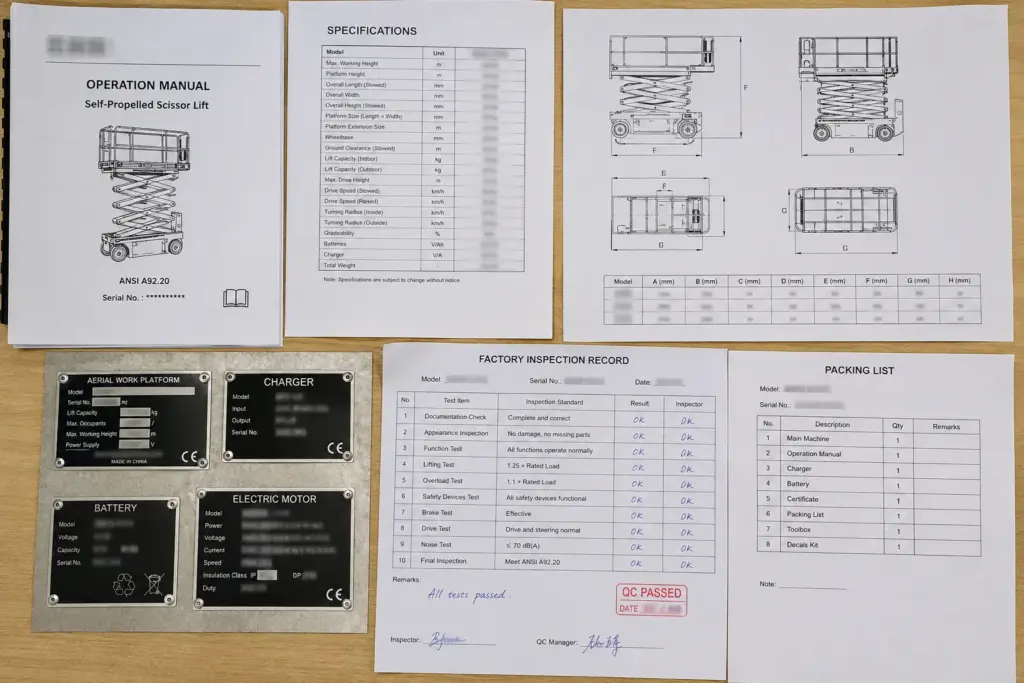
- Product specification sheet for the exact model
- Operator and maintenance manual, current revision
- Identification plate artwork or photographs
- General arrangement drawing
- Electrical and hydraulic schematics where relevant
- Factory functional test and final inspection records
- Load or stability test references where applicable
- Spare-parts list and recommended service parts
- Emergency lowering and rescue instructions
- Warranty and technical-support contact details
Safety-system records
Also request:
- Overload, tilt, interlock, and emergency-lowering system descriptions
- Inspection and calibration information where applicable
- Safety-label plan and English-language decals
- Revision-control record for manuals and safety documentation
Configuration-control records
For the actual order, confirm:
- Approved list of options and deviations
- Battery, charger, controller, or wireless-module specifications
- Written confirmation of changes made after quotation approval
- Serial-number mapping for the shipment
The same fields should match throughout the evidence pack:
| Field | What should match |
|---|---|
| Model designation | Quotation, PO, manual, plate, test records |
| Rated capacity | Datasheet, plate, manual, platform labels |
| Working height | Datasheet, manual, plate where listed |
| Power system | Battery, charger, electrical schematic, quotation |
| Manufacturer | Legal entity name and address across all records |
| Safety functions | Manual, technical file, ordered configuration |
| Serial number | Plate, packing list, factory inspection record |
| Manual revision | Correct for the delivered configuration |
A manual showing 230 kg capacity, a plate showing 250 kg, and a quotation showing 240 kg is not a minor formatting issue. It suggests that documents may have been copied from different configurations.
Buyer takeaway: add a document-consistency review to the pre-shipment inspection checklist. Do it before the container is loaded.
A92 Is Not an Electrical Certification Package
A92.20 does not eliminate the need to review the electrical side of an electric MEWP.
Battery chemistry, charger, BMS, motor controller, wiring, plugs, and wireless components may be subject to separate customer, local-authority, or contract requirements. Battery charging also creates site obligations around ventilation, damage protection, handling, emergency response, and fire protection.
ANSI A92 is not an electrical certification package. UL, NRTL, IEC-based component requirements, and charging-installation requirements are separate review paths that depend on the supplied components, installation, end use, and customer specification.
Do not accept a broad claim that “the whole lift is UL certified” unless the supplier can identify the exact listed product, issuing organization, and scope of the listing.
Buyer takeaway: A92.20 addresses the MEWP design. Electrical conformity and charging arrangements may require separate evidence.
Step 5: Verify the A92.22 Safe-Use Boundary
A machine can be designed and manufactured correctly but still be used unsafely.
ANSI/SAIA A92.22-2021 addresses safe use. It places responsibilities on equipment owners, users, employers, and supervisors to establish a Safe Use Program.
For a rental fleet or industrial user, that program should cover:
- Jobsite risk assessment before use
- Equipment selection for the work area and access route
- Ground conditions, floor loading, slopes, traffic, and overhead hazards
- Pre-use and frequent inspection procedures
- Authorized operator control
- Communication between operators, occupants, and ground personnel
- Maintenance planning and response to defects
- Control of manufacturer safety bulletins and recalls
- Rescue procedures for entrapment, suspension, loss of power, or control failure
A rescue plan deserves particular attention. “Call emergency services” is not always sufficient when a worker is elevated, suspended after a fall, trapped against an overhead obstruction, or unable to operate the platform controls.
The plan should identify who will act, what ground controls or secondary means are available, what equipment is needed, and how long an occupant could remain suspended or otherwise restricted. Rescue delay can introduce suspension-intolerance risk and turn a manageable incident into a medical emergency.
Buyer takeaway: the manufacturer provides machine information. The owner and employer remain responsible for selecting, inspecting, using, and rescuing the machine on the actual site.
Step 6: Verify the A92.24 Training Arrangement
ANSI/SAIA A92.24 covers training requirements for MEWP use, operation, inspection, testing, and maintenance.
Training is not limited to the person holding the platform controls. It can involve:
- Operators
- Supervisors
- Occupants
- Maintenance and service personnel
A proper program normally combines theory, practical familiarization, and evaluation. The evaluation should be carried out by a qualified person with the knowledge and authority to assess the relevant equipment and task.
Training records should identify the equipment category, date, trainer or evaluator, trainee, and result.
Online training may be useful for theory. It does not automatically replace machine-specific familiarization, practical evaluation, or the employer’s responsibility to confirm that the operator understands the actual controls and jobsite conditions.
For rental fleets, this matters because a customer may have MEWP experience but still need familiarization with a different control layout, battery system, emergency-lowering procedure, platform extension, or travel function.
Buyer takeaway: a training card does not authorize every person to operate every MEWP under every condition. Keep training, familiarization, and jobsite authorization as separate records.
How ANSI A92 Interacts With OSHA Requirements
ANSI standards are voluntary consensus standards. OSHA regulations are enforceable legal requirements.
The two systems cannot replace one another. ANSI A92 can become commercially important when it is incorporated into a contract, customer specification, rental condition, insurance requirement, or a regulatory reference. OSHA governs the legal workplace obligations that apply to the work being performed.
One common point of confusion concerns scissor lifts. OSHA’s aerial-lift regulation, 29 CFR 1926.453, addresses vehicle-mounted aerial devices and references ANSI A92.2-1969. OSHA has explained that scissor lifts are not included in that definition of aerial lifts. In construction, applicable scaffold and mobile-scaffold provisions must also be considered.
This does not mean a scissor lift is a lower-risk machine or that site rules can be ignored. Guardrails, fall hazards, moving equipment, open edges, overhead obstructions, uneven ground, and jobsite-specific requirements still matter.
Boom lifts and vehicle-mounted aerial devices require separate attention to fall-protection arrangements, approved anchor points, and manufacturer instructions.
Buyer takeaway: ANSI A92 evidence is one part of the U.S. compliance review. OSHA, state plans, site rules, electrical requirements, and manufacturer instructions still need separate confirmation.
How to Handle Older Fleet Equipment
The 2020 A92 transition did not create a blanket obligation to retrofit every machine manufactured before June 1, 2020.
The design requirements of A92.20 apply at the point of manufacture. In contrast, the safe-use requirements of A92.22 and the training requirements of A92.24 continue to apply to machines of any age.
Older equipment should remain controlled through its applicable design documentation and operating manual, while the owner still meets current OSHA obligations, A92.22 safe-use requirements, A92.24 training requirements, inspection requirements, and site rules.
A mixed fleet needs equipment records by model, serial number, manufacturing date, applicable manual revision, and training needs. Do not assume a new-machine training package alone describes every older unit in service.
Common Mistakes When Reviewing an ANSI A92 Claim
Mistake 1: Accepting a generic ANSI certificate
A supplier sends one certificate or brochure covering many unnamed models.
Fix: Request model-specific technical documents, manual revision, plate details, test records, and configuration confirmation.
Mistake 2: Confusing ANSI with OSHA approval
The buyer assumes ANSI compliance automatically means OSHA approval for every worksite.
Fix: Treat ANSI design and safe-use standards as part of the compliance picture. Confirm OSHA, state, customer, and site requirements separately.
Mistake 3: Ignoring electrical-equipment scope
The machine is configured for ANSI A92, but no one confirms the battery, charger, controller, plugs, charging area, or customer-required electrical listing.
Fix: List all electrical components in the specification and identify the required U.S. electrical review path before production.
Mistake 4: Ignoring optional equipment
A standard machine may be acceptable, but a changed charger, battery pack, platform extension, tire type, wireless control, or safety component may affect the evidence pack.
Fix: Add every option and deviation to the purchase specification before production begins.
Mistake 5: Treating the manual as an accessory
The machine arrives with a generic or outdated manual.
Fix: Require the correct English manual and safety-label plan before final shipment approval.
Mistake 6: Leaving rescue planning to the operator
The site has trained operators but no practical rescue method.
Fix: Require a site-specific rescue plan before work begins, including a time-critical response to a suspended or restricted occupant.
Mistake 7: Assuming old and new equipment have identical requirements
A fleet has machines manufactured under different standard editions and assumes one process covers all of them.
Fix: Keep equipment records by model, serial number, manufacturing date, applicable manual, and training needs.
PO Checklist: What to Request Before Issuing an Order
Before releasing a purchase order, request:
- Exact model and configuration confirmation
- Applicable ANSI/SAIA A92 standard references
- Current operator and maintenance manual
- Identification plate artwork or sample photo
- Product specification and general arrangement drawing
- Factory inspection and functional test records
- Emergency-lowering and rescue information
- Safety-system description for the ordered configuration
- Battery, charger, controller, and wireless-device details where applicable
- Any customer-required electrical listing or component-conformity evidence
- Serial-number traceability plan
- Change-control commitment for safety-related components
- Spare-parts, warranty, and technical-support information
For rental or resale orders, also define who provides operator familiarization, who maintains inspection records, and who receives future safety notices.
FAQ
Is ANSI A92 certification required for every aerial work platform sold in the United States?
ANSI A92 is a voluntary consensus standard suite, not one government-issued equipment certificate. Its requirements may be required through contracts, customer specifications, rental conditions, insurance requirements, or regulations that reference specific standards.
What is the difference between ANSI A92.20, A92.22, and A92.24?
A92.20 focuses on machine design and testing. A92.22 addresses safe use by owners, users, employers, and supervisors. A92.24 addresses training for operators, occupants, supervisors, and maintenance personnel.
Does an ANSI-compliant machine automatically meet OSHA requirements?
No. OSHA regulations, state requirements, jobsite conditions, electrical requirements, and manufacturer instructions must still be followed. ANSI compliance should not be treated as blanket OSHA approval.
Are scissor lifts covered by OSHA’s aerial-lift regulation?
OSHA has explained that scissor lifts are not included in the ANSI A92.2-1969 definition incorporated into 29 CFR 1926.453. In construction, applicable scaffold and mobile-scaffold provisions must also be considered.
Do older MEWPs need to be upgraded to the new A92 suite?
The 2020 A92 transition was not a blanket retrofit requirement for machines manufactured before June 1, 2020. A92.20 design requirements apply at manufacture, while A92.22 safe-use and A92.24 training requirements remain relevant throughout the machine’s service life.
What should a U.S. buyer ask for before shipment?
Request model-specific specifications, manuals, identification plate details, inspection records, safety-system descriptions, emergency-lowering information, serial-number traceability, electrical-component details, and written confirmation of the delivered configuration.
Can a supplier change components after a model is approved?
A supplier should notify the buyer before making safety-related changes. Changes to batteries, chargers, controls, platform dimensions, capacity, guardrails, emergency-lowering parts, or software may affect documentation and customer approval.
ANSI A92 compliance should be planned when the machine is specified, not explained after it reaches the warehouse.
Before quotation, Chenlift confirms the application and machine configuration. Before production, we align the required model-level documentation. Before shipment, we verify consistency across the machine, identification plate, manual, and order records.
Official references: ANSI standards FAQ, SAIA ASC A92 Secretariat, ANSI/SAIA A92.20-2021, OSHA 29 CFR 1926.453, OSHA aerial-lift guidance, and OSHA’s scissor-lift interpretation.