Australia AS Standards for Aerial Work Platforms: What Importers Need to Verify
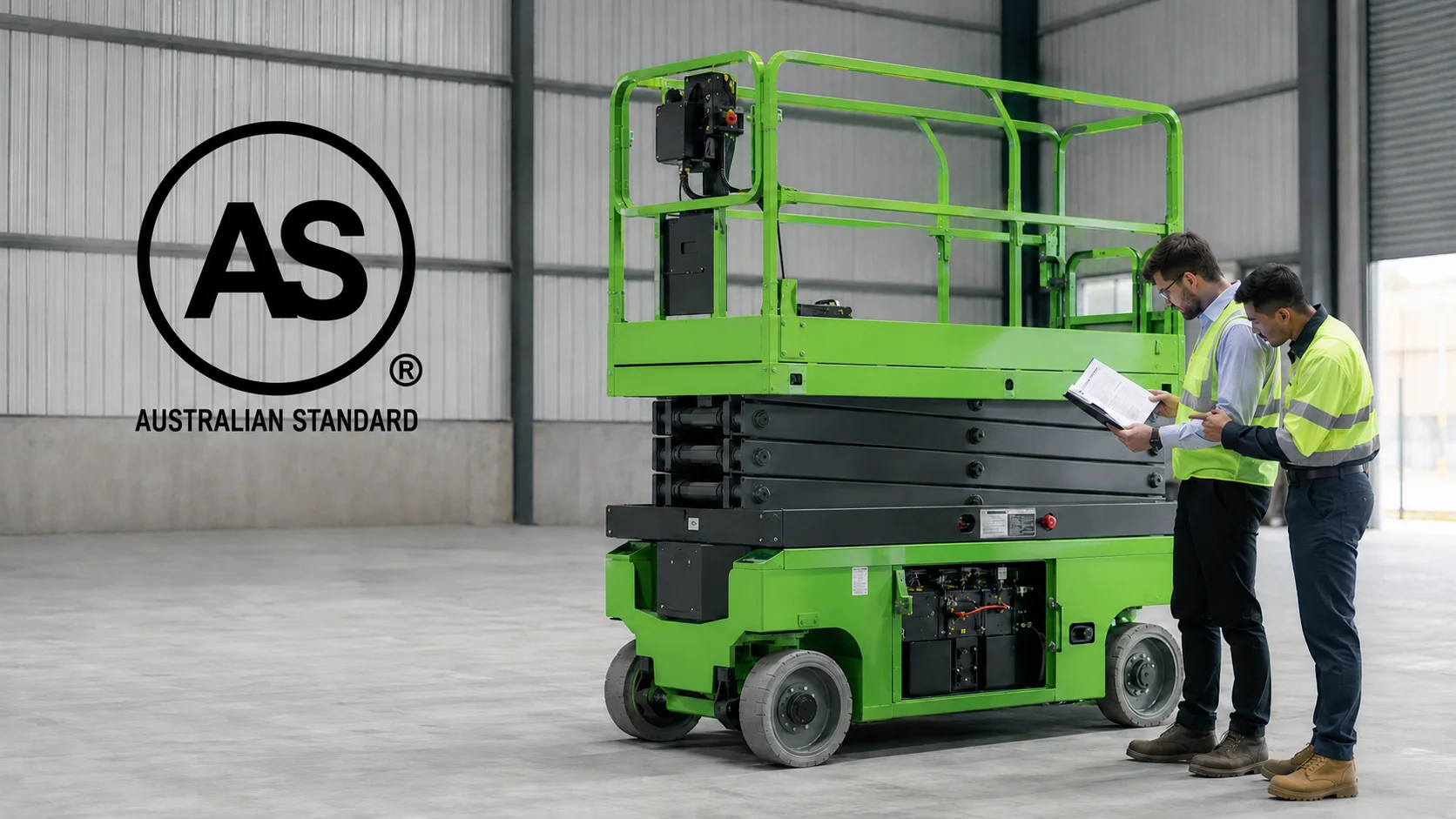
A container arrives at an Australian distributor’s yard. Inside is a new electric scissor lift. The supplier has provided an English manual, a factory test record and a brochure stating that the machine is “AS compliant”. For Australia AS standards for aerial work platforms, that claim needs to be tied to the machine actually being delivered.
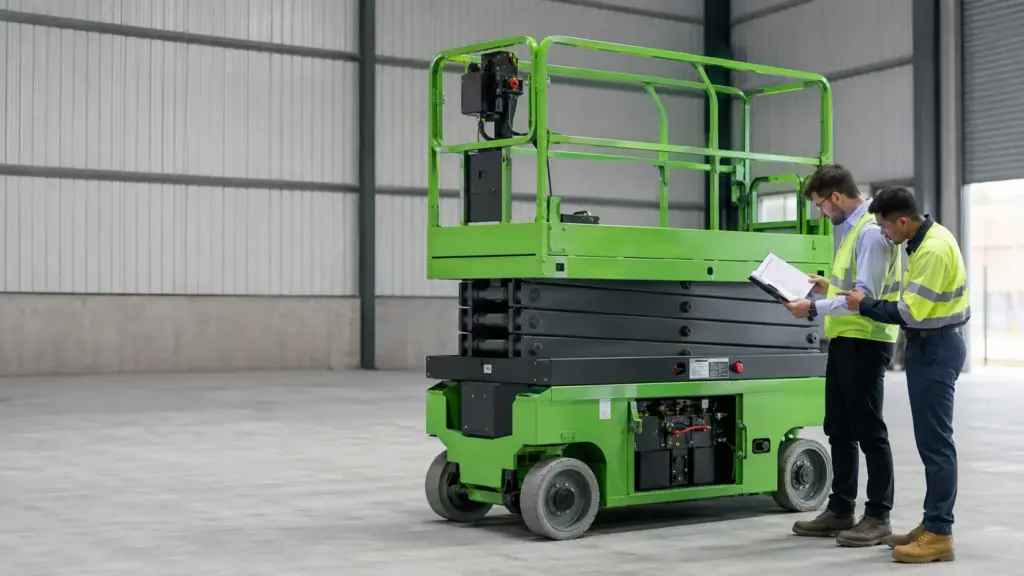
Before the unit is accepted into a rental fleet or released to a customer, the buyer still needs to establish three things:
- Which Australian standard applies to this machine and its final configuration?
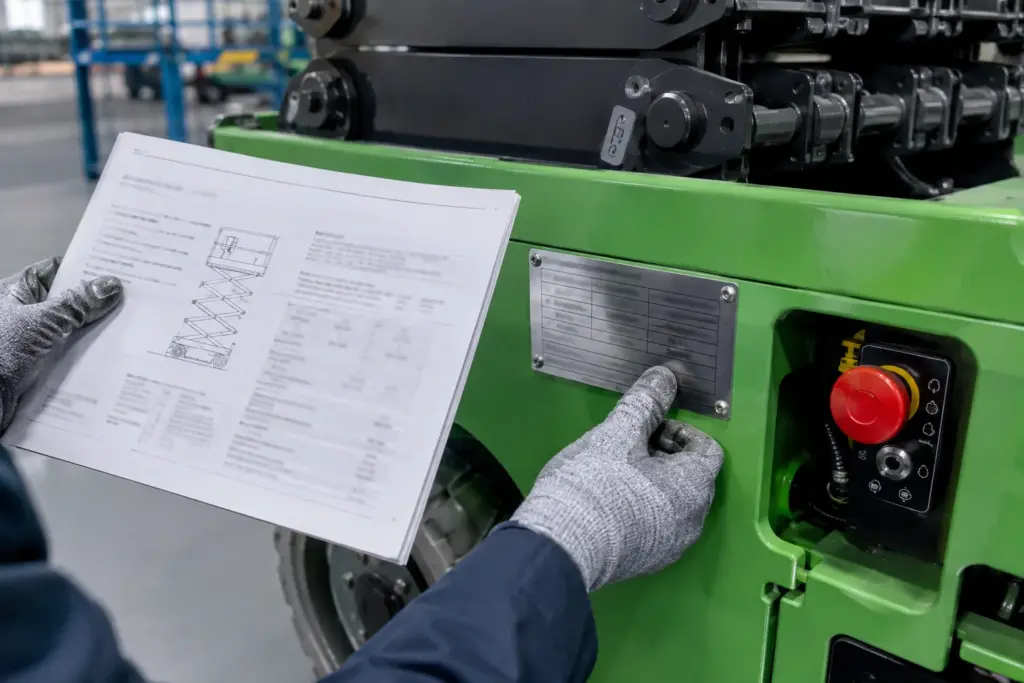
- Do the identification plate, capacity labels, manual and technical records describe the same unit?
- Which responsibilities remain with the importer, fleet owner, employer and jobsite after delivery?
This is where an “AS compliant” claim becomes more than a sales phrase. It becomes a question of machine definition, documentation and responsibility.
This guide is for Australian importers, distributors, rental fleets and industrial buyers sourcing mobile elevating work platforms (MEWPs), commonly called elevating work platforms (EWPs), from overseas manufacturers. It is not legal advice, operator training or a substitute for the WHS requirements that apply in the state or territory where the machine will operate.
AS Standards Are Not a Universal Equipment Certificate
Standards Australia develops Australian Standards. It does not issue a single product certificate that makes every aerial work platform automatically acceptable for every Australian project.
A buyer should separate four different layers:
| Layer | What it covers | What it does not establish |
|---|---|---|
| AS or AS/NZS standard | Technical or safe-use requirements for MEWPs | That a specific machine has been independently certified |
| Third-party assessment | Testing, inspection, audit or technical-file review | That later changes to the model are automatically covered |
| Manufacturer records | Manuals, drawings, labels, test records and inspection documents | That site training and risk assessment are complete |
| WHS and project requirements | Workplace duties, contract conditions and local rules | That a machine can be used safely in every environment |
A standard may be voluntary as a published document, yet still carry weight through a contract, rental agreement, insurance condition, project specification or local regulatory requirement.
The useful question is not, “Can you send an AS certificate?” It is, “Which standard and edition apply to this exact machine, and which records demonstrate that the supplied configuration matches the claim?”
Which Australia AS Standards for Aerial Work Platforms Apply?
For many Australian MEWP applications, two standards are particularly important: one addresses the machine’s design and construction; the other addresses how it is selected, managed and used.
| Standard | Main purpose | Practical relevance |
|---|---|---|
| AS/NZS 1418.10:2025 | Mobile elevating work platform design and construction | The engineering, safety and configuration basis of the machine |
| AS 2550.10:2025 | Safe use of mobile elevating work platforms | Selection, planning, operation, maintenance and personnel responsibilities |
AS/NZS 1418.10:2025 replaced the 2011 edition. It covers MEWP requirements generally and includes particular applications such as work near live electrical conductors and orchard work. Standards Australia highlights updates including a limit-states option for structural calculations, revised platform-deflection criteria for certain one-person indoor Group A MEWPs, and a reference to AS 5247 (ISO 21455 MOD) for operator controls. Standards Australia’s overview of AS/NZS 1418.10:2025
AS 2550.10:2025 is the current edition of the Australian safe-use standard for MEWPs, replacing AS 2550.10-2006. It addresses safe systems of work, management, planning, equipment selection, operation, maintenance and the selection of operators and auxiliary personnel. Current-edition listing
A buyer does not need to become a standards auditor. The point is to avoid treating the design standard as proof that the workplace has been made safe, or treating a site procedure as proof that the machine itself is correctly documented.
Define the Machine Before Reviewing the Claim
“Electric scissor lift” is a product category, not a final technical definition.
The same product family may be supplied with different platform dimensions, rated capacities, extension decks, batteries, chargers, tyres, controls, guardrail arrangements, travel restrictions or outdoor-use limits. Those differences can affect the machine plate, manual, test records and customer acceptance process.
Before placing an order, ask the supplier to confirm:
- Exact model designation and final configuration
- Working height, platform height, rated capacity and extension-deck limits
- Machine weight, tyres, gradeability and ground-use limitations
- Indoor or outdoor operating rating and maximum permitted wind conditions
- Battery, charger, controller and electrical-component configuration
- Emergency-lowering arrangement and relevant safety features
- Identification-plate artwork and serial-number format
- Operator, maintenance and inspection manuals matching the delivered version
- Factory inspection and functional-test records
- The process for notifying buyers of safety-related configuration changes
A catalogue can help with early product selection. It should not be the final evidence package for a shipment.
National Model Framework Does Not Mean One Identical Rulebook
Australia does not operate through one single national workplace-safety regulator. Safe Work Australia develops the model WHS Act, Regulations and Codes of Practice, while the Commonwealth, states and territories implement, regulate and enforce their own laws.
The distinction is material. Model WHS laws do not apply in a jurisdiction unless that jurisdiction separately implements them. Jurisdictions can also make variations. Victoria, for example, has not implemented the model WHS laws. Safe Work Australia’s legislation guidance
For an importer, the practical hierarchy is:
- National framework: Standards Australia and Safe Work Australia materials.
- State or territory regulator: The law, licence rules, adopted codes and enforcement position where the machine will operate.
- Customer or rental fleet: Internal acceptance procedures, inspection records and training requirements.
- Project owner or principal contractor: Site-specific documentation, rescue planning, traffic controls and construction requirements.
An AS-standard discussion is therefore only one part of Australian market readiness. It does not remove the need to verify the actual state or territory requirement before the unit is deployed.
Safe Use Is a Shared Responsibility
A manufacturer can provide machine-specific technical information. It cannot complete the site risk assessment on behalf of the customer.
Safe Work Australia identifies responsibilities for PCBUs, designers, manufacturers, importers, suppliers, equipment owners, persons with management or control, competent inspectors and operators. PCBUs must manage risks so far as is reasonably practicable and ensure workers receive appropriate information, instruction, training and supervision. Safe Work Australia: EWP WHS duties
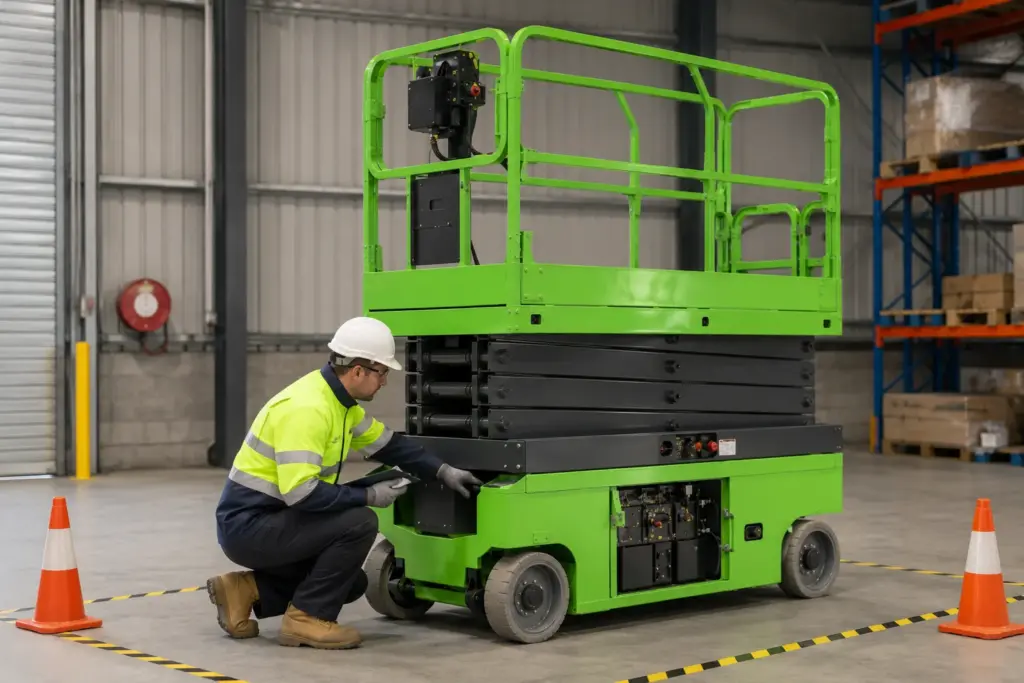
The local review should cover the conditions that actually exist around the machine:
- Ground bearing capacity, slopes, potholes and travel routes
- Overhead lines, structures and crushing or entrapment hazards
- Pedestrian, forklift and vehicle interaction
- Wind, rain, lightning and outdoor-use restrictions
- Exclusion zones, emergency retrieval and rescue planning
- Pre-use checks, maintenance status and defect reporting
- Operator familiarisation and site supervision
A machine can be correctly manufactured and still be the wrong choice for a wet, sloping, congested or wind-exposed worksite.
WP Licences: Verify the Applicable Local Threshold
Boom-type EWP licensing is an area where buyers should avoid casual wording in quotations.
Current regulator guidance commonly states that a WP high risk work licence applies to boom-type EWPs with a boom length of 11 metres or more. SafeWork NSW and WorkSafe WA both use that formulation, while the exact regulatory context and measurement guidance should be checked with the regulator where the machine will operate. SafeWork NSW WP licence guidance and WorkSafe WA EWP guidance
Scissor lifts, vertical lifts and boom-type EWPs below the applicable threshold are not automatically subject to the same WP licence requirement. That does not mean an untrained person can operate them. Employers and duty holders still need to ensure that workers have the correct information, instruction, familiarisation and competence for the particular EWP and task.
The EWPA Yellow Card is an industry training programme covering several MEWP categories. It can support operator competence, but it is not a substitute for a government-issued high risk work licence where a WP licence is required. EWPA Yellow Card programme
A Practical Importer Workflow
A disciplined compliance review does not need to be complicated. It needs to happen early enough that the quotation, production file and shipment documents remain aligned.
1. Describe the intended application
Provide the required working height, outreach, platform load, indoor or outdoor environment, ground condition, access constraints, weather exposure and intended use.
2. Lock the final configuration
Confirm the model, platform, capacity, battery, charger, controls, tyres, guardrails, safety options and any private-label requirements before production.
3. Confirm the standards discussion
Identify the relevant design and safe-use framework. For specialised use, such as electrical-proximity work, orchard use or a highly regulated project, obtain a specific local review rather than relying on the general product description.
4. Request the evidence pack
Ask for the records that match the final machine, not the broader product family.
5. Review consistency before shipment
Check that the specification, identification plate, manual, inspection record, product photographs and shipping paperwork describe the same configuration.
6. Allocate Australian-side responsibilities
Agree who is responsible for delivery inspection, maintenance planning, inspection records, operator competence, rescue arrangements, future safety notices and response to configuration changes.
7. Keep configuration control after the first order
A later order with a different battery, charger, control system, platform size or guardrail arrangement should not be treated as identical merely because the model name has not changed.
For Australia AS standards for aerial work platforms, the most useful compliance review starts before the purchase order is released.
Frequently Asked Questions
Is an AS certificate required for every aerial work platform sold in Australia?
There is no one universal AS certificate for every MEWP. The relevant requirements depend on the machine, its intended use, the applicable standards, local WHS law, customer requirements and project conditions.
What is the difference between AS/NZS 1418.10:2025 and AS 2550.10:2025?
AS/NZS 1418.10:2025 concerns MEWP design and construction. AS 2550.10:2025 concerns safe use, including planning, equipment selection, operation, maintenance and personnel responsibilities. Both may be relevant, but they address different parts of the compliance picture.
Is CE documentation enough for an Australian buyer?
No. CE documents can be useful engineering background, but they do not automatically establish Australian project acceptance, workplace compliance, local operator requirements or site suitability. The final review must be based on the actual machine, its configuration and the jurisdiction where it will operate.
What documents should an Australian importer request from an overseas MEWP manufacturer?
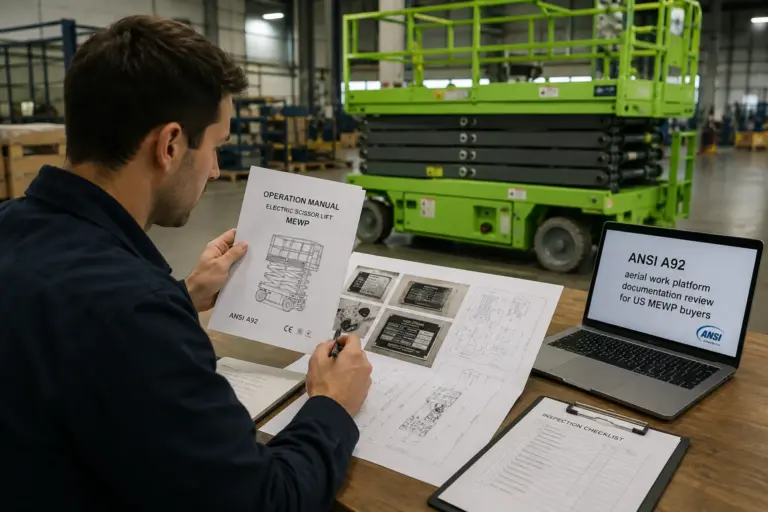
Request the final specification sheet, machine identification-plate details, operating and maintenance manuals, factory inspection and functional-test records, safety-device information, emergency-lowering information, configuration records, serial-number traceability and written confirmation of any applicable technical standard or assessment route. For specialised or project-controlled applications, ask early whether additional documents will be needed.
Does every EWP operator need a WP high risk work licence?
No. The licensing requirement is commonly associated with boom-type EWPs at the applicable 11-metre threshold. Other EWP operators must still be trained, familiarised and competent for the machine and work environment. Confirm the requirement with the relevant state or territory regulator.
Is an EWPA Yellow Card the same as a WP licence?
No. The Yellow Card is an industry training programme. It does not replace a government-issued WP high risk work licence when the work falls within the applicable licensing requirement.
Can a supplier change components after the buyer has reviewed the documents?
Safety-related changes should be disclosed and reviewed before production or shipment. Changes to platform dimensions, capacity, guardrails, batteries, chargers, controls, emergency-lowering components or software may affect the documentation, customer approval and safe-use plan.
Australian AS-standard preparation starts with the machine definition, not with a certificate request after shipment.
Before asking for a quotation, send Chenlift the intended model, working height, platform capacity, operating environment and required configuration. We can review the technical specification and documentation requirements for that machine before production, then check that the delivered unit, identification plate, manual and order records remain aligned before shipment.
Official references: Standards Australia, Safe Work Australia legislation guidance, Safe Work Australia EWP duties, SafeWork NSW, WorkSafe WA, and EWPA.