
Does an Aerial Work Platform Need a PVoC Certificate of Conformity for Kenya?
Not necessarily — and that is the more useful answer.
The first question is not “do we need a CoC?” It is whether your machine falls under Kenya’s PVoC requirements at all, or under one of the applicable exemptions. Those routes lead to different documents, different costs and different failure modes.
There is a second reason to be careful. Kenya’s PVoC framework carries several related instruments at once: a pre-export verification programme, a mobile equipment category with its own treatment, a schedule of exemptions, and a destination-inspection procedure for goods that arrive without a certificate. Kenya’s own published definitions do not name aerial work platforms in the mobile equipment list. So the machine’s classification, not its general appearance as “lifting equipment”, is what determines the route.
Get that classification settled before you book freight. After the vessel sails, your options narrow to destination-side procedures.

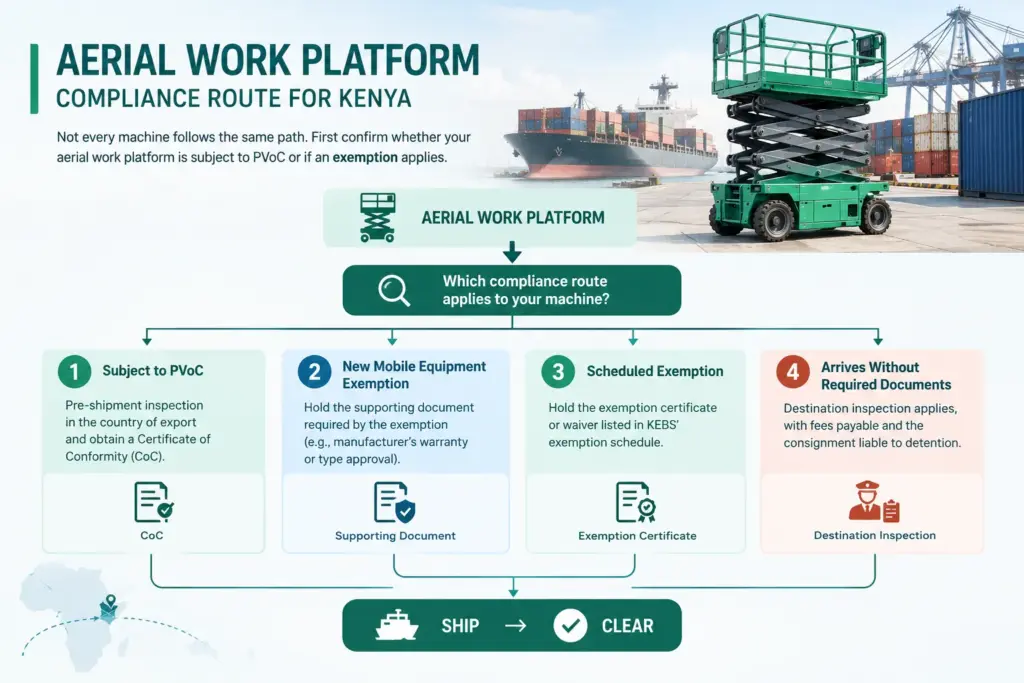
The short answer: check the compliance route before you ship
Work through this in order.
Step 1 — Is the machine subject to a PVoC requirement?
If it is, a Certificate of Conformity (CoC) is obtained in the country of export, before shipment.
Step 2 — If not, does an exemption apply?
Kenya’s framework provides both a general exemption for new mobile equipment and a schedule of specific exempted categories. Each has its own supporting documents.
Step 3 — Follow the matching route:
| If the machine is… | Then… |
|---|---|
| Subject to PVoC | Pre-shipment inspection in the country of export →CoC → ship → clear |
| Covered by the new mobile equipment exemption | Hold the supporting document the exemption requires → ship → clear |
| Covered by a scheduled exemption | Hold the exemption certificate or waiver → ship → clear |
| Arriving without any of the above | Destination inspection applies, with fees payable and the consignment liable to detention |
The rest of this article deals with how to tell which row you are in, and what each one needs.
Why aerial work platforms need a classification check
It is natural to reason that a scissor lift is construction machinery, construction machinery is regulated, therefore a CoC is required. That chain has a weak link: Kenya does not define the relevant category that way.
Kenya’s published glossary defines Mobile Equipment as used trailers, bulldozers, agricultural tractors, excavators, graders, moveable cranes and off-road vehicles.
Two things follow, and both matter.
Aerial work platforms are not named in that definition. Nor are forklifts or wheel loaders. Machine categories are not an open-ended list of anything that moves — if a product is not named, you cannot assume it is inside.
The definition is written around used equipment. That is not a drafting accident. The same framework handles new and used mobile equipment through different routes, and the practical test is the machine’s condition and documentation, not its type alone.
So do not decide on either of these grounds:
- “The machine travels on wheels, so it is mobile equipment” — the category is defined by an enumerated list, not by mobility.
- “It is machinery, so it needs a CoC” — machinery as a general category is not what the requirement turns on.
What actually settles it is the classification assigned to the specific machine, together with the route KEBS applies to it. That is a question for KEBS or an appointed inspection body, not one to resolve from a product brochure.
The mobile equipment exemption — what it actually says
This is the part most buyers have never read, and it changes the whole calculation.
Kenya’s destination inspection guidance states:
Pursuant to the provisions of Legal Notice No. 78 of 28th April 2020; All new motor vehicles and new mobile equipment are exempted from PVOC requirements on condition that they are accompanied with a Manufacturer’s warranty or type approval Certificate.
The supporting document is therefore not a CoC. It is a manufacturer’s warranty or a type approval certificate.
Alongside that, the same guidance sets out the used-equipment route: for used motor vehicles, mobile equipment and spare parts arriving from Japan, Singapore, South Africa, Thailand, the United Arab Emirates and the United Kingdom, KEBS has contracted an inspection company to handle certification, and those consignments require a Certificate of Roadworthiness or Certificate of Conformity issued before shipment.
So the framework is not “all mobile equipment is inspected” or “all mobile equipment is exempt”. Condition drives the route:
| Question | What to establish |
|---|---|
| Is the equipment new or used? | Condition of the machine and the commercial documents |
| Is it treated as mobile equipment for this purpose? | Classification, given that the published list does not name aerial work platforms |
| Which document supports the route? | Manufacturer’s warranty / type approval, or CoC / CoR, or an exemption certificate |
| Who confirms the route? | KEBS or the appointed inspection body — not the supplier alone |
Do not assume a new scissor lift automatically qualifies. The exemption is written for new mobile equipment, and whether a particular aerial work platform is classified that way is exactly the question to put to KEBS. Equally, do not accept the opposite claim — that all such machines must have a CoC — without the same confirmation. Both shortcuts skip the step that decides the outcome.
If you want to pursue the exemption route, ask your supplier for the manufacturer’s warranty or type approval documentation in the form the importing side can present, and confirm with KEBS that it is the right instrument for that machine.
There is also a scheduled exemption list
Separately from the mobile equipment provision, Kenya publishes a schedule of categories exempt from PVoC. The relevant entry for industrial buyers covers:
Industrial raw materials, completely knocked down kits for road vehicles, machinery and industrial spares imported by registered manufacturers for own use
This route is conditional and documentary rather than automatic. The applicant has to demonstrate a quality track record, proof that the imported material is transformed into a finished product, certification to a quality management system, registration as a manufacturer or under bond, and manufacturing authorisation from other agencies. There is an application fee, and the exemption certificate is issued for a fixed period and must be renewed.
For an end user importing a machine for its own operations, this may be the applicable route. For a distributor, dealer or rental operator, it generally is not — the exemption is built around manufacturers importing for their own use.
If PVoC applies, what happens
For consignments that are PVoC-regulated, the practical sequence is:
- The importer raises the IDF (Import Declaration Form) and provides it to the exporter. Nothing downstream starts without it.
- The conformity process begins in the country of export, with an inspection body appointed by KEBS.
- Inspection and document review take place before loading.
- The draft certificate is confirmed, then the CoC is issued against that consignment. KEBS requires the importer or exporter to confirm the details in the draft CoC within 48 hours of receiving it, and does not allow amendments once the final certificate has been issued. Freeze the model designation, quantities and values before the draft arrives — not after.
- The Certificate of Origin and other import documents are prepared, consistent with the CoC.
- The goods ship.
- Clearance proceeds against the certificate.
The sequencing point is structural: PVoC means verification before export, so the certificate is obtained at the port of loading. It is not a step that can be added at the destination, which is why the classification decision has to be made early.
What changed in Kenya’s PVoC system in 2026 — and why older guides mislead
Three things have moved recently enough that guidance written in 2024 or early 2025 can be wrong.
The operational manual has been revised. Kenya publishes an operational manual for the programme, and the current version is dated 2026. If a supplier or agent is quoting a procedure from an earlier edition, ask which version the quote comes from.
The inspection bodies have changed. The body handling your file is not a matter of supplier preference — KEBS allocates contractors by zone, and China sits in the first zone alongside Hong Kong, Taiwan and Mongolia, with several contractors responsible. Critically, KEBS’ own pages do not list identical sets of contractors. One page carries a zone table naming several bodies for the China zone; another lists a shorter set. Before assuming a particular company still holds the mandate, check the current allocation on KEBS’ site or ask KEBS directly. Do not rely on a list copied from a trade article, including this one — the point is that the list is a moving target and should be verified at the time of shipment.
Mobile equipment is handled separately from general goods. The programme distinguishes general goods from motor vehicles, mobile equipment and used spares, and the contractor arrangements differ between them. A supplier who has shipped general cargo to Kenya before may not have dealt with this category at all.
The practical takeaway is not a list to memorise. It is that the route and the counterparties should both be confirmed against KEBS’ current published material at the time of the shipment.
Documents to prepare before shipping
If PVoC applies
- Import Declaration Form (IDF) raised by the importer
- Commercial or proforma invoice
- Product technical documents and specifications
- Certificate of Conformity issued in the country of export
- Certificate of Origin
- Manufacturer information and authorisation, where applicable
- Machine model and nameplate details, consistent across documents
- HS classification confirmed with the clearing agent
If an exemption is being claimed
- The instrument the exemption rests on — manufacturer’s warranty, type approval certificate, exemption certificate or waiver, as applicable
- Evidence supporting the equipment’s classification
- Import documentation consistent with that classification
- Confirmation from KEBS or the inspection body that the route applies, in writing
If the goods may arrive without a CoC
Destination inspection is a defined procedure, not an informal negotiation. Under Legal Notice No. 78 of 2020, paragraph 9, a product arriving at a port of entry without a certificate of conformity, certificate of inspection or certificate of roadworthiness is subject to destination inspection at a fee equal to five per cent of the approved customs value, and where the goods are held in an approved warehouse the importer must additionally execute a security bond equal to a further five per cent of that value. The consignment is held at the port or in an approved warehouse for inspection and testing.
It also ends in a determination. Compliant goods receive a certificate and move on. Goods that do not conform receive a non-conformity report and are not permitted to be imported — they must be re-exported to the exporting country or destroyed, in both cases at the importer’s expense.
Treat this as a fallback with real costs, not a route to plan around.
Why the model, HS code and commercial documents must agree
This is where shipments stall even when the certificate itself is fine.
An aerial work platform tends to pick up several different designations before it reaches the port: a model code on the quotation, a longer description in the technical documentation, a short form on the packing list, and possibly another variation on the invoice. When a certificate references one form and the customs entry uses another, the file is queried — and queries cost time.
Three points to align before shipping:
- Model designation — one string of characters, used identically on the invoice, packing list, certificate and nameplate.
- HS classification — confirmed with the clearing agent for the specific machine. Self-propelled lifts and vehicle-mounted platforms do not necessarily fall in the same heading, so treat any single “standard” code with suspicion.
- Values and quantities — consistent across invoice, IDF and certificate.
None of this is unusual for an import file. It is simply where the avoidable delays come from.
How a Kenyan buyer should verify a supplier’s compliance claim
“The machine is certified” carries no information, because the question is which route applies. Ask these before placing the order:
- Is this machine being treated as PVoC-regulated goods or as exempt mobile equipment?
- If exempt, what document supports the exemption — manufacturer’s warranty, type approval, or an exemption certificate?
- If PVoC applies, which inspection body will handle the shipment, and is it currently allocated to this zone?
- Who applies for the inspection, and who pays for it?
- Who prepares the IDF, and when?
- What exact model designation will appear on the certificate, the invoice and the nameplate?
- Which HS classification is being used, and who confirmed it?
- Who carries the cost if the shipment is held because the compliance route was wrong?
A supplier who has shipped this category before will answer these specifically. A supplier who has only shipped general cargo will reach for “we handle PVoC” — which is the answer that tells you nothing.
The same logic applies in other markets that run their own import conformity regimes. Nigeria applies a comparable two-document structure under SONCAP certification for aerial work platforms, and India’s position on BIS certification for scissor lifts turns on the same question of which requirement applies to the exact machine.
Other Kenya import documentation to watch in 2026
PVoC is one part of the documentation chain, and two recent additions affect Chinese suppliers directly.
Certificate of Origin. Kenya has required a Certificate of Origin on imports, with the requirement enforced in stages from mid-2025. Its details must be consistent with the other import documents.
Export documentation from the country of export. Under Kenya’s Finance Act 2026, from 1 September 2026 importers must obtain and retain an export declaration, export entry, customs export certificate or equivalent document from the country of export, and keep the records for at least five years. The document is expected to show exporter, importer, goods description, quantity, value, tariff classification and country of export, and to be produced on request by the Kenya Revenue Authority.
This one lands on the supplier’s side of the transaction. If you are procuring from China, establish early who will produce the Chinese export documentation and in what form, because without it the importer’s ability to support value, origin or exemption claims can be affected.
Frequently Asked Questions
Does every aerial work platform imported into Kenya need a PVoC Certificate of Conformity?
No. The requirement depends on whether the machine falls under PVoC or under an applicable exemption. Kenya’s framework exempts new motor vehicles and new mobile equipment from PVoC requirements where a manufacturer’s warranty or type approval certificate accompanies the consignment, and separately provides a schedule of exempted categories. Whether a specific aerial work platform falls into one of these depends on its classification, which should be confirmed with KEBS.
Are new mobile equipment exempt from PVoC in Kenya?
The published guidance exempts new motor vehicles and new mobile equipment from PVoC requirements, conditional on a manufacturer’s warranty or type approval certificate. However, the published definition of mobile equipment names specific machine types — used trailers, bulldozers, agricultural tractors, excavators, graders, moveable cranes and off-road vehicles — and does not include aerial work platforms. Do not assume the exemption applies to a specific lift without confirming the classification.
Can a manufacturer’s warranty support a PVoC exemption?
It is the document named in the published guidance for the new mobile equipment exemption. It has to be a manufacturer’s warranty in a form the importing side can present, and the route itself should be confirmed with KEBS for the specific machine.
What happens if PVoC applies and the machine ships without a CoC?
The consignment falls into destination inspection at the port of entry, at a fee equal to five per cent of the approved customs value, with a further five per cent security bond where the goods are held in an approved warehouse. Compliant goods receive a certificate and are released; non-conforming goods are not permitted to be imported and must be re-exported or destroyed at the importer’s expense. It is a costly fallback, not a workaround.
Can a CoC be corrected after it is issued?
No. KEBS allows the importer or exporter 48 hours to confirm the details in the draft certificate, and does not permit amendments once the final CoC is issued. That is why the model designation, quantities and values should be settled before the draft reaches you.
Does a CE certificate replace a Kenyan CoC?
No. CE demonstrates conformity to a different regulatory framework and is not accepted in place of the Kenyan requirement. It can support the technical file, but it does not determine the Kenyan route. For how CE itself is structured and what a buyer should verify, see our CE compliance guide for aerial work platforms.
Who should confirm the compliance route before shipment?
KEBS, the appointed inspection body for the relevant zone, and the Kenyan clearing agent — together, before freight is booked. Treat any single-party assurance, including a supplier’s, as a starting point rather than a conclusion.
Before booking freight, establish the applicable compliance route for the exact machine, its HS classification and the shipment. If you are purchasing an aerial work platform from Chenlift, we can provide the machine’s technical and commercial documentation for your inspection, customs and compliance process — our Kenya market page sets out the ranges we supply to the market.
Official References
- Kenya Bureau of Standards — Pre-Export Verification of Conformity (PVoC) programme and operational manual: https://kebs.org/pre-export-verification-of-conformity/
- KEBS — Destination Inspection: the new mobile equipment exemption, the used-equipment inspection arrangements, and the 5% destination inspection fee: https://inspection.kebs.go.ke/destination-inspection/
- KEBS — PVoC Exemptions, including the schedule of exempted categories and exemption application fees: https://inspection.kebs.go.ke/pvoc-exemptions/
- KEBS — PVoC Contractors and zones of responsibility: https://inspection.kebs.go.ke/pvoc-contractors/
- KEBS — PVoC Overview: the 48-hour draft certificate confirmation rule and the no-amendment-after-issuance rule: https://inspection.kebs.go.ke/pvoc-services/
- Legal Notice No. 78 of 2020 — destination inspection fee and security bond (paragraph 9), official consolidated text on Kenya Law: https://new.kenyalaw.org/akn/ke/act/ln/2020/78
- Kenya Revenue Authority — Finance Act 2026: new documentation requirement for imports, effective 1 September 2026: https://www.kra.go.ke/finance-act-2026-what-it-means-for-you
*Editorial note: Kenya’s PVoC arrangements, the inspection bodies allocated to each zone, and the exemption schedule have all changed in recent years. Published lists are not always consistent between pages, and this article is a practical overview rather than a legal opinion or a customs ruling. Confirm the applicable route, the current contractor, and the required documents with KEBS, the appointed inspection body and your clearing agent before you ship.