Aerial Work Platform Selection: Start with the Work Path, Not the Height
The first question in aerial work platform selection is often: “How high do we need to go?”
It is an understandable place to start, but it is not enough. A machine can meet the required working height and still fail the job because it cannot enter the building, stand beneath the work point, reach over fixed equipment, or carry the people and materials needed on the platform.
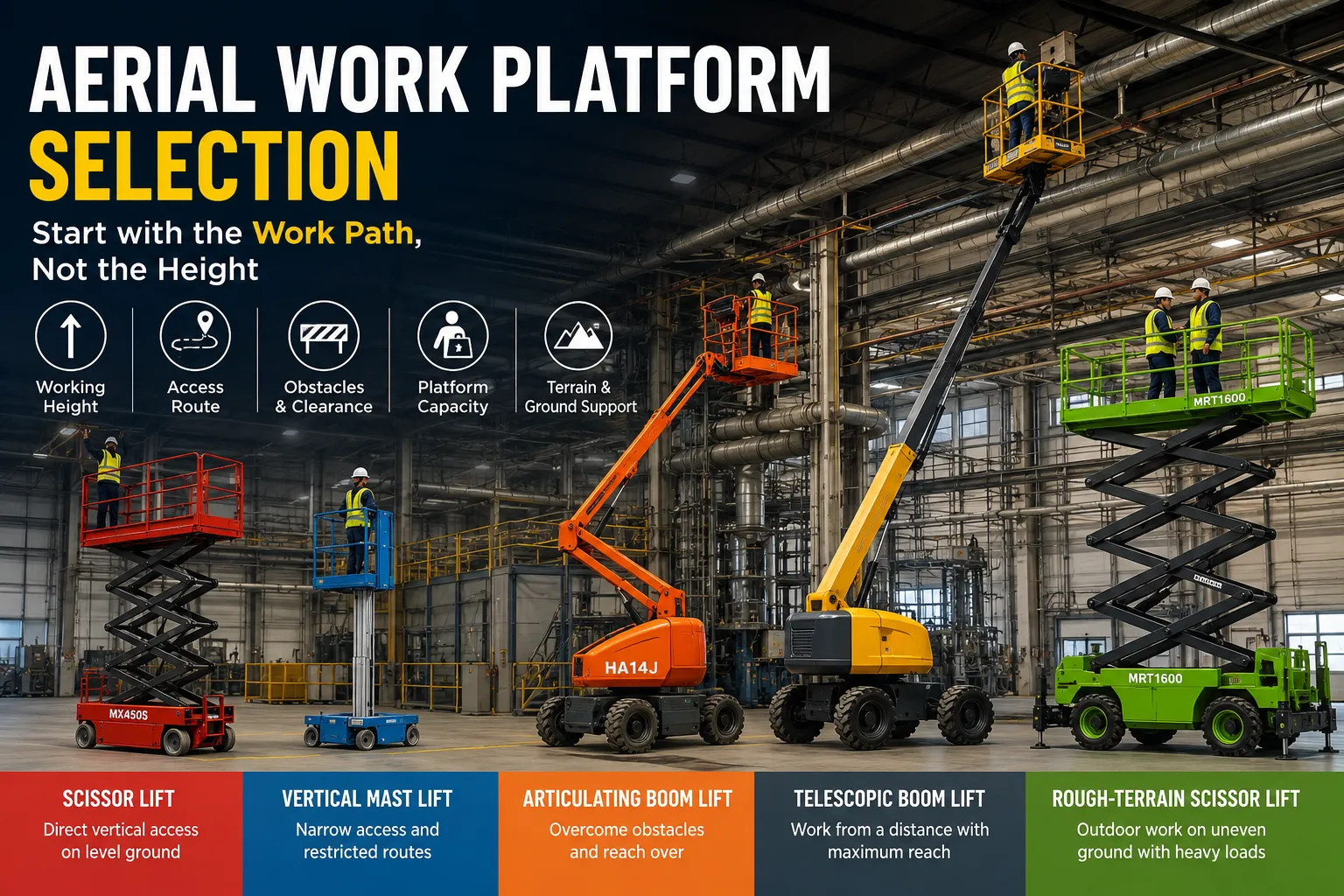
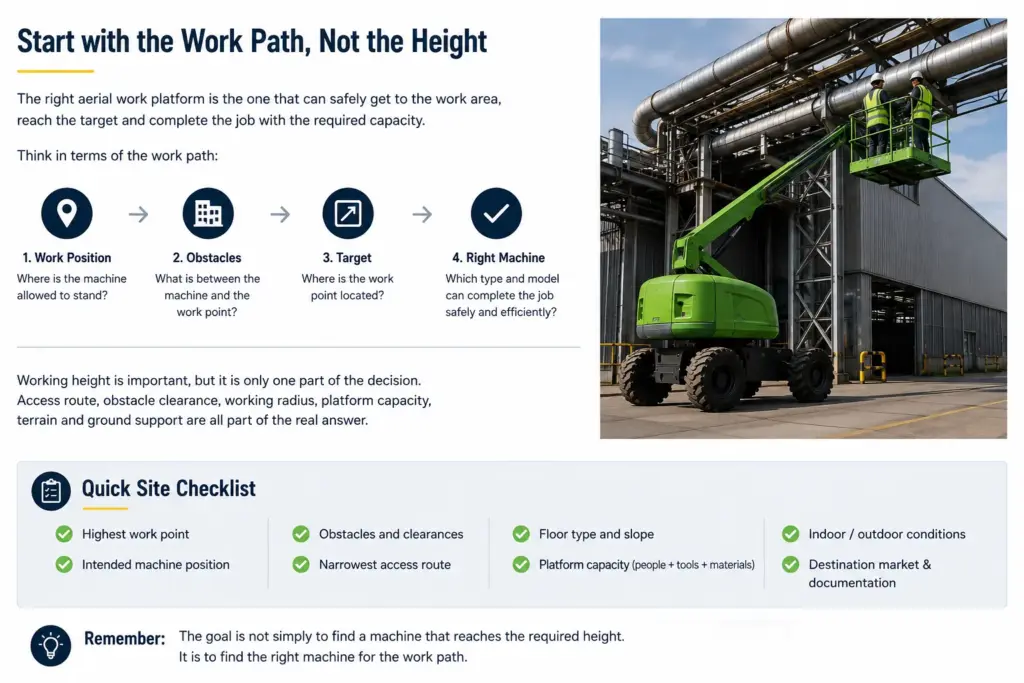
A more reliable selection process starts with the work path. Where can the machine safely stand? Is the work point directly above that position, behind an obstruction, or set back from it? Once that is clear, the difference between a scissor lift, vertical mast lift, articulating boom lift and telescopic boom lift becomes much easier to judge.
Aerial work platform selection starts with the actual work position
Before looking at models, define three things: the highest point the operator needs to reach, the area where the machine can safely be positioned, and any obstacle between those two points.
This distinction matters in practice. A factory may have pipework at 14 metres, but a 14-metre scissor lift is not automatically the right choice. If fixed production equipment sits below the pipework, the machine cannot stand directly underneath it. The issue is no longer vertical height. It is whether the platform can pass over the obstruction and reach the work point from a clear position on the floor.
The same applies to exterior work. When a boom lift must remain behind a barrier, drainage channel, landscaped area or restricted process zone, horizontal reach may matter more than maximum height.
| Site condition | First machine type to compare | Example from CHENLIFT range | What matters most |
| The work area is directly overhead and the floor is level | Self-propelled scissor lift | MX Mini Series | Platform height, deck space, access width and load |
| Indoor access is narrow or the route is restricted | Vertical mast lift | MG Series | Stowed width, height, turning space and platform capacity |
| The platform must pass over machinery, racking or services | Articulating boom lift | HA14J Electric Articulating Boom Lift | Up-and-over clearance and working radius |
| The machine must remain far from the target | Telescopic boom lift | HTJ Series | Horizontal working radius and work envelope |
| The work is outdoors on uneven ground with people and materials on the platform | Rough-terrain scissor lift | MRT Series | Terrain, platform capacity, ground support and levelling limits |
Working height is only one of the measurements
Buyers often use “working height” as a general description of how high a lift can go. It is useful for initial screening, but it should not replace a proper site measurement.
Working height normally describes the maximum height at which an operator can work from the platform. Platform height refers to the height of the platform floor above ground level. Machine height, usually given as stowed height, affects whether the equipment can pass through doorways, enter service corridors or travel inside a building.
For projects involving booms, horizontal reach is another essential figure. A lift can have sufficient working height but still be unable to reach the target if the base must remain away from the work area. That is why site drawings should show both vertical and horizontal dimensions whenever possible.
This is especially relevant where work is carried out above production lines, storage systems, rail infrastructure, loading areas or landscaped spaces. A height requirement alone does not show whether the machine can be positioned safely or whether the platform can follow a usable route to the task.
Scissor lifts for direct vertical access
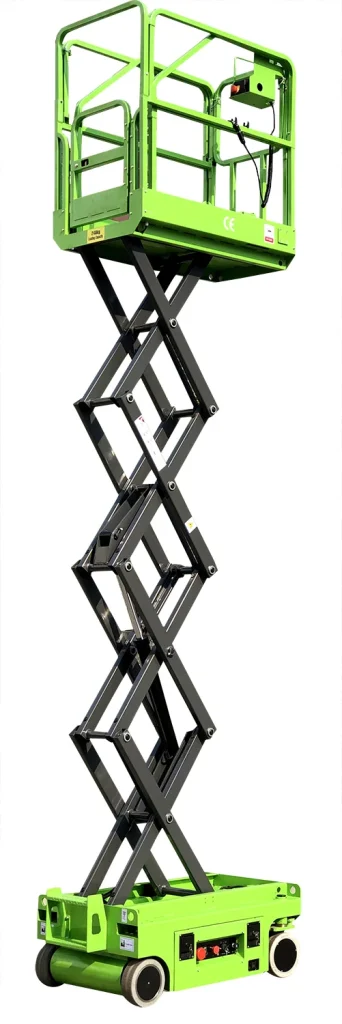
A scissor lift is usually the right starting point when the work area is directly above a clear, level position on the floor. Typical examples include warehouse lighting, ceiling services, racking work, indoor installation and routine maintenance where the machine can be placed below the task.
The strength of a scissor lift is not simply vertical travel. It is the usable deck space it provides for operators, tools and materials. That makes it more practical than a small platform when the work takes time or requires repeated handling of equipment.
However, a scissor lift has a clear limitation: it cannot solve an obstacle problem. If machinery, racking or pipework prevents the chassis from standing below the target, the machine may have sufficient height but no workable access path.
The CHENLIFT MX Mini Series is a useful example for compact indoor work. The MX300S, MX390S and MX450S provide working heights of 5.0 m, 5.9 m and 6.5 m respectively, with a 240 kg platform capacity and an overall width of just 0.76 m. In a warehouse aisle or a retail maintenance route, that narrow footprint can be more valuable than a small increase in working height.
The range also has a 0.55 m platform extension rated for 100 kg. This should be treated as a separate planning point, not as an extension of the platform’s total rated capacity. The placement of operators, tools and materials must remain within the documented limits for both the main deck and extension section.
For higher indoor work requiring more platform space, the MX1000S reaches 11.8 m with a 320 kg platform capacity and a 2.30 × 1.15 m deck. It offers a different balance: more room and capacity, but a larger machine that requires more careful route and floor assessment.
Narrow routes: where mast lifts make sense
Some access problems are decided before the machine reaches the work area. A service doorway, warehouse aisle, lift entrance or tight turn around racking may rule out a larger machine even when there is enough space at the final work point.
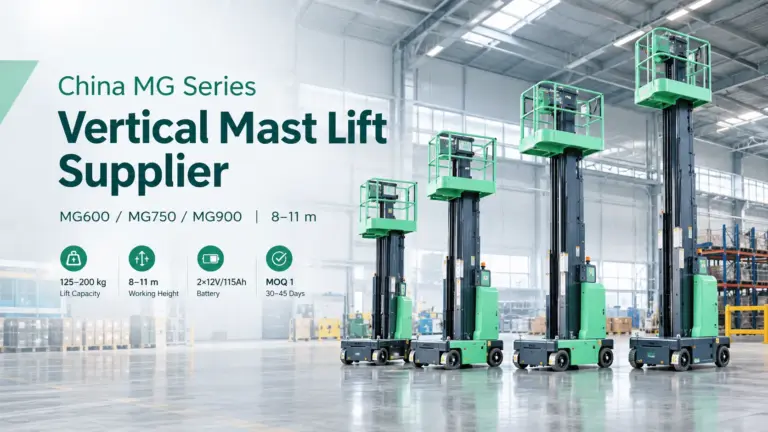
This is where a vertical mast lift can be more appropriate. The MG Series covers working heights from 8 m to 11 m, with stowed widths from 0.79 m to 1.0 m. Depending on the model, platform capacity ranges from 125 kg to 200 kg.
These dimensions make the range relevant for lighter indoor maintenance and constrained access routes. They do not make a mast lift a replacement for every scissor lift. Buyers still need to consider platform area, expected materials and the way the task will actually be performed. A narrow machine may reach the location easily but prove inefficient if the work requires a substantial amount of equipment.
The most useful site check is therefore not “Can the machine fit through the door?” It is whether the entire route works: doorways, turns, ceiling restrictions, floor loading, gradients and the space available to position the machine safely at the task.
Working over obstacles with an articulating boom
An articulating boom lift becomes relevant when the work point cannot be approached from directly below. The machine may need to stand beside process equipment, pass over a pipe rack, reach above storage racking, or approach a façade from behind an obstacle.
The CHENLIFT HA14J Electric Articulating Boom Lift reaches 16 m working height, but its more useful selection figures are the 7.54 m up-and-over clearance and 7.5 m working radius. Those measurements help answer the question that matters on a congested site: can the platform reach the work point without placing the chassis in an unsafe or impossible position?
With a 230 kg platform capacity, the HA14J can suit many maintenance and infrastructure tasks involving operators, tools and materials, provided the combined load remains within the rated limit. Its 1.75 m stowed width and 7,070 kg operating weight still need to be checked against the site route and floor conditions before it is proposed for an indoor project.
An articulating boom should be selected from the obstacle geometry, not because it appears more versatile than a scissor lift. A boom that reaches the right height may still follow the wrong path if its work envelope does not match the position of the obstruction.
When working radius matters more than height
A telescopic boom lift is generally used when the machine has to remain farther from the work point. This is common on building exteriors, bridges, industrial structures and sites where barriers, ground conditions or operating zones prevent close positioning.
The CHENLIFT HT16J electric telescopic boom lift provides 18 m working height with an 11.9 m maximum working radius. Larger models such as the HT20J, HT22J and HT26J extend that horizontal reach to 14.65 m, 17 m and 21 m respectively.
The difference is important because working height tells you how high the platform can reach, while working radius determines how far it can work from the machine’s position. A request for “an 18-metre lift” is therefore incomplete. One project may require access directly above a clear standing position; another may require the machine to stay well away from the target. The first may suit a scissor lift or an articulating boom lift, while the second may require the longer outward reach of a telescopic boom lift.
Machine dimensions remain part of the same decision. The HT16J is 8.5 m long, 2.31 m wide and 2.51 m high when stowed, with a 7,900 kg operating weight. These figures should be checked against the transport route, turning space and ground conditions before the working-height figure becomes relevant.
Indoor power and site access should be reviewed together
For indoor projects, equipment selection is not only about machine dimensions. Power source, emissions, noise, charging arrangements and the operating schedule can influence which models are practical.
Battery-powered equipment is commonly considered for enclosed facilities, warehouses, retail environments and maintenance areas where on-site exhaust emissions are restricted or undesirable. That does not remove the need to plan charging. The site should confirm where the machine will be charged, whether the available power supply is suitable, and whether the duty cycle matches the intended work schedule.
Machine access should be reviewed at the same time. A lift may fit through the main doorway but still be unable to make a turn in a corridor or clear a lower doorway farther along the route. Stowed dimensions, turning radius and travel path should be confirmed before the machine arrives on site.
For projects involving freight lifts or raised slabs, the machine’s operating weight and the lift or floor’s rated capacity also need to be checked by the responsible site party. This is particularly important for boom lifts and rough-terrain equipment, which can be significantly heavier than compact indoor models.
Rough-terrain work requires more than gradeability
On outdoor projects, gradeability is often treated as the headline specification. It should not be.
Gradeability describes the slope a machine can travel on when it is stowed and under the conditions defined by the manufacturer. It does not mean that the platform can be elevated and operated safely on a slope of the same value.
The MRT rough-terrain scissor lift range is designed for projects that need more deck space and higher platform capacity on demanding outdoor sites. The MRT800 reaches 10 m working height with a 567 kg platform capacity, while the MRT1600 reaches 18 m with a 680 kg capacity. Their larger decks, rough-terrain tyres and levelling outriggers can be useful where several operators and materials need to work at height.
Even so, elevated operating limits remain much tighter than travel capability. Both models use tilt sensor settings of 3° front-to-back and 1.5° side-to-side, despite their higher listed stowed gradeability. The MRT1600 weighs 9,010 kg with outriggers, which makes site access, unloading arrangements and ground support conditions part of the selection process from the beginning.
A factory maintenance example
Consider pipework maintenance at approximately 14 m inside a factory. The pipework runs above fixed production equipment, so the machine cannot stand directly below the task. Operators need to work from the platform with hand tools, and the site requires electric operation.
A 14 m scissor lift may initially appear to be the obvious choice. Once the production equipment beneath the pipework is considered, however, that choice changes. The job requires the platform to reach over an obstruction rather than rise directly below the work point.
The HA14J is then a sensible model to assess because its 7.54 m up-and-over clearance and 7.5 m working radius may provide the needed path. The next step is not to assume suitability, but to compare the obstacle geometry with the actual work envelope, confirm that the 230 kg capacity covers the expected platform load, and verify that the access route can accommodate the machine.
If the chassis must remain farther from the work point, a telescopic boom with greater horizontal radius may become the better option. If the area below the work point is clear and the task requires a larger platform for materials, a scissor lift may again be preferable. Good aerial work platform selection comes from site measurements and the required work path, not from the product category name.
What a useful quotation request should include
A request for “a 12 m lift” leaves too much to guesswork. The supplier should receive the highest work point, the intended machine position, the horizontal distance between them, and photographs or drawings showing relevant obstacles.
The request should also identify the narrowest access route, lowest doorway, turning restrictions, floor type, slope, expected number of occupants and the maximum combined weight of tools and materials. Indoor or outdoor conditions, operating frequency, destination market and required documentation should be clarified early as well.
The goal of aerial work platform selection is not simply to find a machine that reaches the required height. It is to find one that can get to the work area, position safely, reach the target and carry out the job within its rated operating limits.
Frequently asked questions
Is working height the same as platform height?
No. Platform height is the height of the platform floor above ground level. Working height normally refers to the maximum height at which an operator can perform work from the platform. Buyers should confirm how each manufacturer defines these figures rather than assuming they are interchangeable.
Can a scissor lift replace a boom lift?
Only when the work area is directly above a suitable standing position. A scissor lift is efficient for vertical access, but it cannot reach over machinery, racking, pipework or other obstructions. Where an obstacle blocks the vertical path, an articulating or telescopic boom lift may be required.
What is the difference between an articulating boom lift and a telescopic boom lift?
An articulating boom lift is generally chosen for working over or around obstacles. A telescopic boom lift is generally chosen when the machine must remain farther from the work point and requires greater outward reach. The correct choice depends on the actual work envelope, not on height alone.
Does 25% or 45% gradeability mean the lift can operate on that slope?
No. Gradeability refers to stowed travel capability under the manufacturer’s specified conditions. Elevated operating limits are different and are controlled by the machine’s permitted working slope, tilt system and operating instructions.
What information should be sent to a lift supplier before requesting a quotation?
Provide the required work height, machine standing position, horizontal distance to the work point, obstacle details, access-route dimensions, floor condition, expected platform load, operating environment and destination market. Photos and simple site drawings can significantly improve the accuracy of a recommendation.