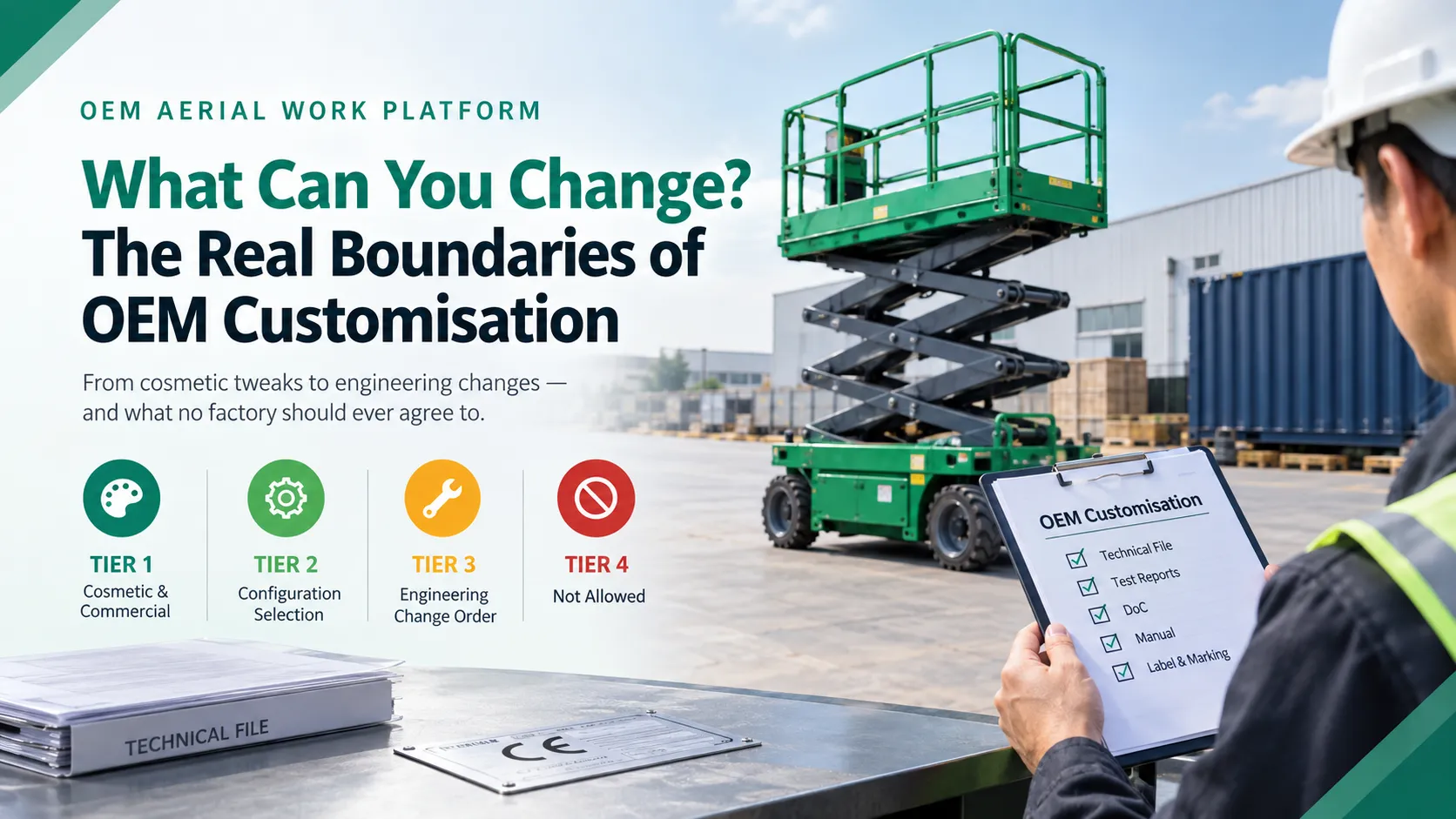
OEM Aerial Work Platform Manufacturer: What Can Be Customised, What Cannot
Every OEM aerial work platform manufacturer has a different answer to “can you change this?”. The boundaries are rarely spelled out at quotation stage, and the difference usually shows up after the deposit is paid. This article sets out where those boundaries sit for a typical Chinese OEM programme for mobile elevating work platforms (MEWPs): what a factory can change cheaply, what can be changed but re-prices the machine, and what no compliant factory should agree to change at all.
If you are evaluating a Chinese OEM aerial work platform manufacturer, the practical question is not “do you support OEM?” — every exporter says yes. The question is: where exactly does the factory’s engineering change-order process stop? The table below is the short version; the rest of the article explains the reasoning behind each boundary, so you can put the right questions into your supplier audit.
The Customisation Boundary Table
Read the four tiers as increasing levels of risk to certification, warranty and delivery. One note on Tier 1: co-branding decals and distributor labels may be added, but they must not replace or obscure the manufacturer’s identification plate — see the documentation section below.
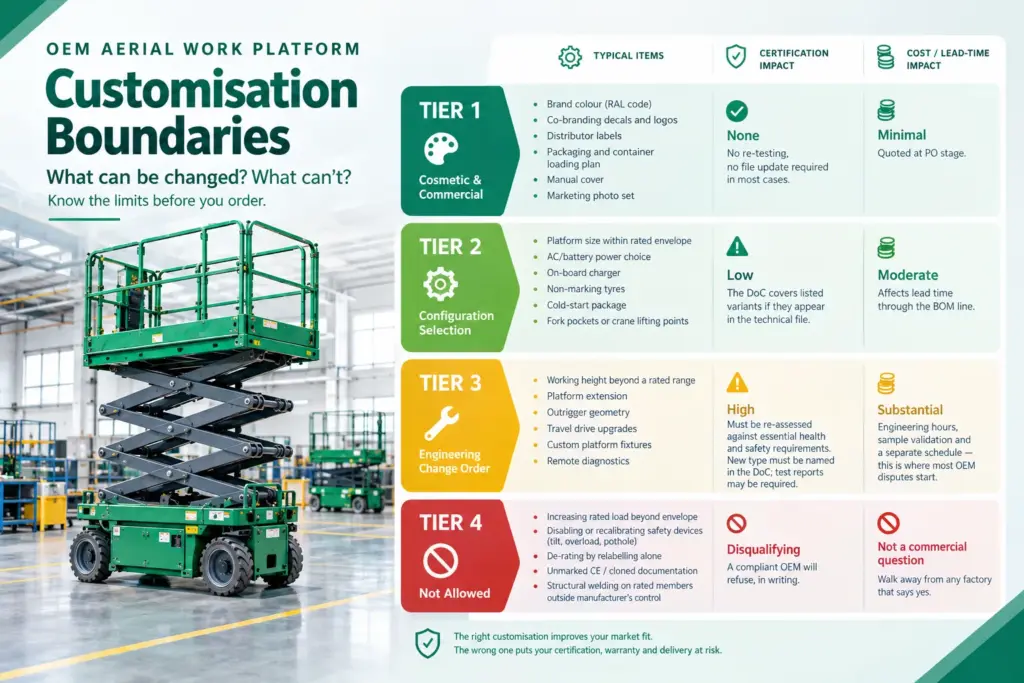
| Tier | Scope | Typical Items | Certification Impact | Cost / Lead-Time Impact |
| Tier 1 — Cosmetic & Commercial | No change to the machine’s safety-relevant configuration | Brand colour (RAL code), co-branding decals and logos, distributor labels, packaging and container loading plan, manual cover, marketing photo set | None — no re-testing, no file update required in most cases | Minimal; quoted at PO stage |
| Tier 2 — Configuration Selection | Selecting among options the factory already engineers and documents | Platform size within rated envelope, AC/battery power choice, on-board charger, non-marking tyres, cold-start package, fork pockets or crane lifting points | Low — the DoC covers listed variants if they appear in the technical file | Moderate; affects lead time through the BOM line |
| Tier 3 — Engineering Change Order (ECO) | Engineering work that changes the machine’s documented configuration | Working height beyond a rated range, platform extension, outrigger geometry, travel drive upgrades, custom platform fixtures, remote diagnostics | High — the variant must be re-assessed against the essential health and safety requirements; the DoC must name the new type; new test reports may be required | Substantial; expect engineering hours, sample validation and a separate schedule — this is where most OEM disputes start |
| Tier 4 — What No Factory Should Agree To | Changes that break the certification chain or the machine’s safety logic | Increasing rated load beyond the rated envelope, disabling or recalibrating safety devices (tilt, overload, pothole), de-rating by relabelling alone — without reassessing stability, updating the technical file and revising the capacity data, un-marked CE / cloned documentation, structural welding on rated members outside the manufacturer’s control | Disqualifying — a compliant OEM aerial work platform manufacturer will refuse, in writing | Not a commercial question; walk away from any factory that says yes |
Two boundaries deserve special attention, because they are where sourcing teams most often misprice risk.
Tier 2 in practice: the options list is a compliance document
Options that appear in the technical file’s variant table are pre-engineered. Options that appear only in the sales quotation are not. When comparing two factories’ OEM programmes, ask for the variant table from the technical file, not the options price list — the overlap between the two documents tells you how much of what sales is selling is actually engineered. The gap between those two lists is where lead-time surprises and documentation mismatches come from.
Tier 3 in practice: the ECO that invalidates your own paperwork
A platform extension or an outrigger modification is not “a small change to the drawing.” Under the Machinery Directive framework, the declaration of conformity covers the type as documented in the technical file. Change the geometry, and you have created a new type — meaning the DoC you receive at shipment no longer describes the machine in the container unless the ECO was processed through the manufacturer’s engineering loop, re-assessed, and the documentation re-issued under the new configuration.
The practical test when auditing an OEM aerial work platform manufacturer: ask to see one completed ECO file — request, engineering assessment, updated drawings, re-test or re-assessment evidence, updated DoC and manual revision. A factory that can produce this on the spot has a real process. A factory that says “no problem, we change anything” has told you it re-labels machines, which is precisely the Tier 4 behaviour this article warns against.
What the Documentation Pack Should Look Like per OEM Order
Assuming your specification lands in Tier 1–2, a complete OEM shipment from a compliant factory includes:
| Document | Scope | What to Check |
| EU Declaration of Conformity | Per type/configuration, naming your machine as shipped | Type designation matches the serial numbers; standards list is current; not a generic “CE certificate” |
| Test report / inspection record | Per machine or per batch, per your PO quality clauses | Dates, serials and results match the packing list |
| Operator manual | Re-branded, revision-controlled, in the required languages | Revision number matches the DoC issue; safety sections unaltered |
| Load chart / capacity plate data | Reflects the actual configuration shipped | Ratings carry the load-centre basis, not a bare number |
| Spare-parts identification | Model-specific, keyed to your serial range | Works with the serial number you hold, not a generic catalogue |
| Conformity markings on the machine | CE marking and identification plate with the manufacturer’s (not the brand owner’s) legal name — see below | Plate data matches DoC; CE marking correctly positioned |
One legal point brand owners sometimes get wrong: in an OEM relationship, the identification plate and the declaration of conformity must name the manufacturer — the party that takes responsibility for design conformity. Placing a machine on the market under your own name or trademark may make your company the manufacturer in the legal sense, regardless of how the contract allocates liability between you and the factory. Your brand goes on the machine commercially; the legal manufacturer of record does not change simply because a contract says so. A factory offering to put your company on the DoC as manufacturer, with no obligations assumed behind it, is handing you a liability rather than a service.
This article is commercial guidance, not legal advice — confirm how the manufacturer role is allocated with your own counsel before the first PO.
How to Run the OEM Conversation: Five Questions That Expose the Boundary
Put these five questions to any OEM aerial work platform manufacturer before commercial negotiation:
- “Show me your variant table.” Establishes whether your required configuration is Tier 2 (pre-engineered) or Tier 3 (new engineering).
- “Show me one completed ECO file.” Establishes whether Tier 3 changes are processed with documentation, or handled informally.
- “What is on your never-list?” A factory that has no never-list has no compliance boundary. The correct answers include: rated load beyond the envelope, safety-device changes, and undocumented structural work.
- “Who is the legal manufacturer on the DoC for my machines?” Establishes where conformity responsibility sits — see the legal point above.
- “What documentation do you re-issue when a Tier 2 option is fitted?” The correct answer is that the DoC’s type description and manual revision follow the configuration; anything less means your file drifts out of sync with your fleet.
The pattern across these questions is the same: you are not asking whether the factory can do OEM. You are checking whether its engineering, documentation and compliance processes run through to the machine you will actually receive.
Commercial Terms That Sit Outside the Engineering Boundary
The four tiers above define what can be engineered. These points sit alongside them and belong in the PO, because they are commercial rather than technical:
| Point | What to Agree Before the PO |
| Minimum order quantity | Whether mixed models and mixed configurations count toward the MOQ |
| Tooling and drawing ownership | Who owns fixtures, jigs and drawings paid for under the programme |
| Warranty allocation | Who handles field claims — factory, brand owner, or split |
| Spare-parts support | Identification method, lead time and stocking commitment for your serial range |
| Territory exclusivity | Whether it is granted, and what volume or term it is conditional on |
None of these move the certification boundary, but each one is a common source of post-PO disputes.
Where Your Request Sits: Confirm It Against the Actual Machine
The four tiers above are the framework. Where a specific request lands depends on the base model, the starting configuration and the market the machine ships to — two requests that look identical on a drawing can sit in different tiers, one inside the documented variant table and one outside it. That is why these boundaries are confirmed per project rather than quoted in general terms.
Two things hold regardless of which factory you ask. Rated load beyond the machine’s envelope, changes to tilt, overload or pothole protection set-points, and structural work outside the manufacturer’s engineering control are Tier 4 at any compliant OEM aerial work platform manufacturer. A supplier that accepts them has told you something about its process.
For everything else, send us three items and we will put your request in a tier, in writing, before you commit:
- The base model and the configuration you need — platform, power, working height, rated load
- The change itself — a dimensional change, an option from our list, or something not on it
- Destination market and any certification requirement attached to the order
Send your specification to our OEM team
What comes back is a tier classification, the documentation that will be re-issued for that configuration, and — when the answer is no — a stated reason rather than a silence. If the request sits in Tier 1 or Tier 2, the conversation is commercial. If it sits in Tier 4, hearing it early is cheaper for both sides than discovering it after tooling.
FAQ
Does OEM customisation delay CE documentation? Tier 1 changes do not. Tier 2 changes are documented when the variant is in the technical file. Tier 3 changes require the ECO loop — engineering assessment, possible re-testing, and a re-issued DoC — and the schedule should reflect that explicitly rather than being absorbed invisibly into lead time.
Can the DoC carry our brand instead of the factory’s name? Not as manufacturer, unless your company formally assumes the legal manufacturer’s obligations. The DoC names the party responsible for conformity. Brand ownership and legal manufacture are different roles; most brand owners want the factory to remain the manufacturer of record.
Is a “CE certificate” enough evidence for an OEM order? No single certificate covers an OEM programme. What matters is that the DoC, test records and manual revision match the exact configuration and serial range you receive — machine-level traceability, not a company-level claim.
How early should we raise a Tier 3 request? At specification stage, before PO. An ECO quoted and scheduled openly costs engineering time; the same change discovered at pre-shipment inspection costs a container.
What if two suppliers quote the same Tier 3 change very differently? The cheaper quote usually skipped the documentation loop. Ask both for the ECO deliverables list — updated DoC, test or re-assessment evidence, manual revision — and compare what is actually included, not the price alone.
Next Step
Already comparing suppliers? Put the five questions above to each of them and compare what comes back on paper, not what is promised on the call. If you would rather start with your own machine, send us the specification — we will tell you which tier it falls into, and we tell you early when the answer is no.