SONCAP Certification for Aerial Work Platform Imports into Nigeria
SONCAP certification for aerial work platform imports is a pre-shipment requirement that Nigerian buyers should settle before freight is booked. For scissor lifts, vertical mast lifts and boom lifts imported for resale, distribution or dealer stock, the document process normally needs to be in place before the equipment leaves the country of origin.
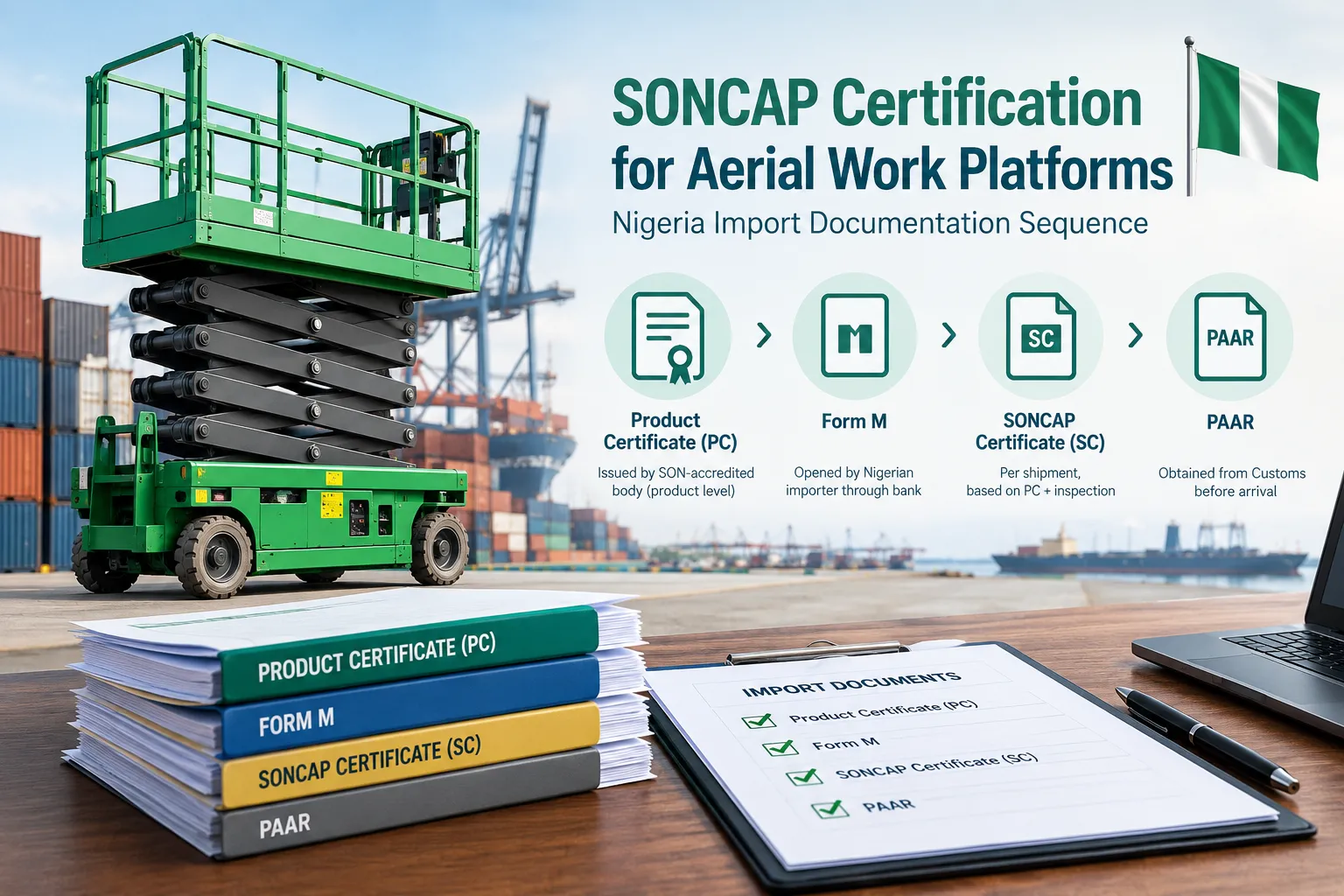
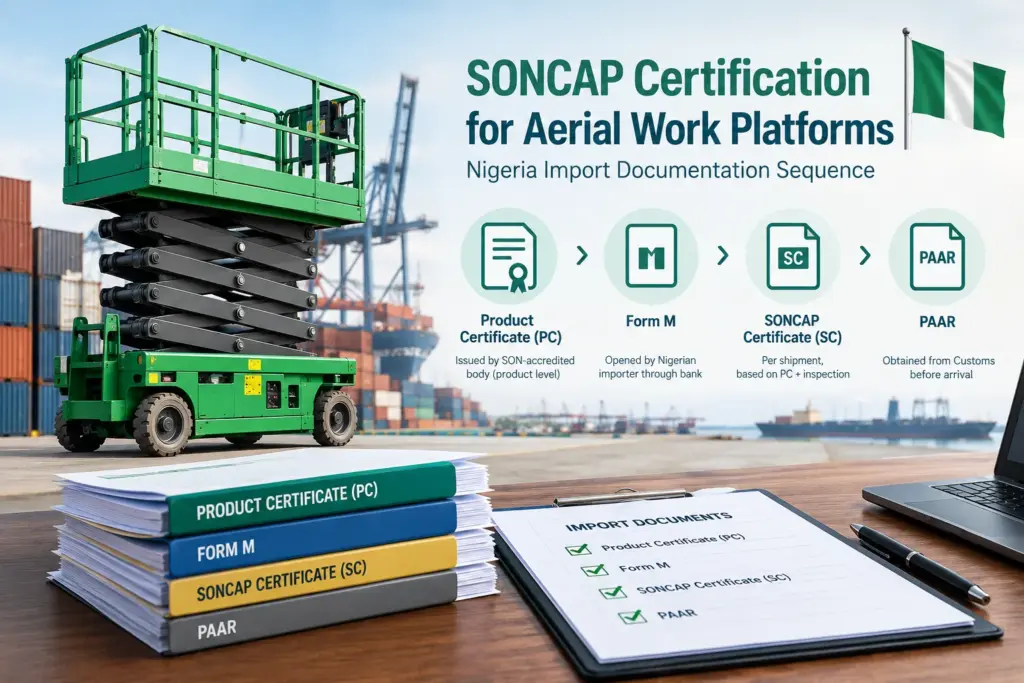
The process is often misunderstood because it involves two different certificates. A Product Certificate applies to the product or model range, while a SONCAP Certificate applies to a specific shipment. The importer must also coordinate Form M, PAAR and, since March 2026, the relevant steps on Nigeria’s National Single Window (NSW) platform.
This matters for scissor lifts, vertical mast lifts, articulated boom lifts and telescopic boom lifts alike. The fact that a machine is industrial equipment does not, by itself, put it outside SONCAP. What matters is why it is being imported and what will happen to it after clearance.
A dealer bringing in machines for onward sale is clearly importing commercial goods. So is a distributor building stock for local customers. In both cases, the SONCAP product certification route will normally apply.
The position becomes less straightforward when the importer says the machine is for its own use. SON provides an Import Permit route for bona fide manufacturers importing raw materials, packaging materials or industrial machinery for their own operations. That is a purpose-based exemption, not a blanket exemption for anything described as machinery.
A factory buying one scissor lift for maintenance work inside its own plant may have a basis for asking about an Import Permit. A trader importing the same lift for resale does not. Rental companies should be particularly careful here. A rental fleet is not resale stock, but it is also not automatically the same as a manufacturer importing equipment for its own production use. That question should be settled in writing with the accredited conformity assessment body and the Nigerian clearing agent before the machine is shipped.
SONCAP certification for aerial work platform shipments: PC and SC
A large share of SONCAP problems start with a simple misunderstanding. Suppliers often say that a product is “SONCAP certified” when they mean that they hold a Product Certificate. That may be useful, but it does not mean the buyer’s shipment is ready for customs clearance.
The Product Certificate, usually referred to as the PC, applies to a defined product or model range. It is obtained through a SON-accredited conformity assessment body by the exporter, manufacturer or another party appointed to handle the application. Its role is to support the Form M process on the Nigerian side.
The SONCAP Certificate, or SC, is different. It is issued for a specific consignment, based on the relevant Product Certificate and the applicable pre-shipment conformity assessment process. This is the document that supports the shipment’s customs clearance.
SON’s own FAQ makes the division clear: the Product Certificate is required for processing Form M, while the SONCAP Certificate is required for Nigerian Customs clearance of SON-regulated goods.
The distinction sounds administrative, but it has practical consequences. A PC issued for a product line last year is not automatically an SC for a shipment leaving this month. An SC issued for another importer is not evidence that the next buyer’s machines are covered. A buyer should always ask what document exists, who it was issued to, and whether it refers to the actual consignment being booked.
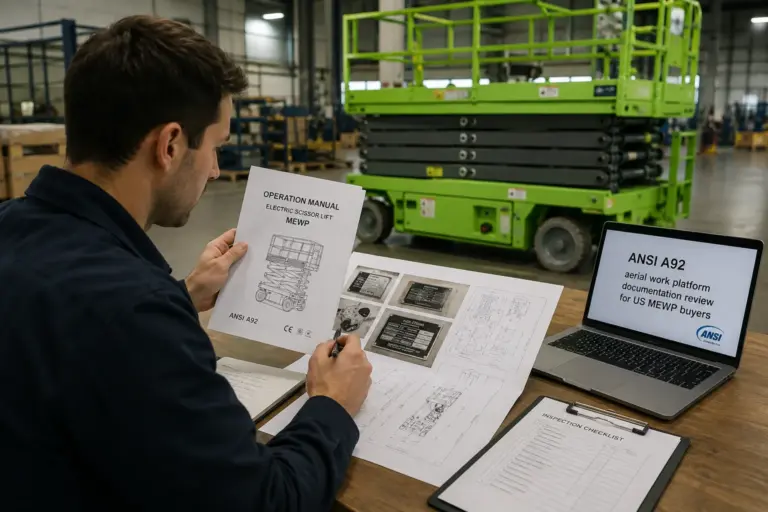
The model description matters just as much as the certificate number. If the quotation says one model, the Product Certificate names another, and the machine nameplate uses a third description, the file is likely to attract questions. Before production is finished, compare the wording that will appear on the quotation, commercial invoice, packing list, PC, SC and nameplate. Small inconsistencies are much cheaper to correct before loading.
The paperwork has to move in sequence
The Nigerian importer normally opens Form M through its bank, using its TIN and the supplier’s commercial documents. The Product Certificate supports that process. The shipment then proceeds through the applicable pre-shipment assessment requirements, after which the SONCAP Certificate is issued for the consignment.
The importer and clearing agent also need to arrange the PAAR, or Pre-Arrival Assessment Report. This is a separate customs document, and it has its own timing requirement. SON advises that the PAAR application should be made when the consignment departs for Nigeria, rather than after it has reached a Nigerian port or border.
There is no advantage in treating these as separate jobs assigned to different people without coordination. The supplier may arrange inspection, the importer may open Form M, and the clearing agent may handle PAAR, but all three are working from the same commercial shipment. The supplier name, consignee, machine model, quantity, invoice value and HS classification should align throughout.
HS classification deserves an early conversation. A self-propelled scissor lift, a vehicle-mounted platform and another type of lifting machine may not be classified in the same way. The correct code affects duty treatment and may affect how the conformity assessment body handles the file. The supplier’s proforma invoice can be a starting point, but it should not be treated as the final customs classification. That confirmation belongs with the Nigerian customs broker and the appointed conformity assessment body.
The National Single Window step now needs attention
Since late March 2026, SONCAP and Import Permit applications have moved into Nigeria’s National Single Window system. The relevant process is initiated through Nigeria’s National Single Window platform, while certificates continue to be issued by the accredited bodies handling the conformity assessment work.
For buyers, the important change is operational. It is no longer enough to ask a supplier whether the certificate has been issued. The Nigerian-side NSW process must also be completed so that the documentation can be used alongside Form M, PAAR and the clearance file.
This is worth spelling out in the purchase order or shipping instructions. Ask who will coordinate the certificate application, who will provide the documents needed by the importer, and who is responsible for confirming that the required NSW action has been completed before the shipment departs. A certificate that exists but is not usable in the clearance process does not solve the importer’s problem.
Suppliers and freight agents sometimes continue to describe the process in terms they used before the NSW migration. That does not necessarily mean they are wrong, but it does mean the buyer should ask a more precise question: has the certificate been issued for this shipment, and has the required NSW process been completed for the Nigerian import file?
Why this should be settled before freight is booked
SONCAP is designed as a pre-shipment programme. If the required steps are missed before the goods leave the country of origin, the normal route may no longer be available for that consignment.
SON states that its SONCAP Default procedure may apply where a shipment has departed without following the required pre-shipment process. The published charge is 20% of the CIF value of the consignment or NGN 2 million, whichever is higher. Even where the cost is not the main concern, the delay can be significant because the importer is trying to resolve a document issue after the point at which the process is intended to take place.
The PAAR timing is separate but leads to the same practical conclusion. It should be treated as part of departure planning, not as a task for after arrival.
For a buyer, the useful question is not “Does the supplier have SONCAP?” It is: “What will be in place for this exact shipment before it sails?”
A supplier who understands the process should be able to provide the Product Certificate number, identify the accredited body that issued it, explain whether the quoted model is within scope, and describe how the shipment-level SONCAP Certificate will be handled. They should also be able to provide commercial and technical documents early enough for the importer to open Form M and for the clearing agent to prepare the customs file.
Where a certificate refers to a broad product family rather than a specific machine model, ask for confirmation that the quoted model falls within that certificate scope. It is a routine request, and it can prevent a model-description dispute later.
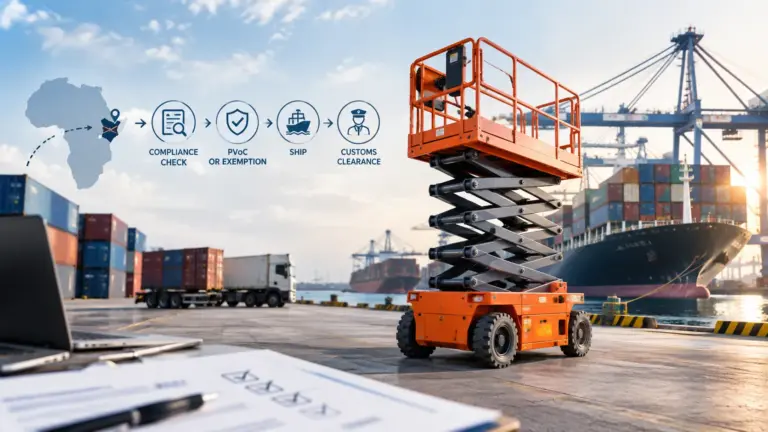
The same discipline is useful in other regulated markets. Kenya follows a similar pre-shipment structure through its PVoC certificate of conformity programme. India requires buyers to consider which rules apply to the individual machine under BIS certification for scissor lifts. The documents differ, but the principle is the same: certification claims should be checked against the actual product, shipment and importer.
Before you place the order
The best time to resolve SONCAP is before production is complete and well before a vessel is booked.
The buyer and supplier should agree who will handle the Product Certificate, which accredited body will be involved, and whose responsibility it is to arrange the shipment-level SONCAP Certificate. The exact model description should be agreed in writing, including how it will appear on the invoice, packing list and machine nameplate.
The Nigerian importer should have enough information to open Form M in parallel with the supplier’s certification work. The clearing agent should be asked to confirm the HS classification and PAAR requirements early, rather than relying on a code copied from a supplier’s quotation.
For Chenlift buyers, we can provide the technical specifications, commercial documents and model information needed for certification and customs preparation. The final certification route, HS classification and clearance requirements should still be confirmed with SON, the appointed conformity assessment body and the Nigerian clearing agent before shipment. Our Nigeria aerial work platform market page provides an overview of the equipment ranges supplied to the market.
For a broader supplier due-diligence process, including factory records, documentation and shipment controls, see our guide for aerial work platform distributors, rental fleets and OEM buyers.
Official references
- Standards Organisation of Nigeria: SONCAP FAQ
- SON announcement on migration of SONCAP and Import Permit processes to the National Single Window
- Nigeria National Single Window
This article is a practical guide to the import documentation process and is not legal advice or a customs ruling. Confirm the applicable SONCAP route, NSW requirements and HS classification with SON, the accredited conformity assessment body and your Nigerian clearing agent before shipment.