Aerial Work Platform Manufacturer: A Practical Guide for Distributors, Rental Fleets and OEM Buyers (2026)
Buying lifting equipment from overseas rarely goes wrong at the start. The problem comes later: when the documents do not match the model, a rental branch needs a part that was never planned, or a private-label order reaches production without a clear sign-off on the configuration.
That is why choosing an aerial work platform manufacturer is not only a question of working height and rated capacity. The equipment has to suit the job, but the factory also has to be able to document the exact machine, communicate changes, and support the order after shipment.
Chenlift is a China-based manufacturer of aerial work platforms and material lifting equipment. Its range covers scissor lifts, vertical lifts, boom lifts, loading dock equipment, lift tables, and specialised metro and rail machines. This guide is written for buyers who need a sensible way to assess both the machine and the supplier behind it.
Start With the Work, Not the Catalogue
Before comparing manufacturers, write down the actual job the machine must do. That sounds basic, but it prevents many expensive mismatches.
A warehouse team may need a compact electric unit that can work in an aisle without marking finished floors. A contractor may need horizontal outreach over pipework or a facade. A depot may need a rail-mounted platform that can travel on track and still fit within the available clearance. Those are different jobs, so they should not start with the same product shortlist.
For an initial inquiry, give the supplier these details:
- Working height and any horizontal outreach required
- Number of operators, tools and materials carried on the platform
- Indoor, outdoor, rough-terrain, rail or production-line use
- Available aisle width, doorway width, floor loading and ground condition
- Power preference: electric, diesel or another site requirement
- Destination country and the documents your importer, customer or authority requires
- Whether the purchase is for resale, rental use or private-label supply
With that information in hand, it becomes much easier to judge whether an aerial work platform manufacturer is proposing the right machine or simply pushing the model already in stock.
Check Documents Against the Exact Model
For lifting equipment, a generic statement that a factory is “CE certified” is not enough. Ask for the CE Declaration of Conformity and supporting documents that correspond to the exact model being quoted. Check the model designation, manufacturer name, applicable requirements and document date. If the machine is being modified for a private label, different power package or destination-specific configuration, confirm whether the supplied documentation still applies.
CE documentation is relevant to products placed on the European market, but it is not a substitute for every destination country’s import or operating requirements. For a general explanation of CE marking, refer to the European Commission’s CE marking guidance. UAE, India, Saudi Arabia and other markets may have their own registration, conformity or shipment procedures. Confirm the current requirement with the local authority, importer of record or customs broker before production is released. Chenlift publishes market information for the UAE, India and Saudi Arabia; use it as a starting point for the conversation, not as the final legal check.
ISO 9001:2015 addresses a manufacturer’s quality-management system rather than approving a particular lift model. It is useful background, especially when comparing factories, but it does not replace model documentation, inspection records or destination-market approval.
Match the Lift Type to the Job
Scissor lifts for straight-up access
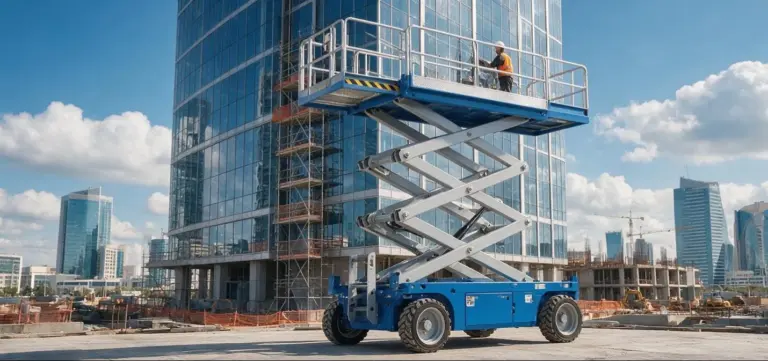
Scissor lifts make sense when the work is mainly vertical and the operator needs room for tools or materials. They are common in warehouses, factories, fit-outs and construction work where the floor is level and the platform does not need to reach around an obstacle.
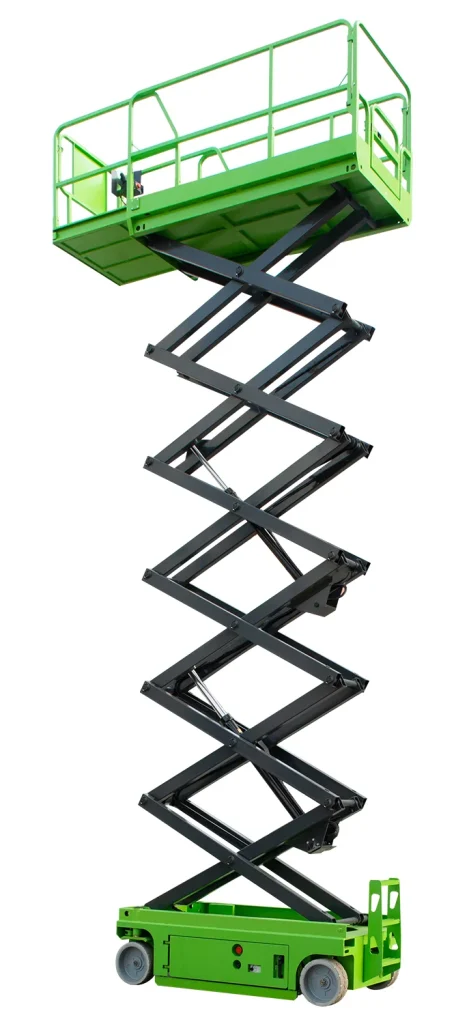
Chenlift’s self-propelled scissor lift range includes compact MX MINI models and larger MX machines. The MX300S, MX390S and MX450S provide working heights of 5 m, 5.9 m and 6.5 m respectively, each with a 240 kg platform capacity and a 760 mm width. Their platform heights are 3 m, 3.9 m and 4.5 m. At the larger end of the listed range, the MX580S reaches 7.8 m with a 227 kg capacity, while the MX1600S reaches 17.8 m with a 320 kg capacity and a 1.53 m width.
Manual-push scissor lifts are another option where self-propelled travel is not needed. The standard MK range covers 8 m to 18 m working height at 500 kg, while the MK T-series is rated at 1,000 kg. Buyers should confirm the available power supply, platform size and how the machine will be moved between work areas.
For rough outdoor ground, a compact electric scissor lift is not the right comparison. The MRT diesel range covers working heights from 10 m to 18 m, capacities from 345 kg to 567 kg and 4WD, with gradeability varying by model. The MC crawler range is relevant where tracked travel and uneven access matter: rubber-track models cover 4.4 m to 9.6 m platform height, while steel-track models with outriggers reach up to 15.8 m working height.
For a rental fleet, do not stop at the headline specifications. Ask which wear parts are normally stocked, what is included in the first spare-parts package, and how model changes are identified in the parts list. An unavailable switch, tyre or charger can leave a rental machine parked, so parts availability belongs in the first order discussion.
Vertical lifts for tight indoor work
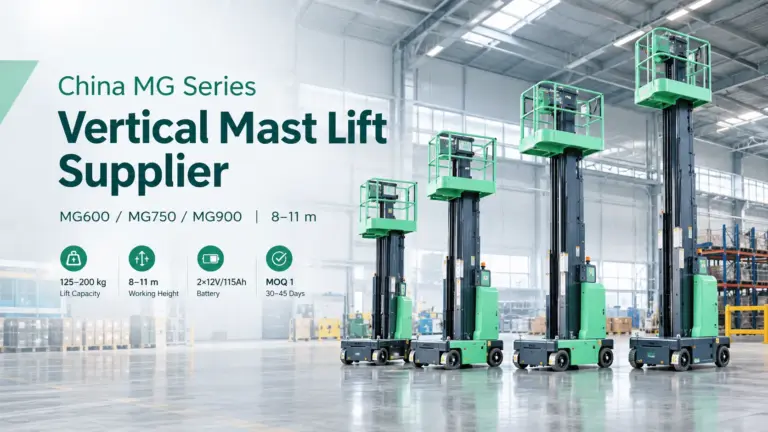
Vertical mast lifts suit narrow aisles, retail spaces and indoor maintenance where a wider scissor platform is impractical. The buyer should measure the stowed width, turning space, doorway clearance and floor condition before choosing a model.
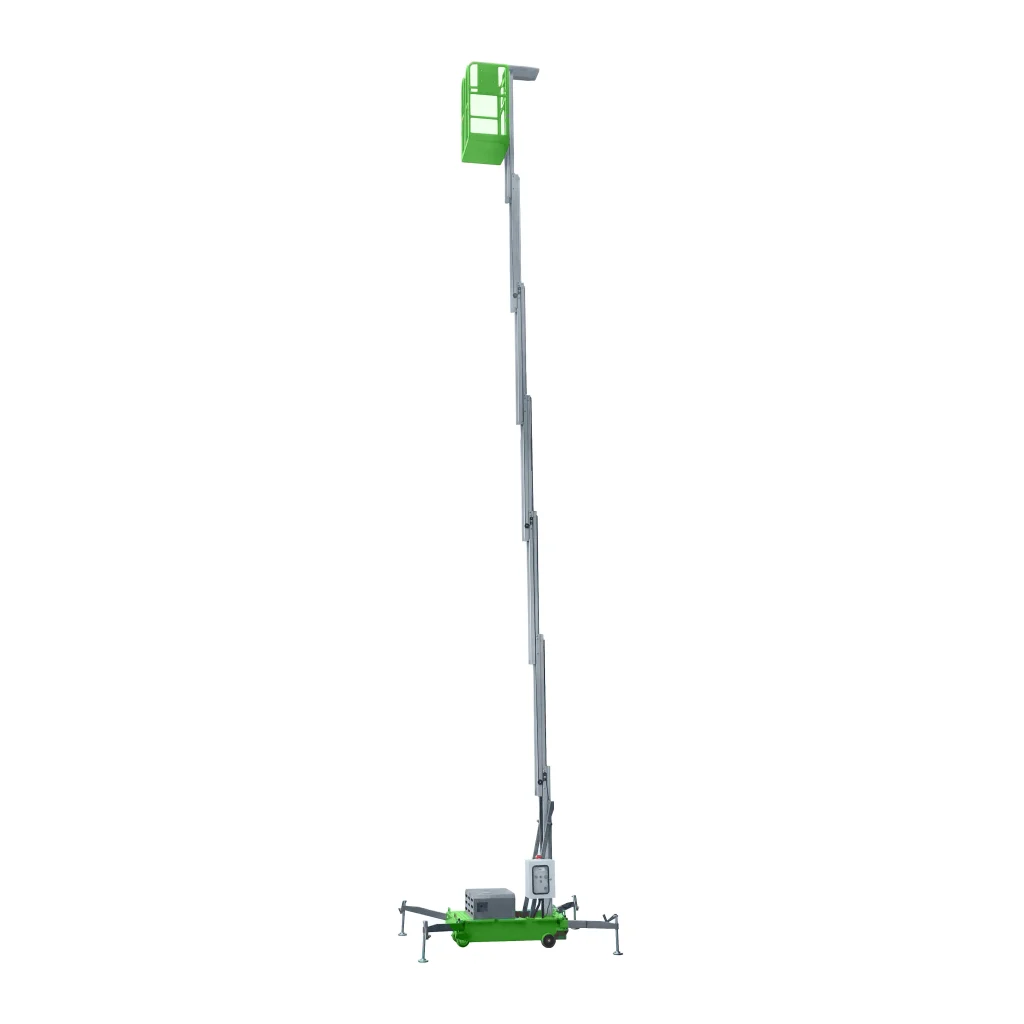
The vertical lift range includes aluminium mast and self-propelled formats. The MD390-2 uses an Electric Lifting Push Rod rather than a hydraulic lifting system, so there is no hydraulic oil in the lifting system. It has a 6 m working height, 230 kg base capacity, 113 kg extension capacity, 800 mm machine width, 2 x 12 V / 100 Ah batteries and 25% gradeability. For sites such as food production, pharma, clean warehouses and finished interiors, that oil-free arrangement can be a practical point to assess alongside cleaning procedures and floor requirements.
The aluminium ME range covers single-mast working heights from 8 m to 12 m at 125 kg, double-mast models up to 16 m at 200 kg, and multi-mast configurations up to 22 m working height. The self-propelled MG range covers 8 m to 11 m working height, 125 kg to 200 kg capacity and 0.79 m to 1.0 m width. Confirm the exact model data sheet before quoting an end user; mast configuration and capacity vary across the range.
Boom lifts when access is not straight up
If the platform must go over a roof edge, pipe rack, machinery line or facade obstruction, a boom lift is normally the better starting point. The key decision is the reach path, not only the maximum working height.
Chenlift’s articulated HAJ diesel range runs from 16 m to 40 m working height, with 4WD, continuous 360-degree rotation and gradeability varying by model. Electric HAJ variants are available from HA10J to HA26J. The telescopic HTJ diesel range runs from 16.7 m to 48 m; larger models use 4WD4WS, and listed platform capacity ranges from 230 kg to 480 kg. Electric HTJ variants run from HT16J to HT26J, up to 28.5 m working height.
For an outdoor job, ask the site team to specify the obstacle, the required outreach at working height, terrain, wind limits and transport restrictions. “Need a 20 m boom” is not enough information to select between articulated and telescopic designs.
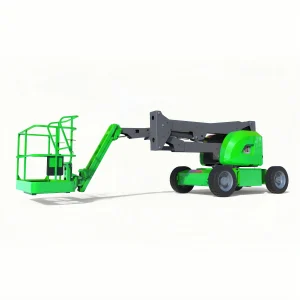
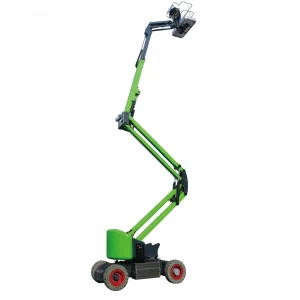
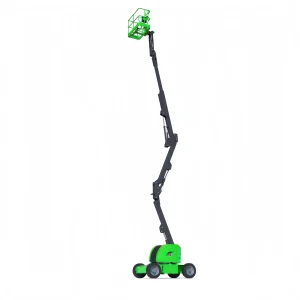
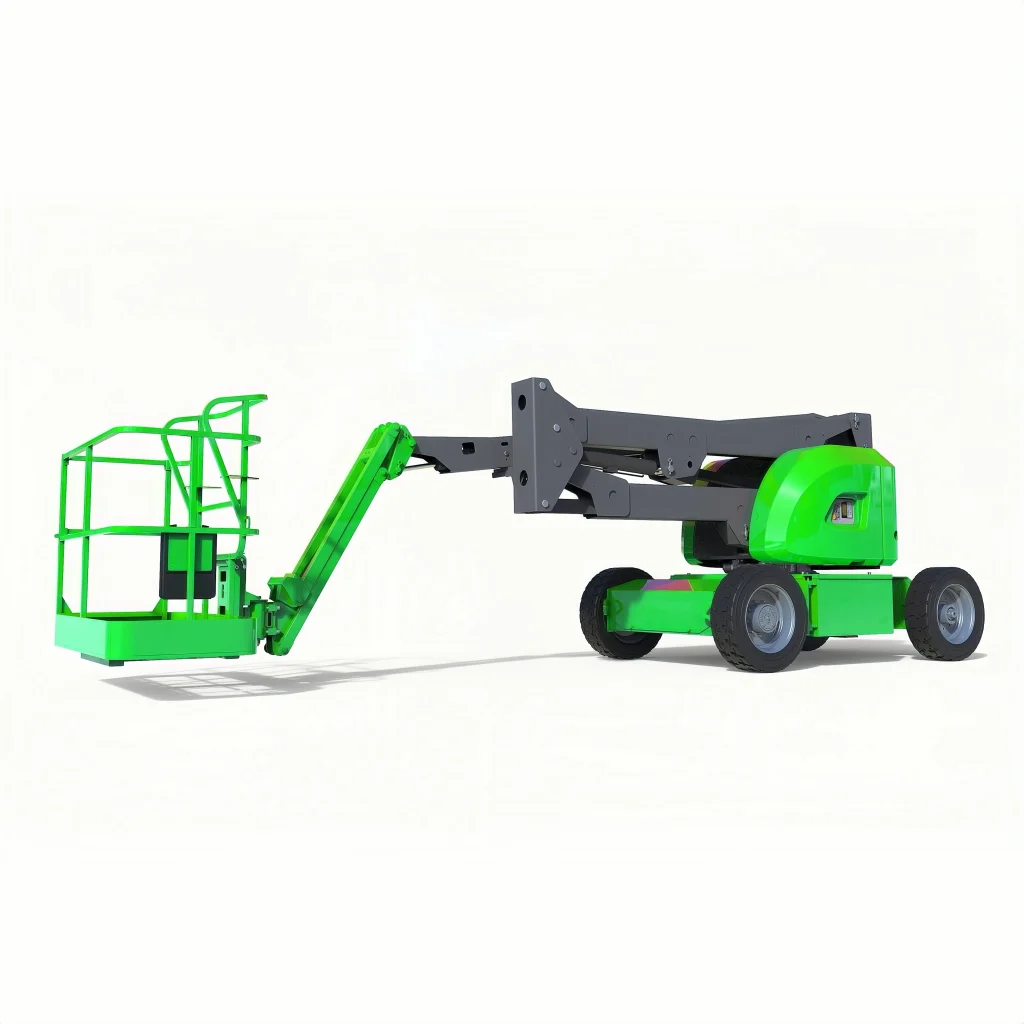
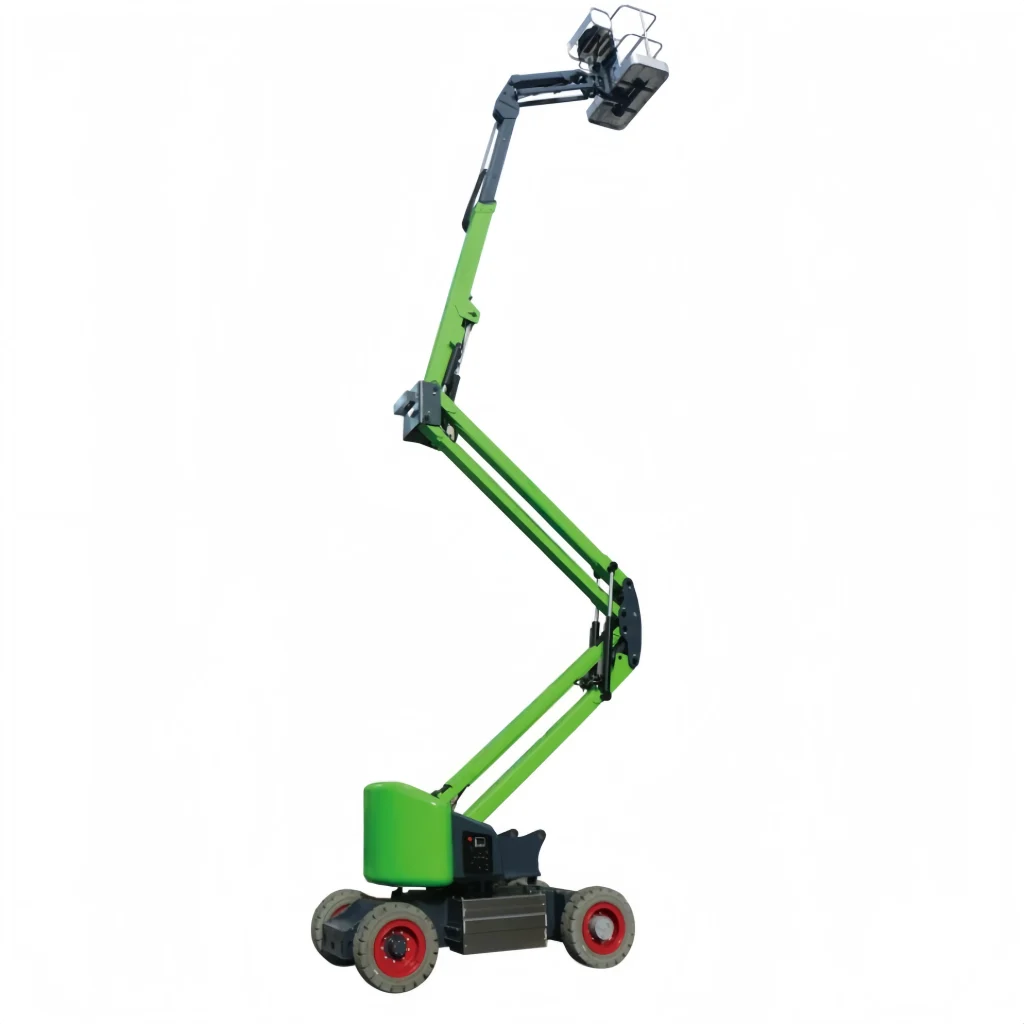
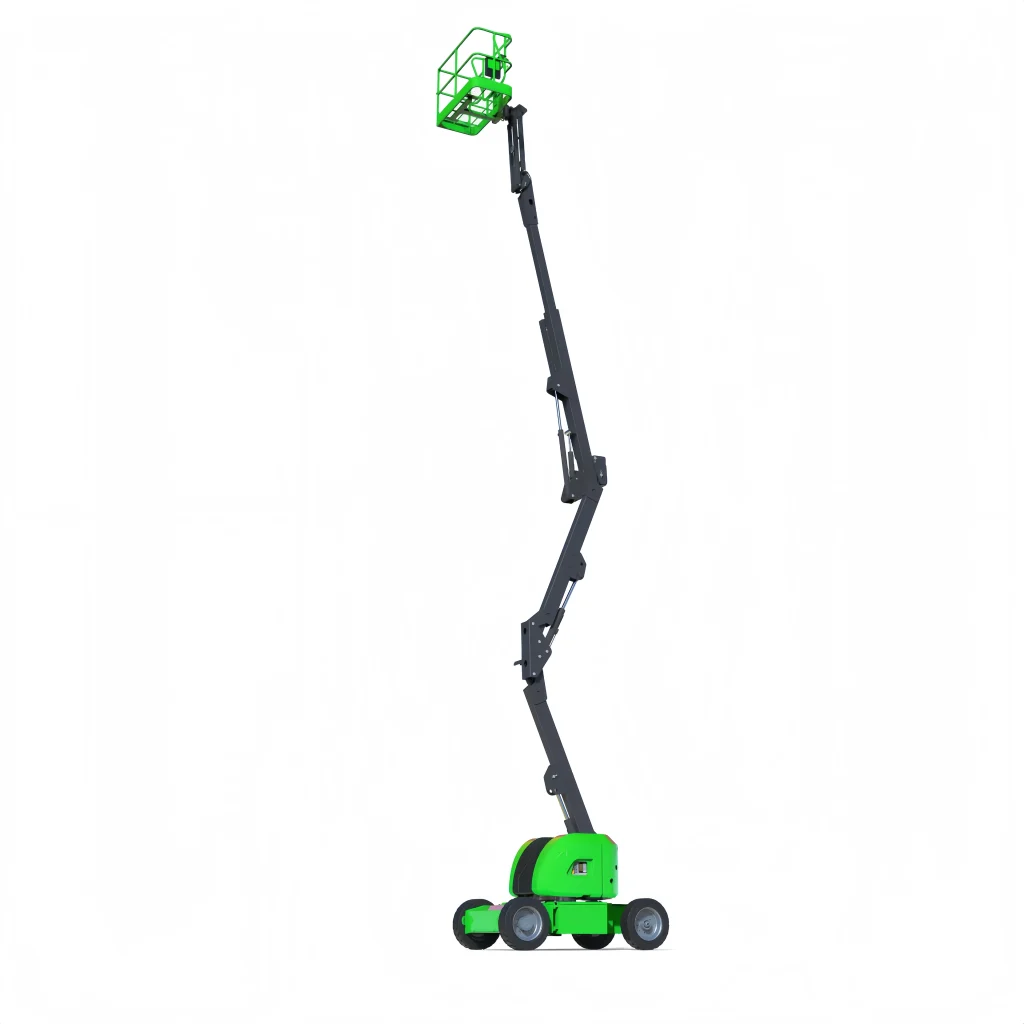
HAJ Series Diesel Articulating Boom Lift — HA26J Diesel
The HA26J Diesel reaches 28 m working height with 230 kg platform capacity on a 2.44×0.91 m platform. Kubota or Cummins diesel engine, 4WD2WS, 360° continuous turntable, 10.2 m crossing height, 17.28 m working radius, and 45% gradeability — for the most demanding large-scale remote outdoor construction and infrastructure projects.
Dock equipment and lift tables for material flow
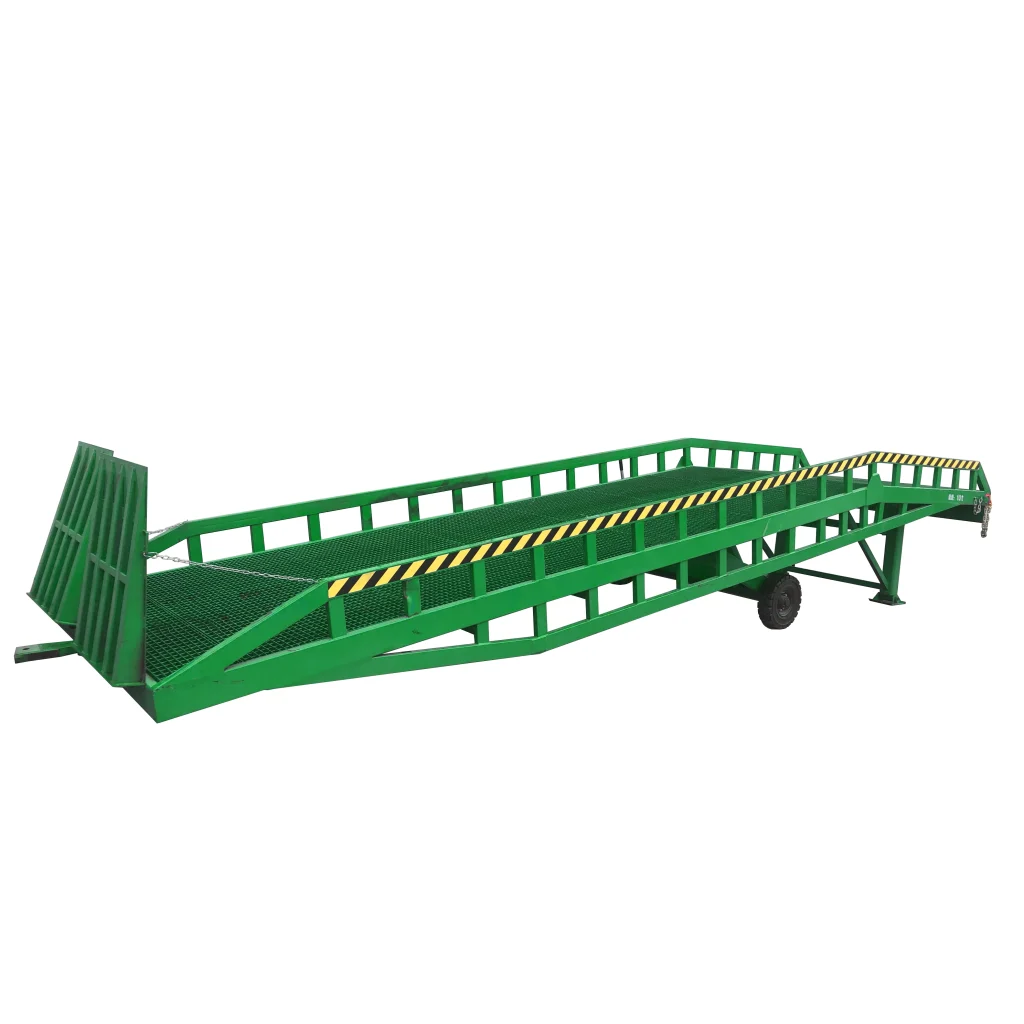
Loading dock equipment solves a different problem from aerial work platforms: it bridges the level difference between trucks and a warehouse floor. The stationary DCQ dock leveler range has listed capacities of 6 t, 10 t and 15 t, with travel of plus or minus 250 mm or 300 mm depending on the model. The mobile DCQY ramp is intended for portable loading applications. Match the equipment to the vehicle mix, dock height and load pattern rather than choosing by tonnage alone.
Lift tables belong in production and material-handling workflows, where the goal is to position a workpiece or pallet at a usable height. Platform size, load, travel, pit arrangement and line layout should be confirmed together. Customisation is useful here, but it needs a signed drawing and a clear statement of the load and duty cycle before fabrication begins.
When Rail Work Needs a Rail-Specific Machine
Metro tunnels and depot work bring constraints that ordinary site equipment does not automatically solve: track gauge, stowed width, tunnel clearance, movement on and off rail, and sometimes lifting or transport of heavy components.
Chenlift’s Metro & Rail solution uses the TG series for this kind of work. The rail-mounted HA12JRTG has a 14 m working height, 230 kg capacity, 360-degree turntable and 1.5 m track gauge. The CLP10TG is a full-electric crawler rail-mounted platform with 12 m working height, 200 kg capacity and 1.2 m stowed width. The MC400TG is a crawler hoisting transport machine with a 3 t crane and a 6.5 t chassis. The series uses steel-wheel and crawler dual-mode travel and has 25% gradeability.
Those figures do not replace a route survey. The buyer still needs to provide the actual gauge, clearance envelope, rail authority rules, access points and lifting plan before the machine is specified.
A Representative Indian Buyer Scenario
Consider a representative Indian distributor in Mumbai. An end user has asked for a compact electric lift for indoor maintenance across several finished-floor sites. The first request is usually for a catalogue and a price, but the useful work starts with four less glamorous measurements: the narrowest clear opening, the door frame and turning space, the required working height, and the load to be carried by the operator and tools.
The MX300S, MX390S and MX450S are all 760 mm wide, but a 760 mm doorway is not automatically an acceptable access route. The dealer still has to check the frame, the route turns and the room needed to operate the machine. Once those dimensions are on the table, the conversation can move from “smallest lift” to a model that can actually reach the work area. At Chenlift, that is the point at which we would confirm the model, documents, power arrangement and delivery scope rather than push a machine already in stock.
For a distributor, the next question is which small group of machines will suit the local market well enough to stock and support. Ask for the parts-book structure, document package, warranty terms, packaging details and a clear process for technical questions after delivery. If private branding is required, agree the logo artwork, decal location, manuals, nameplate details and approval samples before production starts.
Rental fleets have a different problem: a machine can be specified correctly and still become unprofitable if a common part keeps it off hire. Before ordering, ask which wear parts are normally stocked, whether service and wiring documents are available, and whether batteries, chargers or common controls can be standardised across the fleet. The Rental & Fleet solution page is a useful starting point, but the fleet’s own utilisation and maintenance records should decide the final mix.
For OEM and ODM buyers, the base model should be settled before branding discussions expand into technical changes. List every requested deviation – colour, decals, platform size, electrical configuration, optional equipment, documents and destination-market requirements – then confirm which ones affect drawings, lead time, test records or the applicability of existing documentation. That prevents a private-label order from turning into a dispute after production has started.
Inspect the Process, Not Just the Finished Machine
For a first order, a buyer should ask how materials, welding, assembly, functional testing and final inspection are controlled. Then ask what records can be shared for the order. A clear answer should identify the checks, the responsible party and the point at which a configuration change must be approved.
The review should cover material sourcing, in-process inspection, functional and load testing, final inspection, packing and the planned spare-parts list. At the factory stage, that means checking the nameplate and model against the order sheet, looking over welds and guards before power-up, running travel and lifting controls through their working range, and recording load-test results where applicable. The final pack should include the agreed manual, wiring information, spare-parts list and inspection records.
Where an on-site visit is not practical, pre-shipment inspection gives the buyer an independent checkpoint before the balance payment or container loading. Chenlift supports third-party inspection by SGS, Bureau Veritas and TUV on request. Decide the inspection scope early: model identity, quantity, finish, function, key dimensions, documents and packing should all be listed before the inspector arrives.
A Short Supplier Review Before You Issue the PO
Use this list before committing to an aerial work platform manufacturer:
- Does the quote identify the exact model and the configuration being supplied?
- Have you seen the relevant model documentation, not only a company certificate?
- Are destination-market requirements assigned to a named party for confirmation?
- Do dimensions, capacities and power details match the actual site and end-user need?
- Has the parts package, warranty scope and service-document list been agreed?
- For OEM work, are branding and technical changes recorded in an approved drawing or specification?
- For rail or other special projects, has the buyer provided the project constraints in writing?
- Is pre-shipment inspection required, and what will it check?
The list is deliberately short. It is meant to expose gaps while the quote and configuration can still be changed.
Talk Through the Application Before You Request a Quote
If you are comparing an aerial work platform manufacturer for distribution, rental use, OEM supply or a specialist project, start with the job details and the document requirements. Chenlift can then recommend a suitable base model and discuss the configuration, documentation and inspection scope needed for the order. Visit chinaliftplatform.com to start the conversation.