
22m Tiltable Mast Lift: How It Solves Height-Restricted Access Challenges
High-level maintenance work is not always difficult because of the working height. In some projects, getting the equipment to the work area can be just as challenging.
This is particularly common in commercial buildings, industrial facilities and large indoor spaces where service entrances, loading areas or covered passages have limited overhead clearance. A lift may need to reach more than 20m once it is in position, but the route to the work area may be much lower.
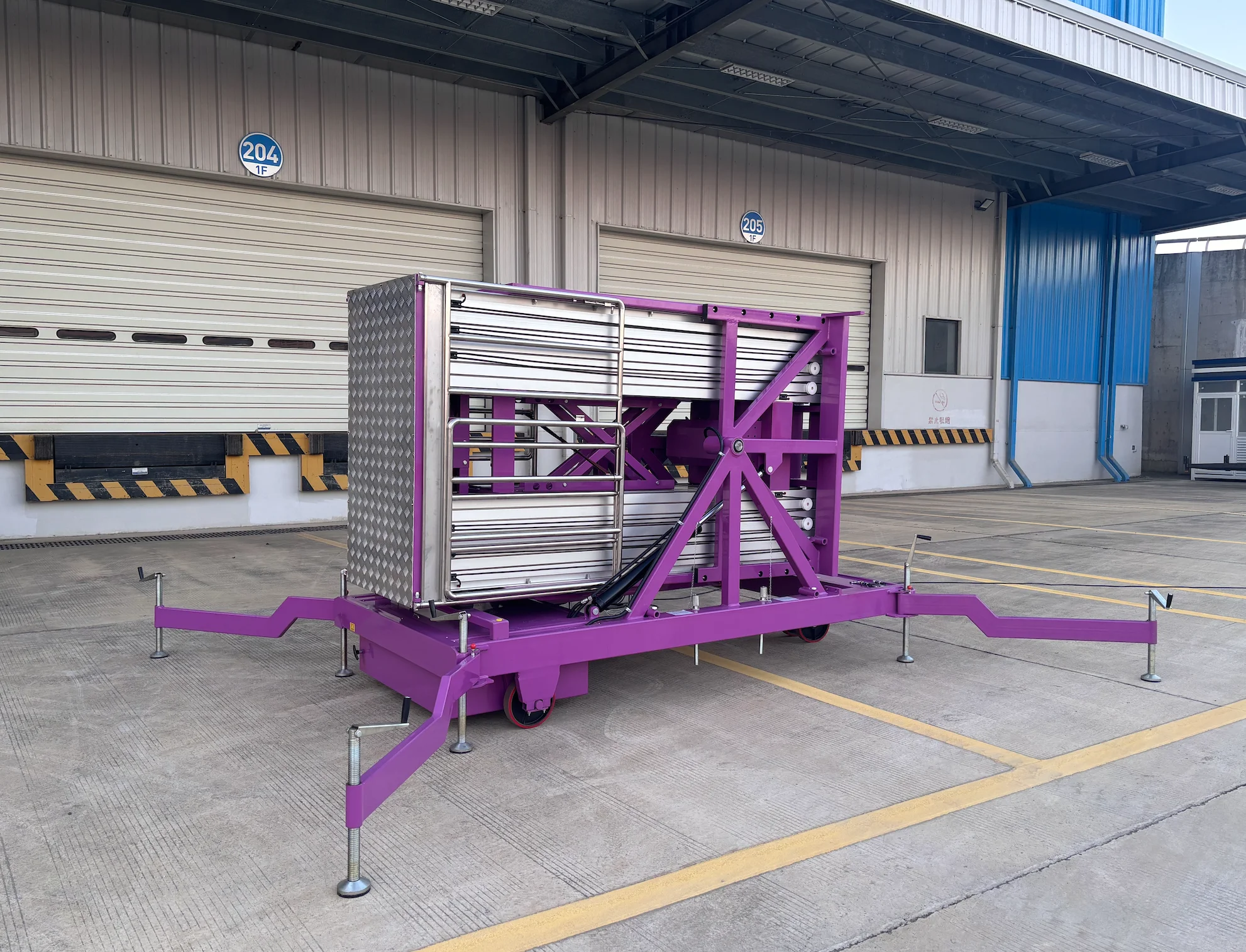
For a maintenance project in Dubai, UAE, a 22m manual-push aluminium mast lift with a tiltable mast was selected for this type of application. The mast can be lowered when the machine needs to be moved through restricted-height areas and raised again once it reaches the work position.
This design gives maintenance contractors another option when a conventional upright mast lift may not be suitable for the access route.
The Access Route Can Be the First Challenge
When selecting an aerial work platform, working height is usually one of the first specifications to consider. However, it is not the only one.
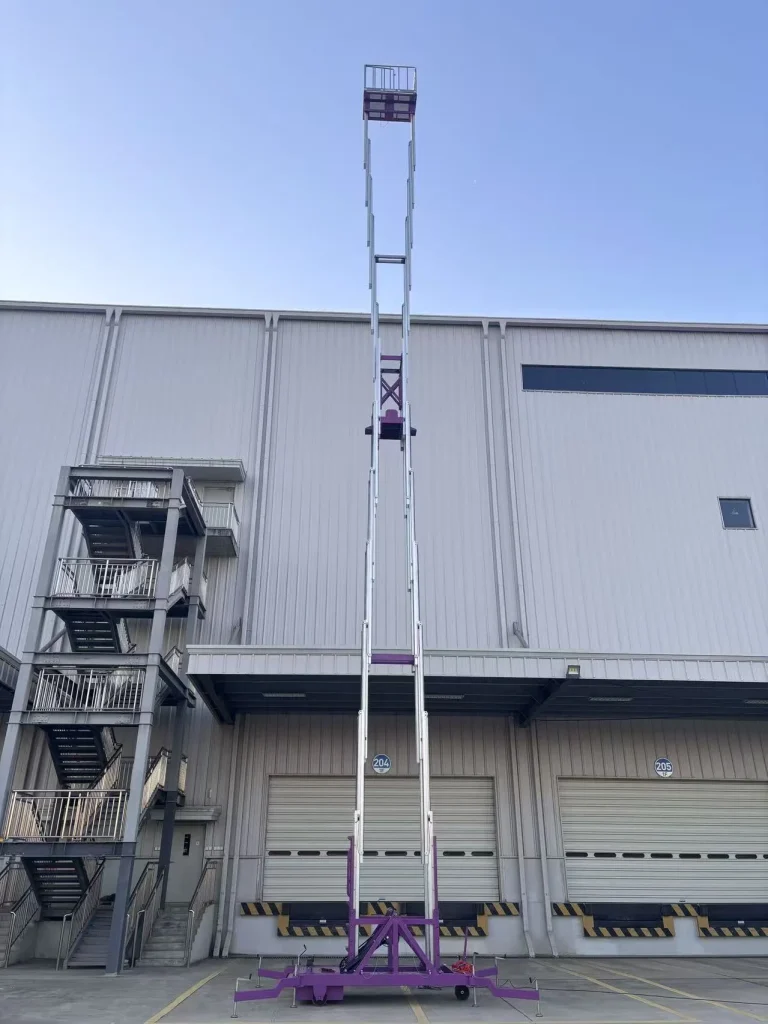
A machine may have the required platform height and load capacity but still be difficult to use if it cannot reach the intended work area.
For example, a maintenance project may involve:
- A 22m-high work point
- A low service entrance
- A covered loading area
- A doorway with limited overhead clearance
- Internal routes with height restrictions
In these situations, the machine needs to be considered from two stages: how it enters the site and how it performs once it is in position.
A conventional upright mast lift remains in its vertical configuration while being moved. Its stowed height therefore becomes an important factor when passing through restricted areas.
The 22m tiltable mast lift approaches the problem differently. The mast can be lowered for access and then returned to the upright position for high-level work.
How the Tiltable Mast Design Works
The operating principle is relatively simple.
Before entering a height-restricted area, the mast is tilted down to reduce the machine’s overall height. The unit can then be moved through the available access route. After reaching the designated work area, the mast is returned to its operating position and the machine is set up for elevated work.
The process can be summarised in three stages:
Lower the mast → Move through the restricted area → Raise the mast for work
The actual access height depends on the selected machine configuration and should always be checked against the dimensions of the entrance and the complete travel route.
This feature is particularly relevant when the work area itself has sufficient vertical clearance but the route leading to it does not.
22m Working Height in a Compact Aluminium Mast Lift
The machine supplied for the Dubai project has a platform height of 22m and uses a manual-push triple-mast aluminium configuration.
Its main specifications include:
- Platform height: 22m
- Rated load: 100kg
- Platform size: 1,570 × 900mm
- Mast type: Manual-push triple-mast aluminium
- Access configuration: Tiltable mast for height-restricted areas
- Wheels: Soft PU wheels suitable for concrete and hardwood surfaces
- Safety equipment: Full harness and fall-arrest anchor point per unit
The aluminium mast construction keeps the machine relatively lightweight compared with larger types of aerial work platforms, while the manual-push configuration allows the unit to be relocated between work positions without relying on a conventional self-propelled drive system.
For maintenance contractors working across multiple locations, these characteristics can be useful where equipment needs to be moved regularly and access conditions vary from one site to another.
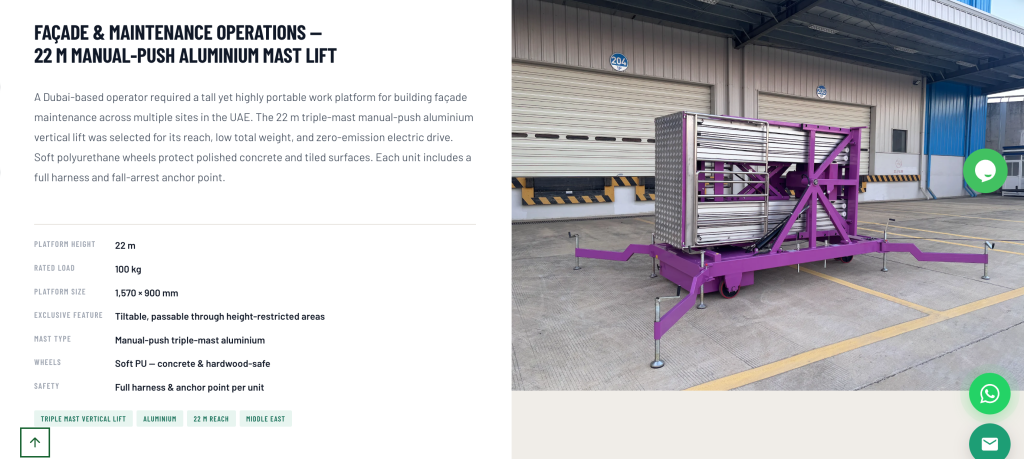
Façade & Maintenance Operations —
22 m Manual-Push Aluminium Mast Lift
Where a Tiltable Mast Lift Can Be Used
The tiltable configuration is most relevant to projects where the required working height is significantly greater than the available clearance along part of the access route.
Building and Facade Maintenance
Commercial buildings often have high-level facade, lighting and building-service maintenance requirements. At the same time, the equipment may need to enter through service entrances or other areas with restricted clearance.
A tiltable mast lift can be considered when the machine needs to reach a high working position after passing through a lower-clearance access point.
Shopping Malls and Large Commercial Buildings
Indoor commercial facilities may have high ceilings and large open areas, but the entrances used by maintenance equipment can be much lower.
Typical applications may include:
- Lighting maintenance
- Signage installation and repair
- HVAC-related work
- Interior building maintenance
- Inspection of high-level facilities
Industrial Facilities
Factories and industrial plants often have complex internal layouts. Equipment may need to pass through doors, production areas or covered passages before reaching the maintenance location.
In these environments, the ability to lower the mast during access can simplify equipment planning, provided the machine’s dimensions and the site’s operating conditions are suitable.
Warehouses and Distribution Centres
High-level lighting, electrical systems, sensors and building services all require periodic inspection and maintenance.
A tiltable mast lift may be suitable where the work area has sufficient height but the access route includes a lower doorway or other overhead restriction.
Airport and Transport Facilities
Large transport facilities can combine high ceilings with complex access routes and strict operational requirements.
For these projects, the machine configuration, access dimensions, floor conditions and site procedures need to be assessed in advance. Where the conditions are suitable, a tiltable mast design can provide additional flexibility when moving equipment into high-level maintenance areas.
Tiltable Mast Lift vs Standard Upright Mast Lift
The main difference between the two configurations is the way the machine approaches restricted access.
| Feature | Tiltable Mast Lift | Standard Upright Mast Lift |
|---|---|---|
| High-level vertical work | Yes | Yes |
| Mast position during access | Can be lowered | Remains upright |
| Height-restricted access | Suitable for selected applications | Depends on stowed machine height |
| Access planning | Requires checking lowered dimensions | Requires checking full stowed height |
| Typical advantage | Combines high reach with a lower access profile | Simple access where sufficient clearance is available |
This does not mean that a tiltable mast lift is the right choice for every project.
If the access route is high enough for a conventional upright mast lift, a standard configuration may already meet the requirements. The tiltable design becomes more relevant when the available clearance is lower than the height of the machine in its upright travel configuration.
For this reason, equipment selection should begin with the actual site conditions rather than the platform height alone.
Dubai Project: 22m Manual-Push Aluminium Mast Lift
The Dubai project involved facade and maintenance operations across multiple sites in the UAE.
The operator required a platform with sufficient height for high-level work, while also considering portability and access conditions between different work locations.
The selected configuration was a 22m manual-push triple-mast aluminium lift with a tiltable mast.
The equipment combines:
- 22m platform height
- 100kg rated load
- 1,570 × 900mm platform
- Triple-mast aluminium structure
- Manual-push operation
- Tiltable access configuration
- Soft PU wheels
- Full harness and fall-arrest anchor point
For this type of project, the tiltable mast is the feature that sets the machine apart from a conventional upright configuration. The mast can be lowered when moving through restricted-height areas and raised again once the equipment is positioned for work.
The exact access dimensions should be confirmed for each project, including the machine’s lowered height, doorway width, turning space and the complete route to the work area.
What to Check Before Choosing a Tiltable Mast Lift
Before selecting a machine, it is useful to review the complete route from the delivery point to the final working position.
Entrance Height
Measure the lowest clearance along the route. This may include doorways, loading bays, overhead beams, pipes and covered passages.
Doorway Width
Height is only one part of the access requirement. The narrowest doorway or passage should also be checked against the machine’s overall width.
Ground Conditions
Check the condition and load-bearing capacity of the floor along the travel route and at the final work position.
Required Platform Height
Confirm the required platform height for the task and distinguish it from overall working height when discussing the application.
Platform Load
Consider the combined weight of the operator, tools and any materials that will be carried onto the platform.
Stabilizer Position
The final work area must provide sufficient space for the stabilizers to be deployed correctly and for the machine to be set up according to the manufacturer’s instructions.
Local Site Requirements
Indoor and outdoor projects may have different requirements covering floor protection, operating procedures, safety equipment and local regulations. These should be reviewed before the equipment is selected and delivered.
A clear understanding of the access route can help determine whether a tiltable mast lift is appropriate for the project.
Is a Tiltable Mast Lift the Right Choice for Your Project?
A tiltable aluminium mast lift is worth considering when a project combines two requirements:
High-level vertical access and restricted access to the work area.
The 22m configuration supplied for the Dubai project is designed around this type of requirement. Its aluminium triple-mast structure provides the required platform height, while the tiltable mast allows the equipment to be lowered when moving through suitable height-restricted routes.
For projects where the access route is already high enough for a conventional upright mast lift, the additional tilting function may not be necessary. For sites with lower entrances or other overhead restrictions, however, it can provide greater flexibility during equipment selection and site planning.
If you are considering a 22m mast lift for a project with restricted access, Chenlift can review the required platform height, rated load, entrance dimensions and site conditions to help determine a suitable configuration.
Email: sales@chinaliftplatform.com
WhatsApp: +86-13951119762
Frequently Asked Questions
What is a tiltable mast lift?
A tiltable mast lift is a vertical lifting platform with a mast that can be lowered for access and relocation and returned to its upright position for elevated work.
It is particularly useful for applications where the work area requires significant vertical reach but the route to the site includes height restrictions.
How does a tiltable mast lift pass through a low-clearance area?
The mast is lowered before the machine enters the restricted section of the route. Once the machine reaches a suitable working position, the mast is raised again.
The actual clearance required depends on the specific machine configuration, so the lowered machine dimensions should be compared with the site’s access measurements before delivery.
Can a 22m tiltable mast lift be used indoors?
It can be used for suitable indoor applications where the access route, floor conditions, overhead clearance and final working area meet the requirements of the selected machine.
Applications may include commercial buildings, shopping malls, industrial facilities and warehouses.
What is the difference between a tiltable mast lift and a standard mast lift?
The main difference is the mast position during access.
A tiltable mast lift can lower its mast to reduce its height when entering or relocating through suitable restricted areas. A conventional upright mast lift remains in its normal vertical configuration, so its stowed height may limit access through lower entrances.
What should I measure before ordering a tiltable mast lift?
At minimum, the project team should check the lowest entrance height, narrowest doorway width, turning space, floor conditions, required platform height, platform load and available stabilizer space.
The machine’s confirmed dimensions should then be compared with the actual site measurements.
Is a tiltable mast lift suitable for facade maintenance?
It can be suitable for selected facade and building maintenance projects where the required work height is high but the access route includes height restrictions.
The suitability of the machine depends on the actual site conditions, required reach, load, access dimensions and operating environment.