CE Certified Aerial Work Platform: 6-Step Buyer’s Compliance Guide for Sourcing from China
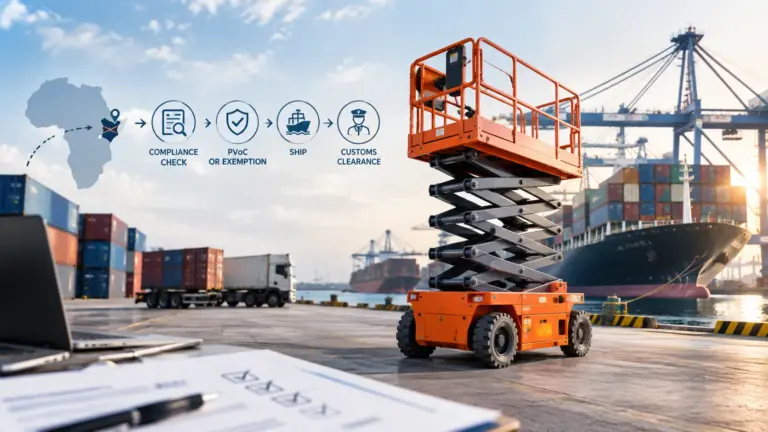
A container arrives at Rotterdam. Inside: a CE certified aerial work platform — scissor lift, CE mark on the identification plate, customs cleared without incident. The machine goes into your rental fleet.
Six months later, a workplace authority requests documentation following an incident involving a different unit from the same supplier. They want the Declaration of Conformity for every model in your fleet, the technical file index, and proof that the operator manual you shipped matches the machine serial.
You call the supplier. The sales contact doesn’t know what a technical file index is. The DoC they send you covers a product family, not the specific model configuration you bought. The manual is a 2019 generic revision that predates the control system change made in 2022.
That is the compliance gap. Not a fake CE mark. A real CE mark backed by incomplete or mismatched documentation.
This guide gives European distributors, importers, and procurement managers a buyer-side framework for verifying CE readiness before the PO is signed—using real documentation standards, not supplier marketing claims.
CE Mark ≠ CE Compliant: The Distinction That Matters at the Port
The CE mark on an identification plate is a manufacturer’s declaration. It tells you the manufacturer claims conformity. It does not tell you whether:
- The Declaration of Conformity is drafted for the exact model and configuration you are buying
- The legal basis is current and correct for the placing-on-the-market date
- The harmonised standards listed are relevant, current, and actually applied
- The operator manual is the correct revision for the configuration shipped
- The technical file exists per model and can be produced to a competent authority on request
- The plate details—manufacturer name, model, serial, year—match the paperwork word for word
If you operate as an EU importer or distributor, “we saw a CE mark” is not a defensible compliance position under the Machinery Directive. The legal obligations for placing machinery on the EU market sit with the importer when the manufacturer is outside the EU. That means the documentation risk is yours, not the supplier’s, once goods cross the border.
Buyer takeaway: Treat the CE mark as an entry point for document verification, not as evidence of compliance. Build your supplier qualification around model-specific documentation.
What EU Machinery Directive 2006/42/EC Actually Requires from a Supplier
Most aerial work platforms currently on the EU market were placed there under Directive 2006/42/EC—the framework that has governed machinery safety since 2010. The new Machinery Regulation 2023/1230 takes over from January 2027, but 2006/42/EC remains the operative legal basis for equipment being sold today.
From a procurement standpoint, you do not need a policy lecture. You need a clear picture of what your supplier must be able to produce—and what you can audit before committing a PO.
1. A machine that meets Annex I essential health and safety requirements
Annex I is where the Directive’s safety obligations live. The supplier’s job is to identify hazards, assess and reduce risks, and document residual risks and safe use conditions in the manual.
For aerial work platforms, the practical evidence of this work is not a generic “CE certificate.” It is a technical documentation trail: risk assessment tied to the specific configuration, design calculations, control system safety validation, test records, and instructions.
A supplier who cannot explain in plain technical language the main hazards of their equipment and the risk-reduction measures applied is a supplier whose technical file you should treat as unverified.
Buyer takeaway: Ask for a risk assessment summary—hazards, controls, residual risks—even if the full technical file is not shared. If it cannot be produced in summary form, the full file is unlikely to exist in usable condition.
2. Correct CE marking and identification plate information
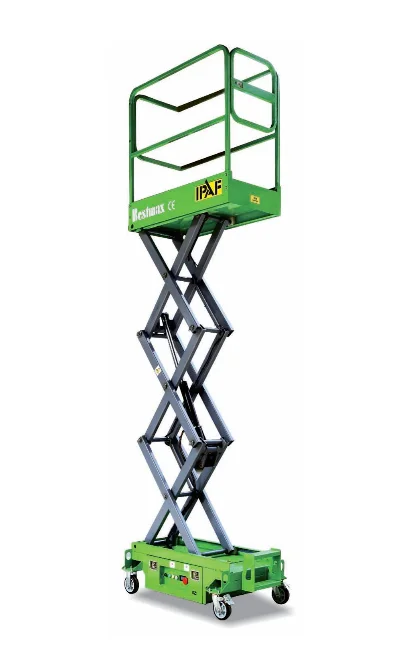
The CE mark is traceable only when combined with the identification plate. When you review pre-shipment documentation, the plate should show: manufacturer name and full address, model designation, serial number, year of manufacture, rated load or platform capacity, and CE marking.
Require a pre-shipment photo pack that shows the identification plate for each unit (or a representative sample with serials mapped per delivery). This becomes part of your compliance file.
Buyer takeaway: Make the identification plate photo a standard pre-shipment requirement. Ensure every field matches the DoC and manual revision. “CE mark present” is incomplete until the documentary trail is consistent.
3. A Declaration of Conformity that matches the machine you are buying
The DoC is the formal manufacturer’s statement of conformity. For buyers, it is also the first document to sanity-check for scope, completeness, and mismatch signals.
Know the boundary condition: partly completed machinery uses a Declaration of Incorporation, not a DoC. If a supplier provides a Declaration of Incorporation for equipment being sold and marketed as a complete, ready-to-use MEWP, treat that as a high-risk mismatch that requires clarification before the order proceeds.
Buyer takeaway: Require the DoC for your exact model before issuing a PO. Confirm it is signed by an accountable person—name, position, signature, date. A DoC signed by a sales representative with no defined compliance role is a documentation quality signal.
4. An operator manual that is Annex I-aligned and market-ready for your customers
The manual is not marketing collateral. Under the Machinery Directive, instructions are part of the safety package: intended use, foreseeable misuse, safe operation procedures, maintenance requirements, residual risks, emergency procedures, and warnings calibrated to actual hazards.
Manuals from Chinese suppliers commonly fail in predictable ways:
- A single generic manual covers an entire product family regardless of configuration differences
- The manual is not updated when the design changes—control system revisions, guarding changes, power type differences
- Emergency and rescue procedures are incomplete or absent
- The manual is not provided in the language required for the end-user market
Buyer takeaway: Require the exact manual revision that will ship with the machine. Ask how manuals are revision-controlled. Verify the manual references the same model designation as the DoC and identification plate.
5. A Technical File available per model, producible on request
The supplier does not ship the technical file in the crate. They do need to be able to produce it to competent authorities on request—typically for a specific model configuration, within a reasonable timeframe.
“Technical file available on request” stated in a sales pitch is a casual claim. “Technical file available per model configuration, response time within [X] business days to named competent authority contact” stated in a purchase contract is a documented obligation.
Buyer takeaway: Put technical file availability into your purchase terms as a contractual commitment. Ask who holds the file—manufacturer or trading company. Require a technical file index (table of contents) as a minimum deliverable before finalising supplier qualification.
Reading a CE Certificate: What Annex VIII Actually Means
When a supplier provides a CE “attestation of conformity” from a notified body or third-party certification body, buyers commonly assume this is equivalent to an EU type-examination. It is not. The procedure referenced in the certificate matters.
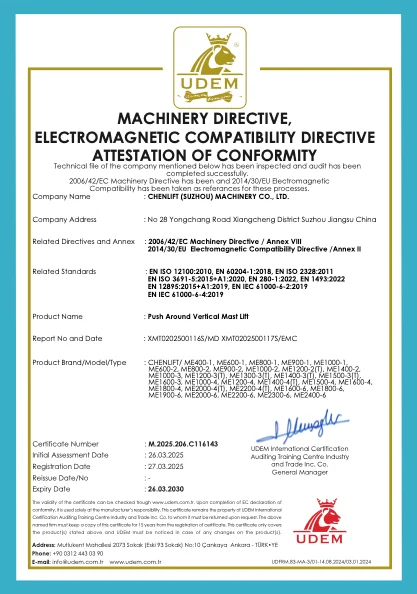
Under the Machinery Directive, manufacturers can follow different conformity assessment routes depending on product risk level. For most aerial work platforms not listed in Annex IV (the highest-risk machinery category), manufacturers can follow Annex VIII—which involves a third-party body reviewing and auditing the technical file, without performing independent type-examination testing.
What Annex VIII means in practice: A qualified third party has inspected the technical documentation and confirmed the technical file is in order. It is a meaningful step beyond pure self-declaration. It is not the same as Annex IV type-examination, which applies to the highest-risk machinery categories and involves the notified body examining the machine itself.
What to look for on the certificate:
- Which Annex is referenced (Annex VIII vs Annex IV vs others)
- Which body issued the certificate—check that it is a recognised certification body
- Which product types and model designations are specifically covered
- The standards listed, and whether they are MEWP-relevant
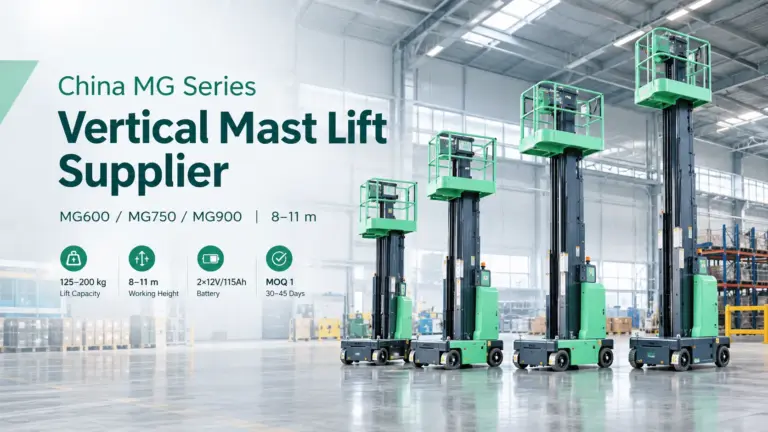
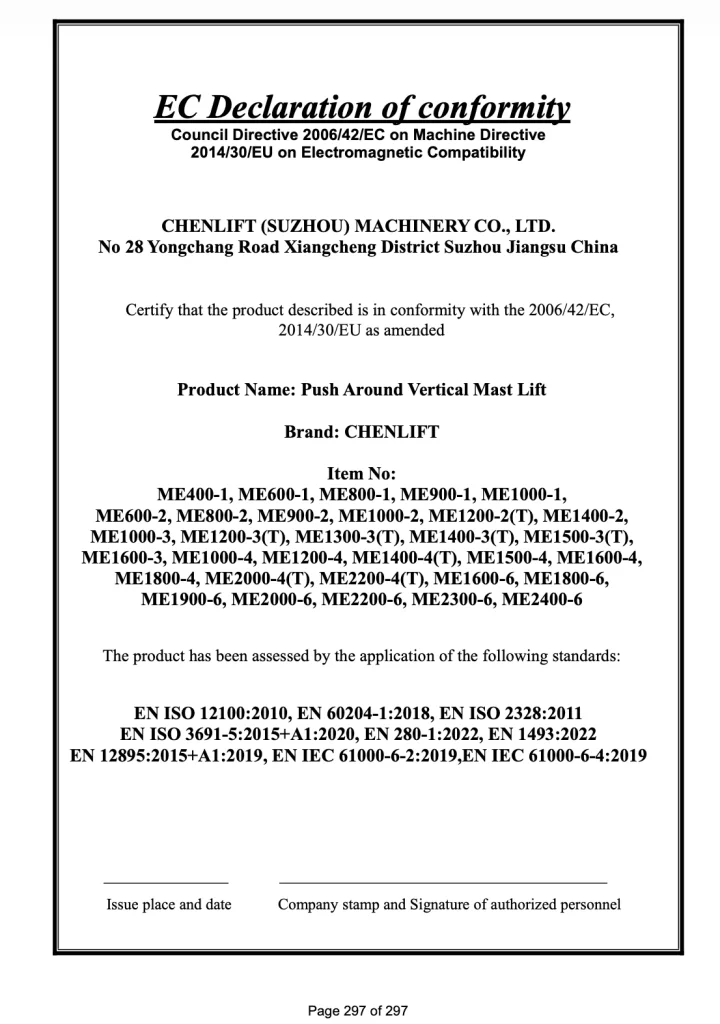
A practical example from the field: Chenlift’s current certificates (issued March 2025, valid to March 2030) are issued by UDEM International Certification under Annex VIII of 2006/42/EC, combined with 2014/30/EU EMC Directive Annex II. The standards listed include EN ISO 12100:2010, EN 60204-1:2018, EN 280-1:2022, EN 1493:2022, EN ISO 13849, EN 12895:2015+A1:2019, and the relevant EMC standards. The certificate covers specific named model families—ME series vertical mast lifts (31 models from ME400-1 through ME2400-6) and MK Mini scissor lifts (MK300DC, MK390DC, MK450DC)—not a blanket “all products” claim.
That model-level specificity is what a credible attestation looks like. A certificate that covers “aerial work platforms (various models)” without naming them is not model-specific and should be questioned.
Buyer takeaway: Ask for the certificate and read the Annex reference. Confirm model coverage is explicit. Understand that Annex VIII is third-party technical file review—credible, but not independent testing. Verify the standards listed match the product type.
Standards on the DoC: What Each One Signals
Suppliers often list harmonised standards on the DoC without buyers understanding what each standard validates. You do not need to audit the standards line by line. You need to confirm the standards listed are relevant to the equipment you are buying, and that the supplier’s compliance story is internally coherent.
EN 280-1:2022 — the MEWP-specific type-C standard
For MEWPs—scissor lifts, boom lifts, vertical mast lifts—EN 280-1 is the standard buyers should expect to see referenced. It sets out structural requirements, stability requirements, safety device performance, and test regimes specific to mobile elevating work platforms.
If the DoC for a MEWP does not reference EN 280-1, ask why. The answer may be legitimate (some low-height push-around platforms reference different standards), but it requires explanation.
Ask for a test report index showing which EN 280-1 tests were performed. “Tested to EN 280” without a test report reference is a low-value claim.
EN ISO 12100:2010 — risk assessment methodology
EN ISO 12100 defines the risk assessment and risk reduction process: identify hazards, estimate risk, apply protective measures, document residual risks. Its presence on the DoC signals that a formal risk assessment process was followed.
In supplier qualification, ask for a redacted risk assessment summary—hazards identified, protective measures applied, residual risks documented in the manual. If the risk assessment cannot be summarised because it is generic or does not exist per model configuration, that is a documentation quality failure.
EN ISO 13849 — safety-related control systems
MEWPs depend on control systems for core safety functions: platform load limits, interlocks, emergency stop logic, tilt sensing, operating envelope enforcement. EN ISO 13849 is the standard used to validate that safety-related parts of the control system achieve the required performance level.
Ask for a safety functions list and a validation summary tied to the control system actually used in the machine you are buying. “PL achieved” without supporting records is a claim, not evidence.
EN 60204-1:2018 — electrical equipment of machinery
EN 60204-1 covers electrical safety for machinery. Its presence on the DoC should be supported by electrical schematics in the technical file and electrical safety instructions in the manual.
Ask whether electrical schematics are included in the technical documentation. Verify the manual covers electrical isolation and maintenance procedures appropriate to the machine’s electrical design.
EN 12895:2015+A1:2019 and IEC 61000 series — EMC
Electromagnetic compatibility standards (EN 12895 for industrial trucks in electrically sensitive environments, IEC 61000-6-2 and 61000-6-4 for immunity and emissions) are relevant for electrically powered equipment operating in mixed environments. Their presence alongside the Machinery Directive standards indicates the equipment has been assessed under the EMC Directive as well as the Machinery Directive—a combined assessment that reduces the documentation burden for importers handling multiple directives.
EU Machinery Regulation 2023/1230: What Changes, and What to Ask Suppliers Now
The new framework—Regulation (EU) 2023/1230 on machinery—replaces Directive 2006/42/EC and becomes fully applicable on 20 January 2027. Equipment placed on the market before that date under 2006/42/EC remains valid.
For buyers, the transition creates three practical issues.
Issue 1: Mismatched legal basis on the DoC
You will receive DoCs from suppliers in 2026 and early 2027 that reference different legal frameworks. A DoC referencing 2006/42/EC for a machine placed on the market after 20 January 2027 is legally incorrect. Add a PO clause: “The legal basis cited in the Declaration of Conformity must correspond to the placing-on-the-market date.”
Issue 2: Software-dependent safety functions
The 2023/1230 Regulation strengthens requirements for software-driven safety functions and connected machinery. This matters for buyers because modern aerial work platforms increasingly rely on firmware-controlled interlocks, load management systems, and remote diagnostics.
For equipment with software-dependent safety functions, ask:
- Which safety functions depend on software or firmware?
- What validation evidence exists for those functions?
- How are firmware/software updates controlled—versioning, change notification, conformity re-assessment?
- Does a software update that changes a safety-related function require a new DoC?
Issue 3: Documentation accessibility and digital delivery
The new Regulation anticipates digital documentation delivery. Suppliers need a clear policy on how operator manuals, DoCs, and technical file indices are maintained and made accessible over the product’s service life—not just at the point of sale.
Buyer questions to ask now (before 2027):
- Which legal framework will your DoC reference for deliveries after 20 January 2027?
- Do you maintain a model-specific Technical File index per configuration?
- Which safety functions in this model depend on software, and what is your validation record?
- What is your policy for firmware/software updates that affect conformity?
- How do you provide documentation accessibility over the product service life?
- If a competent authority requests technical documentation, what is your response time and process?
Suppliers who cannot answer questions 3–6 are not necessarily non-compliant today. They are signalling documentation readiness risk for the post-2027 environment—and that risk lands with you as the importer.
What a Complete DoC Should Contain: A Field-by-Field Checklist
For machinery, the DoC is the document you can audit field by field against a known standard. Use this checklist as a sanity check before you file the DoC for any model you intend to distribute.
Manufacturer identification
- Legal company name (not trading name or brand name)
- Full address including street, city, country (not only city/country)
Authorised representative (if applicable)
- Name and EU address (only required if the manufacturer appoints one)
Machine identification
- Product name/type
- Model designation — must match identification plate exactly
- Serial number range or unit serial
- Configuration code if options change safety functions (recommended for configurable equipment)
Legal basis
- References to applicable EU legislation — verify the framework matches the placing-on-the-market date
Harmonised standards
- Standards listed with correct designation and edition/year
- For MEWPs: EN 280-1 reference expected; EN ISO 12100, EN ISO 13849, EN 60204-1 as applicable
- No unexplained standards that do not apply to the product type
Notified body / third-party involvement (where applicable)
- Body name and notified body number
- Annex procedure referenced (Annex VIII, Annex IV, etc.)
- Certificate or reference number
Place, date, and signature
- Place of issue
- Date of issue
- Handwritten or qualified electronic signature
- Full name and position/title of signatory (must be an accountable person with compliance responsibility)
Statement of conformity
- Clear statement that the machine conforms to the referenced requirements
Fast red flags when reviewing a DoC:
- Model name on DoC does not match the identification plate
- Address is incomplete or lists only a city and country
- Standards list includes EN 280 but product is not a MEWP in scope—or excludes EN 280 for a product that is
- Signatory is a sales contact with no defined compliance role
- DoC date is several years old with no revision record, but the machine design has been updated
- DoC covers a broad product family with no serial or configuration traceability to the unit you are buying
CE vs UKCA: Post-Brexit Handling for UK Distributors
If you distribute into the UK, you are operating in three distinct regulatory environments: the EU, Great Britain (England, Scotland, Wales), and Northern Ireland. These require separate compliance files.
European Union: CE marking under 2006/42/EC (transitioning to 2023/1230 in January 2027). Standard buyer-side requirements apply as described throughout this guide.
Great Britain: UKCA is the UK conformity marking. The UK has extended acceptance of CE marking for many product categories under transitional arrangements, but these arrangements are subject to policy updates. Do not treat “CE accepted in GB” as a permanent assumption. Require clarity from your supplier on whether documentation is prepared for EU (CE) or GB (UKCA) basis, and which marking applies to the specific equipment category and delivery date.
Northern Ireland: NI follows a distinct regime under the Windsor Framework. CE marking remains central for NI. UKNI-marked goods are not for the EU market. If you distribute cross-border between NI and GB, maintain separate compliance files.
Practical distributor action: Run two parallel compliance file tracks—EU pack and UK pack. Require the market destination to be stated on the DoC and shipment documents. Do not assume a CE-marked machine with EU documentation automatically satisfies GB requirements.
Common Mistakes When Verifying CE Documentation from Chinese Suppliers
These are avoidable procurement failures. They show up repeatedly in distributor onboarding reviews and post-incident investigations.
Mistake 1: Asking for a “CE certificate” instead of a DoC plus file evidence
A “CE certificate” from a third-party body is supplementary context. The core documents are the model-specific Declaration of Conformity, the operator manual for the exact configuration, the identification plate photo, and confirmation that a Technical File exists and can be produced. When you ask only for “the CE certificate,” you get a piece of paper and assume compliance has been verified.
Fix: Standardise your supplier documentation request. Ask for DoC, manual, plate photo pack, and technical file index—not “the CE certificate.”
Mistake 2: Not checking the legal basis and transition timing
Suppliers may reference outdated templates or the wrong framework. A 2019 DoC template citing 2006/42/EC for equipment placed on the market in 2028 is legally mismatched.
Fix: Add a PO clause requiring the DoC legal basis to match the placing-on-the-market date. Ask how the supplier plans to handle the 2023/1230 transition for deliveries around early 2027.
Mistake 3: Accepting generic manuals that do not match the configuration you bought
Options change safety information. Different control systems, power types, guarding configurations, and load ratings require different instructions. A generic manual that covers “MX series” does not cover your specific model configuration.
Fix: Require the exact manual revision for the configuration on your PO. Ask for a revision control statement showing how manuals are updated when the design changes.
Mistake 4: Ignoring model and serial traceability
When a workplace authority requests documentation following an incident, they need to see which documents apply to which serial numbers. A DoC that covers “product family X” without serial traceability to the unit in question is not useful in that situation.
Fix: Require serial mapping in the packing list and documentation pack. Keep plate photos in your procurement file per delivery.
Mistake 5: Not verifying who holds the Technical File
If you buy through a trading company, the Technical File may sit with the original equipment manufacturer—who may have no relationship with the trading company. When an authority requests documentation, the chain breaks.
Fix: Require a written statement, contractually, that the manufacturer holds the technical documentation and will provide it to competent authorities on request. Ask for the name and role of the responsible compliance or engineering contact—not the sales contact.
Evidence Pack: What to Request Before Signing a PO
This is the procurement artifact that closes the documentation gap fastest. Apply it to every product line you intend to distribute: scissor lift, vertical mast, boom lift, dock leveller, lift table.
A. Core documents (per model)
- EU Declaration of Conformity (model-specific, not product-family-generic)
- Operator manual (Annex I-aligned; correct language for your market; correct revision for the configuration)
- Identification plate photo pack (CE mark, model designation, serial number format, year of manufacture, manufacturer name and address)
- Technical File availability statement—written confirmation that the file exists per model/configuration and can be provided to competent authorities on request, with a stated response time
B. Technical file index
Request a table of contents listing at minimum:
- General arrangement drawings
- Electrical schematics and control system architecture
- Risk assessment document reference (EN ISO 12100-based)
- Safety functions list and validation summary (EN ISO 13849 where applicable)
- Test plan and test reports tied to EN 280-1 requirements (for MEWPs)
- Inspection records and final quality checks
C. Standards and compliance matrix
A one-page matrix that maps Annex I EHSR topic areas to the standards applied (EN 280-1, EN ISO 12100, EN ISO 13849, EN 60204-1) and to the evidence documents in the technical file. This forces the supplier to show the logic of their compliance claim, not just list standards.
D. Process commitments (for purchase terms)
- Documentation revision control: how manuals and DoCs are versioned and updated when design changes
- Design change notification: written notice before shipment if any change affects conformity
- Response time and process if a competent authority requests technical documentation
- Software/firmware update policy: versioning, change control, conformity re-assessment trigger
E. Traceability and labelling controls
- Serial number mapping per shipment
- Packing list referencing model/configuration
- Plate content sample and confirmation it matches the DoC template
F. Third-party certification context
If a supplier provides a third-party attestation (such as Annex VIII certification from a recognised body), treat it as a credibility marker that confirms the technical file has been reviewed by a qualified third party. It supplements but does not replace the model-specific document evidence above.
IPAF membership in the manufacturer category is a separate credibility indicator—it confirms the manufacturer engages with the international powered access industry’s safety standards and training framework. It is not a conformity assessment.
PO-Ready Evidence Pack Request: Email Template
Copy and adapt for your supplier qualification process.
Subject: MEWP CE compliance evidence pack request — [Your Company] supplier qualification — [Model/Product Line]
Hello [Supplier Name],
We are qualifying suppliers for EU distribution of mobile elevating work platforms and lifting equipment. Before we proceed to RFQ or PO, we require a model-specific CE compliance evidence pack for the following:
- Product line: [scissor lift / vertical mast / boom lift / dock leveller / lift table]
- Model(s): [model designation]
- Configuration/options: [power type, control options, guarding]
- Delivery date range: [month/year]
- Target market: [EU member states / Great Britain / Northern Ireland]
Please provide the following before we proceed:
- EU Declaration of Conformity (DoC) for each model — PDF, model-specific (not product-family-generic)
- Operator manual for each model/configuration — latest revision, revision date, language correct for our market
- Identification plate photo pack — showing manufacturer name and address, model designation, serial number format, year of manufacture, CE marking
- Written confirmation that a Technical File exists per model/configuration and can be provided to competent authorities on request — please state your response time
- Technical File index (table of contents) — listing at minimum: risk assessment reference, standards applied (EN 280-1, EN ISO 12100, EN ISO 13849, EN 60204-1 as applicable), safety functions list/validation summary, and test report references
- Documentation revision control statement — how you manage updates to manuals and DoCs when design changes occur
- Third-party attestation certificate (if applicable) — with Annex procedure referenced and model coverage confirmed
Please also confirm:
- The responsible technical/compliance contact for documentation requests (name, role, direct email)
- Your response time if an EU market surveillance authority requests technical documentation
- Your plan for DoC legal basis after 20 January 2027 (2006/42/EC transition to 2023/1230)
If any model on this list is partly completed machinery, please state this clearly and provide the relevant Declaration of Incorporation and assembly instructions.
Regards, [Name] | [Title] | [Company] | [Email]
How to Qualify a CE Certified Aerial Work Platform Supplier
Treat Chenlift the same way you treat any supplier in this process: apply the evidence pack request and verify model-specific documentation.
What the public record shows: current Annex VIII attestations (March 2025–March 2030) covering ME-series vertical mast lifts across 31 named model variants and MK Mini push-around scissor lifts, issued under both 2006/42/EC Machinery Directive and 2014/30/EU EMC Directive by UDEM International Certification. Harmonised standards include EN 280-1:2022, EN ISO 12100:2010, EN 60204-1:2018, EN ISO 13849, EN 1493:2022, EN 12895:2015+A1:2019, and the IEC 61000 EMC series.
The Mini MX self-propelled scissor lift series carries a separate 2025 certificate with independent EN 280-1, EN 60204-1, and EN ISO 12100 test reports on file—a step beyond attestation-only documentation. The MRT1200 rough-terrain scissor lift has its own dedicated certificate and test report.
Technical File and DoC are available on request per model. The full product range covers scissor lifts, vertical mast lifts, boom lifts, dock levellers, and lift tables.
Use the evidence pack template with Chenlift as with any supplier. The starting point for product range reference and documentation requests is chinaliftplatform.com.
FAQ
What does “CE certified MEWP” actually mean for an EU buyer?
“CE certified MEWP” typically refers to a mobile elevating work platform placed on the EU market by a manufacturer who has affixed CE marking and prepared a Declaration of Conformity supported by a technical documentation set. For machinery, “certified” in the strict sense depends on which conformity assessment route was followed. Equipment assessed by a third party under Annex VIII of the Machinery Directive has had its technical file reviewed by a qualified external body—a meaningful step beyond pure self-declaration, though not the same as Annex IV type-examination. For buyers, the practical test is model-specific traceability: the DoC names the model you are buying, the standards listed are relevant to a MEWP, the operator manual matches the configuration and language requirements, and the supplier can confirm the Technical File exists and can be produced to authorities on request.
Which EU machinery directive requirements apply when importing scissor lifts or boom lifts?
For MEWPs placed on the EU market now, the operative framework is Directive 2006/42/EC until 20 January 2027, when Regulation 2023/1230 becomes fully applicable. The Directive requires the manufacturer to meet Annex I essential health and safety requirements, draw up a Declaration of Conformity, affix CE marking, and maintain a Technical File available to competent authorities. As an EU importer buying from outside the EU, your obligations include verifying that the manufacturer has fulfilled these requirements before you place the machine on the market. The documentation package to verify is: model-specific DoC, operator manual aligned with the configuration, identification plate with traceable details, and a Technical File availability commitment. Use EUR-Lex for the Directive text directly, and require suppliers to show model/serial traceability across all three documents.
What changes under EU Machinery Regulation 2023/1230 for aerial work platform buyers?
The new Regulation keeps most of the Directive’s structure but strengthens requirements in areas that matter for modern aerial work platforms: software-controlled safety functions, connected and digitally supervised machinery, and digital documentation accessibility. For buyers, the practical shift is documentation discipline across the product lifecycle—not just at the point of sale. Suppliers need version-controlled documents (manuals, DoCs, technical file indices) and a defensible process for software and firmware updates that could change safety-related behaviour. Add these questions to your supplier qualification process now, before the January 2027 deadline makes them mandatory: which safety functions depend on software, how are firmware updates controlled, and how is documentation made accessible over the machine’s service life.
What should a DoC for a scissor lift include?
A compliant DoC for a scissor lift should identify the manufacturer by legal company name and full address; identify the specific machine by product type, model designation, and ideally serial number or serial range; state the applicable EU legislation with the correct Annex reference; list the harmonised standards applied—for a MEWP, EN 280-1 is expected alongside EN ISO 12100, EN ISO 13849, and EN 60204-1 as applicable; include notified body or third-party certification details where applicable (body name, number, Annex procedure, certificate reference); and be signed and dated by an accountable person with name and position. The buyer-side test is consistency: model designation and manufacturer details must match the identification plate and the manual revision in use for that configuration.
Is CE documentation sufficient for the UK after Brexit?
Not automatically. Great Britain (England, Scotland, Wales) uses UKCA marking under its own conformity framework. The UK has accepted CE marking under transitional arrangements for various product categories, but these arrangements are not permanent and are subject to policy changes—check current GOV.UK guidance for your specific equipment category. Northern Ireland operates under a distinct regime where CE marking remains central, and UKNI-marked goods are not for the EU market. As a UK distributor, maintain two parallel compliance file tracks: an EU documentation pack (CE, DoC under 2006/42/EC) and a UK documentation pack (UKCA or confirmed CE acceptance, appropriate declaration basis for GB). Always state the market destination on both the DoC and shipment documents to avoid cross-market compliance mismatches.
How do you verify whether a Chinese MEWP supplier’s CE documentation is genuine?
The most effective verification approach is structural: request the full evidence pack (DoC, manual, plate photo, technical file index, third-party certificate) and check for internal consistency rather than looking for a single “authentic” document. Red flags for documentation weakness include a DoC that covers a broad product family without naming your model, a manual that doesn’t match the configuration you ordered, a third-party certificate without Annex procedure reference, and a supplier who cannot name a technical or compliance contact separate from the sales team. For third-party certificates, the issuing body’s website usually allows certificate number verification—use it. For DoCs, the consistency test (plate vs DoC vs manual) is more reliable than any authenticity check on the document itself.
Chenlift (Suzhou) Machinery Co., Ltd. | No. 28 Yongchang Road, Xiangcheng District, Suzhou, Jiangsu, China | CE certified aerial work platform manufacturer | IPAF Member (Manufacturer category)
Full product range and CE documentation requests →