
Self-Propelled vs Push-Around Scissor Lift: MX Series vs MK Series Compared
You are evaluating scissor lifts and the shortlist has come down to two categories: a self-propelled electric model that drives itself, and a push-around model that stays where you put it. Both can reach the same working height. Both are built for elevated access work. The decision between them is not obvious — and making the wrong call means either paying for capability you don’t use, or discovering mid-job that your machine can’t do what the work actually requires. This is a direct comparison of the self-propelled vs push around scissor lift decision, using Chenlift’s MX and MK Series as the reference models.
This comparison covers Chenlift’s MX Series (self-propelled scissor lifts) and MK Series (manual push scissor lifts) across every dimension that matters to a buyer: drive system, platform capacity, aisle requirements, power setup, working environment, and the six job scenarios where each machine wins.
The Single Biggest Misconception: Bigger Machine, More Capacity
Before the spec comparison, one fact that surprises most buyers:
The MK Series carries more load than the MX Series. Standard MK models (MK600 through MK1600) have a platform capacity of 500 kg. The MX Series tops out at 320 kg for most models. The MK T-Series (MK600T, MK900T, MK1200T) goes further — up to 1,000 kg platform capacity.
The self-propelled machine is not the heavy-duty option. The push-around machine is.
This matters enormously for jobs involving heavy components — HVAC units, electrical panels, structural fixtures, or any situation where two people plus substantial materials need to be on the platform simultaneously. If your procurement decision is driven by load capacity, the MK Series wins on that dimension regardless of anything else.
Side-by-Side: Core Specifications
| MX Series (Self-Propelled) | MK Series (Manual Push) | |
|---|---|---|
| Working height range | 5.8m – 17.8m | 8m – 18m |
| Platform capacity | 230 – 320 kg | 500 kg (1,000 kg T-Series) |
| Platform size | Up to 3.00 × 1.15 m | Up to 2.73 × 1.50 m |
| Drive system | Self-propelled electric, drivable at full height | Manual push, no drive motor |
| Inside turning radius | Zero (can pivot within own footprint) | Fixed position when outriggers deployed |
| Power source | 4 × 6V battery (200–260 Ah), on-board charger | AC 220V/380V mains supply (DC optional) |
| Travel speed (stowed) | 3.5 km/h | Manual push (no drive) |
| Travel speed (raised) | 0.8 km/h | Not applicable |
| Machine weight | 860 – 4,200 kg | 1,018 – 2,950 kg |
| Outriggers | Not required | Deployed for all elevated work |
| Gradeability | 25% | Not rated for ramp travel |
| Indoor/outdoor | Both | Primarily indoor |
| Typical operator count | 1–2 operators on platform | 1–2 operators on platform |
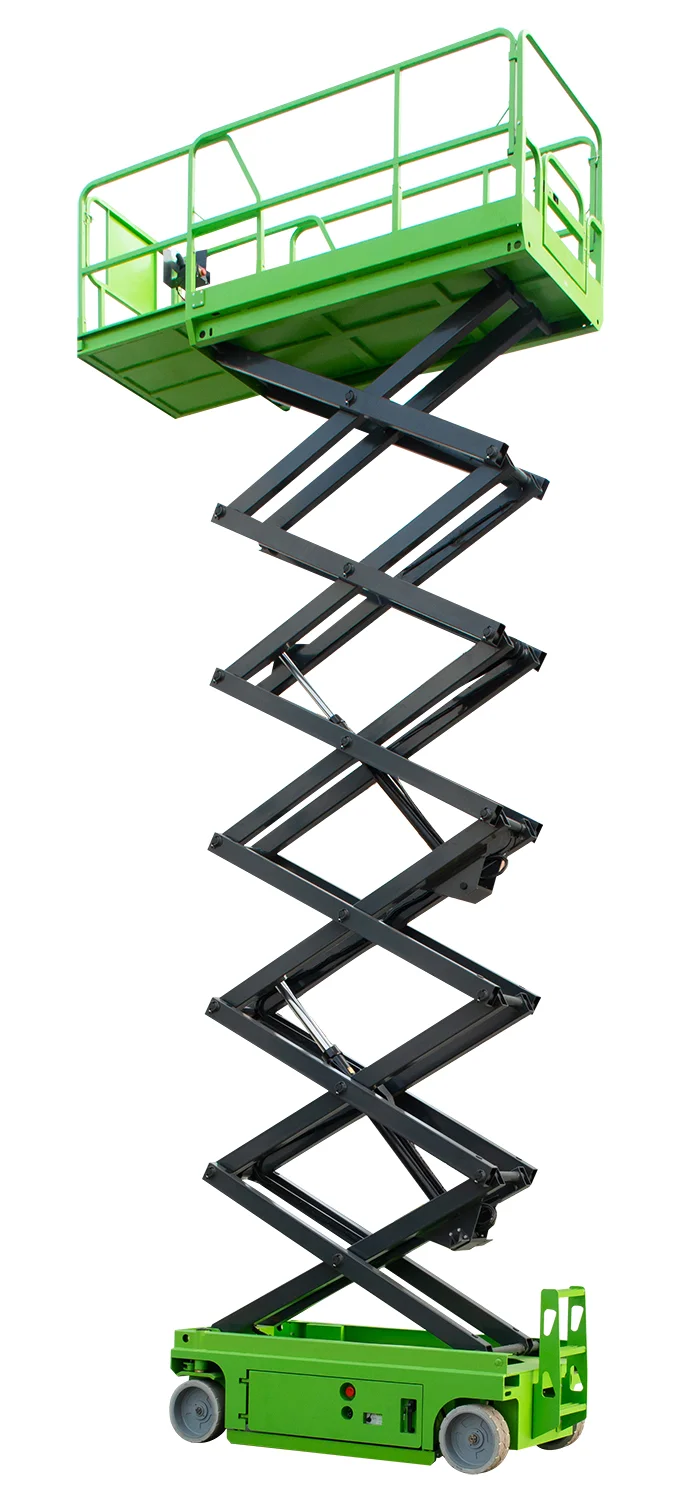
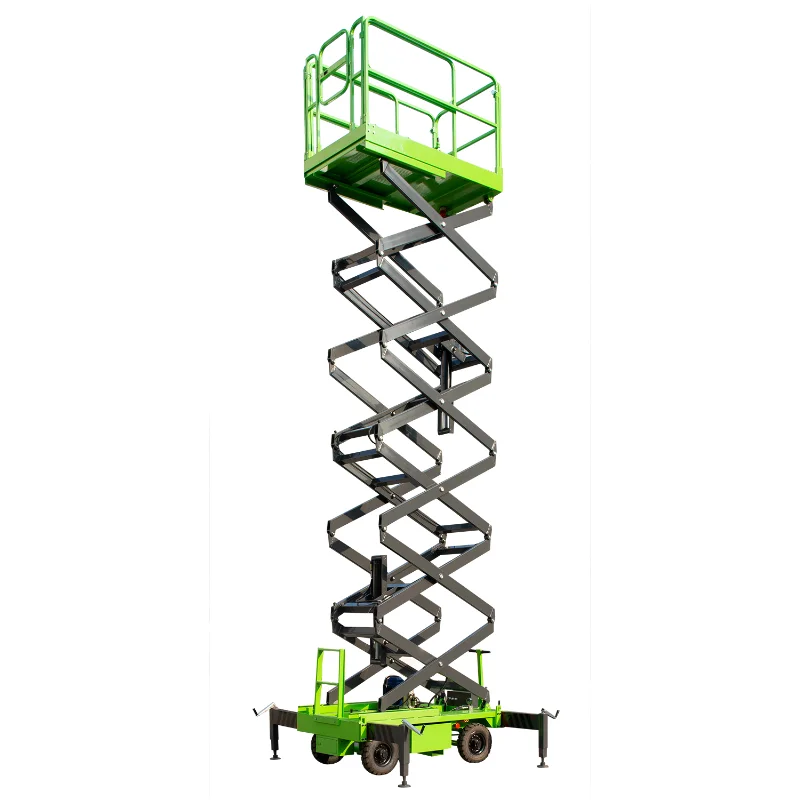
Chenlift MX self-propelled vs MK push-around scissor lift comparison
Explore the full specifications:
Drive System: What It Actually Changes
The drive system is where the self-propelled vs push around scissor lift decision becomes most visible in daily operation. The drive system difference is not just about convenience. It fundamentally changes what kind of work is practical.
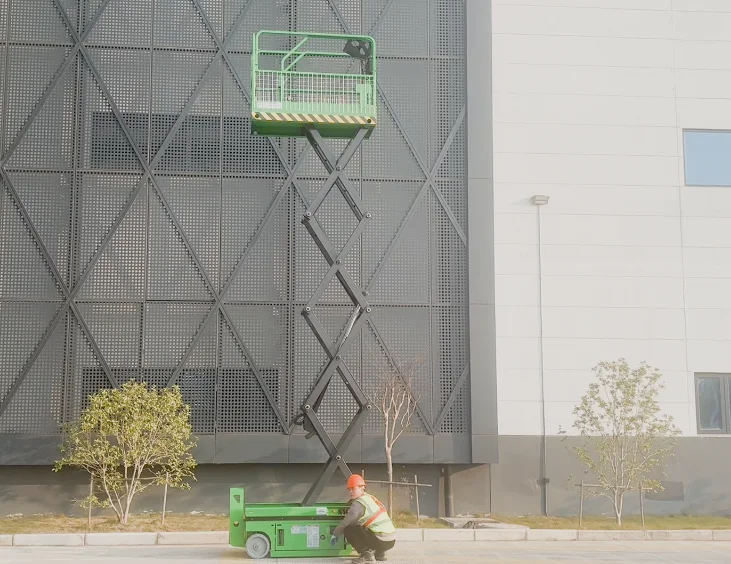
MX Series — self-propelled at full height. The MX Series uses an asynchronous AC motor with proportional joystick control. The machine drives at 3.5 km/h when stowed and continues to move at 0.8 km/h when fully elevated — the operator stays at height and repositions without descending. For a job that involves 10 or 20 repositioning moves across a large facility — replacing lighting along a racking run, inspecting overhead infrastructure bay by bay — the time difference between driving at height and repeatedly lowering, moving, and re-elevating adds up to hours across a full day’s work.
The zero inside turning radius means the MX can pivot within its own footprint. In an active warehouse aisle where space is shared with forklifts and racking, this allows precise positioning in tight corridors without multi-point turns.
MK Series — fixed when elevated. Once the MK’s outriggers are deployed and the platform is raised, the machine does not move. Repositioning means lowering the platform, retracting the outriggers, physically pushing the machine to the new position, re-deploying outriggers, and re-elevating. On a job with two or three fixed work points, this adds minimal time. On a job requiring constant repositioning across a large floor area, it becomes the constraining factor on productivity.
This is not a flaw in the MK design — it is the correct trade-off for a machine that prioritises stability and load capacity over mobility. The question for the buyer is which constraint matters more for the specific work at hand.
Platform Capacity: When 500 kg Changes the Decision
The MX Series handles two operators plus a standard tool load comfortably within its 230–320 kg platform rating. For maintenance, inspection, and installation work where the load on the platform is primarily people and hand tools, the MX capacity is sufficient.
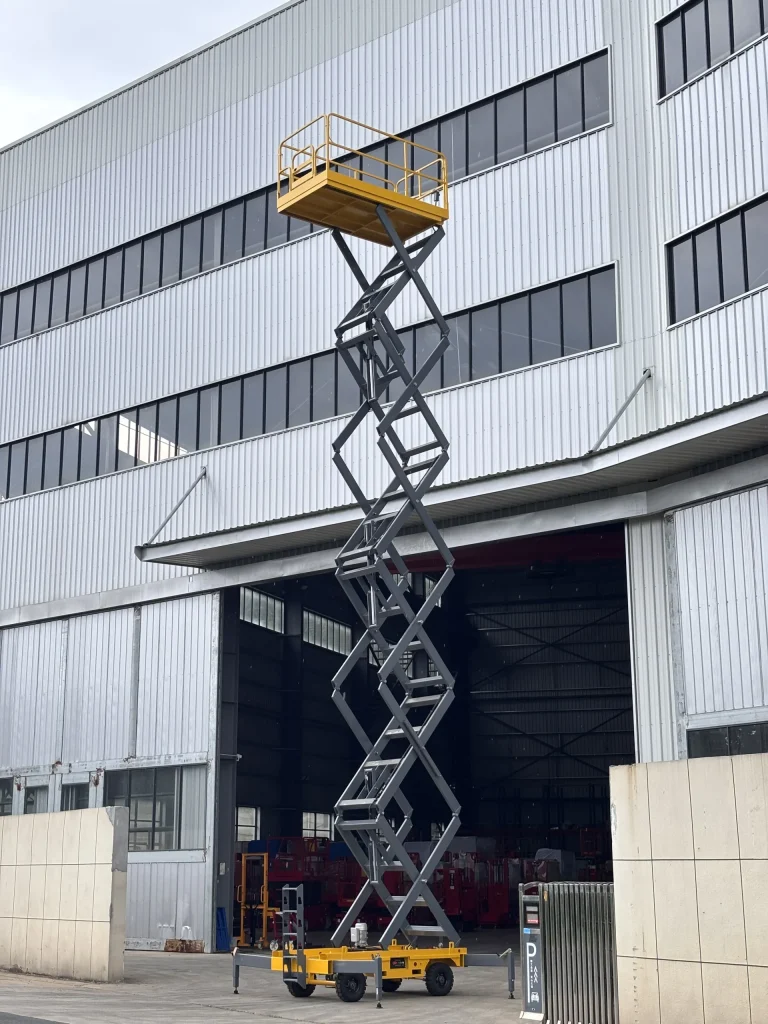
The MK Series 500 kg rating opens different categories of work:
- Staged component installation: A 500 kg platform can hold two operators (180 kg combined) plus 300+ kg of components, fixtures, or equipment being installed at height. This is not possible on an MX platform without exceeding its rating.
- Heavy HVAC or mechanical work: Air handling units, ductwork sections, and mechanical equipment that must be positioned at height benefit from the MK’s load headroom.
- Material staging: Using the platform as a temporary staging surface for multiple heavy items while working is viable on an MK in a way it is not on an MX.
The MK T-Series (600T, 900T, 1200T) with 1,000 kg capacity is a separate category entirely — designed for industrial and construction applications where extreme platform loads are the primary requirement.
If load capacity is driving the decision, the MK Series is the correct starting point. If mobility and repositioning speed matter more than load headroom, the MX Series is correct.
Power and Infrastructure Requirements
MX Series: Battery-powered with an on-board charger accepting 96–265V AC input. The machine operates without a power cable during use — no trailing cable to manage, no proximity to a power outlet required. A full charge supports a standard working day of typical warehouse maintenance tasks. Charging happens during off-hours from any standard outlet.
MK Series: Primarily AC mains-powered during operation, with the lifting motor drawing from 220V or 380V supply depending on the model. An optional DC battery kit is available for cordless operation when mains access is limited. For facilities with fixed AC outlets in the work area — common in manufacturing plants and large warehouses — the AC power supply is straightforward. For facilities where access points are spread across large floor areas without consistent outlet proximity, the DC option or the MX Series becomes more practical.
The infrastructure question matters most at the point of purchase, not in the spec sheet. Before choosing a push-around model, confirm that power outlets are accessible at all the work locations you intend to use it. For a facility that regularly works in areas more than 15–20 metres from the nearest outlet, the DC option or a battery-powered machine becomes necessary.
Aisle Width and Space Requirements
MX Series: Machine widths range from 0.76 m (MX580S, MX Mini models) to 1.53 m (MX1400S, MX1600S). The narrow entry models (MX580S at 0.76 m, MX800SN at 0.81 m) are specifically designed for aisle operation in racking environments where forklift aisles are 2.5–3.0 m wide. Zero inside turning radius means no additional clearance needed for maneuvering.
MK Series: Machine widths range from 1.02 m (MK600) to 1.64 m (MK1600). The critical space consideration is the outrigger footprint rather than machine width — outriggers extend the effective working footprint to 2.54 m × 2.1 m for the MK600, and up to 2.94 m × 2.73 m for the MK1600. In a racking aisle, deploying MK outriggers requires clearing the aisle completely — the machine occupies the full aisle width during operation. For facilities where work can be scheduled during off-hours when aisles are clear, this is manageable. For facilities with continuous material flow that cannot pause, the MX’s ability to operate while sharing an aisle is a practical advantage.
Self-Propelled vs Push Around Scissor Lift: Six Job Scenarios
Scenario 1: High-bay racking maintenance across multiple bays Choose the MX Series. The job involves repeated repositioning across a long racking run. Driving at full height between bays means 10 repositioning moves take minutes, not an hour. An MX800S or MX1000S covers this scenario with two operators and tool loads well within the 320 kg rating.
Scenario 2: Installing heavy mechanical equipment at height Choose the MK Series. If the component being installed weighs 200–300 kg, plus two operators, the MX platform rating is exceeded before tools are added. The MK’s 500 kg capacity and stable outrigger base make it the correct machine for this category of work. The job has fewer repositioning moves; the load capacity is the binding constraint.
Scenario 3: Active production facility, shared aisle with forklifts Choose the MX Series. The MX can maneuver in an active aisle with zero turning radius and drive at full height between positions. MK outrigger deployment requires a clear aisle and significantly more setup time per position.
Scenario 4: Indoor facility with reliable AC power, fixed work points Choose the MK Series. For work at fixed overhead locations — a ceiling-mounted system being maintained in place, specific structural connection points — the MK’s mains-powered operation is clean, simple, and well-suited. The 500 kg capacity handles most industrial component work. Lower equipment cost relative to a self-propelled machine of equivalent height.
Scenario 5: Large distribution centre, mixed work heights across multiple zones Choose the MX Series. The ability to drive between work zones, adjust height on the move, and operate without a trailing power cable makes the MX the more productive machine over a full working day across a large facility. Battery run time is a consideration for extended shifts — plan charging around break periods.
Scenario 6: Rental fleet or multi-site deployment Depends on the use profile. MK Series machines are generally lighter for equivalent working heights, simpler mechanically (no drive system), and lower in acquisition cost — factors that favour fleet economics for rental operators serving customers who primarily need static elevated access. MX Series machines carry higher utilisation rates in self-service fleet environments where end-users value mobility and don’t want to manage power supply logistics.
What Chenlift’s MX and MK Series Are Built For
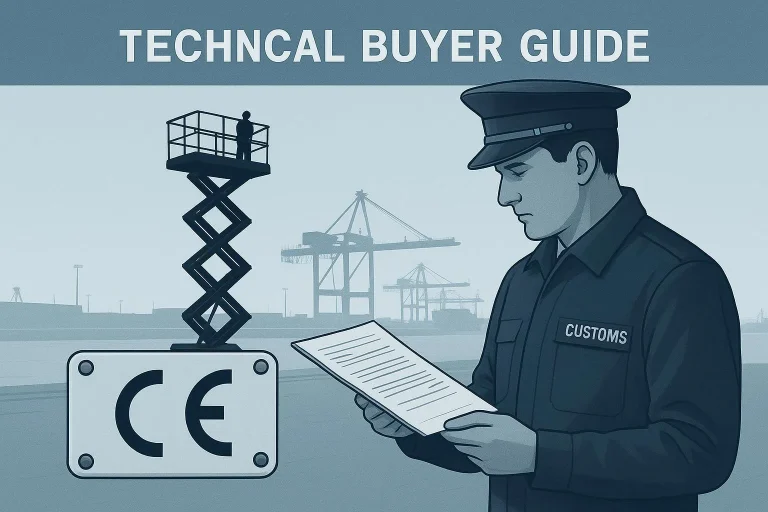
Both product lines are fully electric with zero direct emissions — suitable for indoor operation where combustion equipment is excluded. CE certification under EU Machinery Directive 2006/42/EC applies to both series, issued by UDEM International Certification (valid 2025–2030), covering all standard models.
MX Series specific features worth noting:
The asynchronous AC motor with proportional control enables smooth, variable-speed movement that makes precise positioning at height practical rather than approximate. Automatic pothole protection halts drive movement if the front wheels drop more than a set threshold — a relevant safety feature in warehouses with floor joints, damaged concrete, or dock transitions. Tilting protection sensor cuts operation if the machine exceeds safe inclination limits. Drivable at full height is the standard configuration across all MX models, not a premium option.
The MX800SN is a narrow-aisle variant of the MX800S — 0.81 m wide instead of 1.18 m, with a correspondingly narrower platform (2.30 × 0.81 m). For facilities where aisle width is genuinely tight, this model closes the gap between maximum reach and minimum footprint.
MK Series specific features worth noting:
Detachable outriggers on standard MK models allow configuration for different floor environments and work requirements. The optional motorized device with DC power converts the push-around machine into a self-propelled unit for repositioning — useful for facilities where the job mix varies between static and mobile work. AC power supply in both 220V and 380V variants covers the full range of industrial power standards encountered globally.
The MK T-Series (1,000 kg capacity) positions these machines as purpose-built heavy-lift platforms rather than simply higher-capacity versions of the standard MK — suitable for construction phase work, heavy equipment installation, and industrial applications where standard MEWP capacity limits are inadequate.
On Pricing
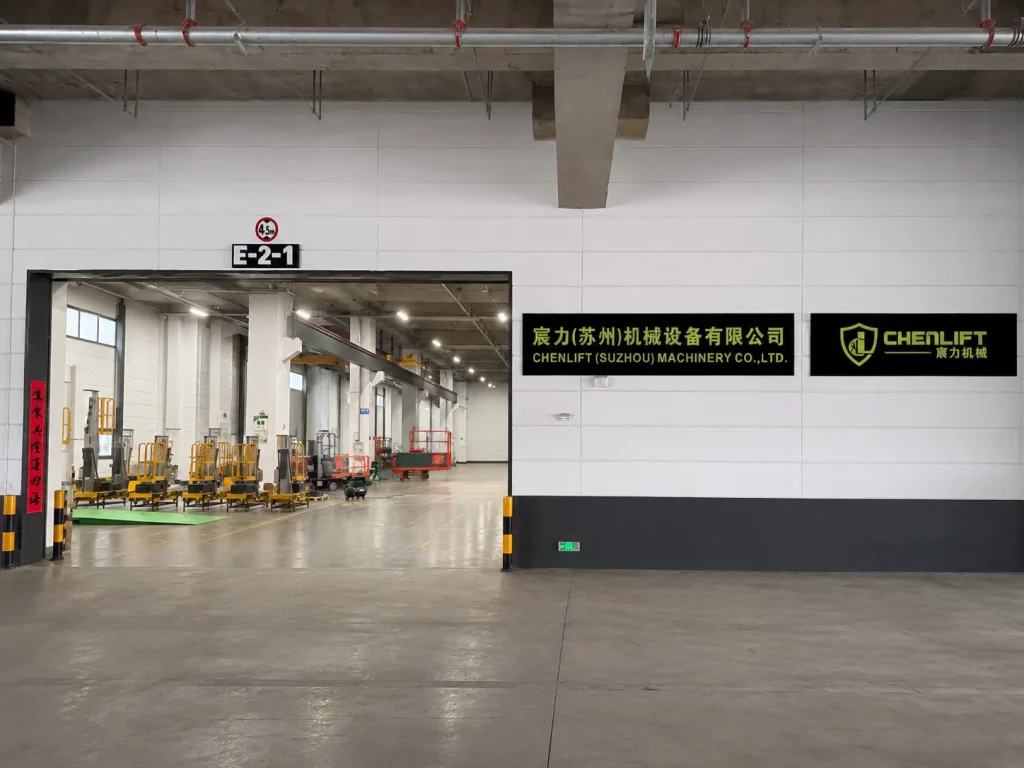
Both MX and MK series machines are manufactured at Chenlift’s facility in Suzhou, Jiangsu, China and shipped globally. As a general principle, the MK Series has a lower initial acquisition cost than the MX Series of equivalent working height — the absence of a drive system, traction motor, battery management electronics, and travel controls means fewer components and lower manufacturing cost. For buyers where upfront equipment cost is a primary constraint, this difference is meaningful.
However, the final landed cost for any buyer depends on factors that cannot be generalised: destination country, applicable import duties and taxes, shipping mode and current freight rates, local distributor or direct-purchase arrangements, and any certification or documentation requirements for the destination market (CE for EU, SABER for Saudi Arabia, and so on). A price quoted ex-works Suzhou and a price landed in Brazil, Germany, or the UAE are entirely different numbers, and publishing a single figure would mislead more buyers than it helps.
The correct approach is a project-specific quotation. Contact Chenlift directly with your destination, model requirements, and order quantity — the sales team can provide a landed-cost estimate that reflects the actual variables in your situation.
For full product specifications before requesting a quote:
- MX Series: chinaliftplatform.com/products/scissor-lift/mx-series
- MK Series: chinaliftplatform.com/products/scissor-lift/mk-series
PDF datasheets for individual models are available at chinaliftplatform.com/support/aerial-work-platform-pdf-download.
Frequently Asked Questions
Can a push-around scissor lift be used without mains power?
Yes. Standard MK Series models operate on AC 220V or 380V mains supply, but a DC battery option is available for cordless operation. The DC kit includes a battery pack and charger, allowing the machine to operate independently of outlet proximity in the same way a self-propelled machine does. For buyers who need the MK’s load capacity but cannot guarantee consistent outlet access, confirm the DC configuration at the time of order. This is one of the most common clarifications buyers need when evaluating self-propelled vs push around scissor lift options.
Is the MX Series suitable for narrow warehouse aisles?
The MX580S (0.76 m wide) and MX800SN (0.81 m wide) are the narrow-aisle configurations in the MX range. A standard 2.8–3.0 m forklift aisle comfortably accommodates either model with clearance for personnel on both sides. The zero inside turning radius means no additional maneuvering space is needed beyond the machine width. For aisles below 1.5 m, no scissor lift is appropriate — a vertical mast lift should be considered instead.
What is the maximum working height available in each series?
The MX Series reaches 17.8 m working height (MX1600S). The MK Series reaches 18 m working height (MK1600). For most warehouse and industrial maintenance applications below 14 m, either series covers the requirement — the height ceiling is not typically the deciding factor in the MX vs MK choice.
Can two people work on a push-around scissor lift at the same time?
Yes. Standard MK models have platform capacities of 500 kg with platform sizes up to 2.73 × 1.50 m — sufficient for two operators plus heavy materials. Check the specific model’s platform dimensions and capacity rating against the combined weight of all personnel and materials intended for simultaneous platform use. Never exceed the rated capacity regardless of platform size.
Does the self-propelled MX Series require a special driving licence or certification?
Operator certification requirements vary by country and jurisdiction. In most markets, operating a self-propelled scissor lift requires a platform work equipment or MEWP operator qualification — similar to the requirement for other powered aerial work platforms. The machine itself does not require a vehicle driving licence. Buyers are responsible for ensuring operators are trained and certified to the standards applicable in their country of use.
What maintenance differences should I expect between the two series?
The MX Series has a drive system in addition to the lifting mechanism — drive motors, drive electronics, and battery management add to the maintenance scope compared to a push-around machine. Battery health and charging practices directly affect MX Series operational reliability over time; a well-maintained battery pack on a scheduled replacement cycle performs predictably, while a neglected one degrades performance before failure is obvious. The MK Series has a simpler mechanical scope — the lifting cylinder, hydraulic circuit, and electrical controls for the lift function only. For operators managing a mixed fleet, MK machines generally require less scheduled maintenance per operating hour than MX machines of equivalent age.
Not Sure Which Series Fits Your Facility?
If the scenarios above haven’t resolved the decision — or if your application has constraints that don’t map cleanly to either category — Chenlift’s engineering team can advise based on your specific requirements. Provide your working height, platform load, aisle width, power availability, and destination country, and the team will recommend the most suitable model and provide a landed-cost quotation.
Contact Chenlift via the website or WhatsApp (+86-139-5111-9762) to start the conversation.
For CE certification documentation applicable to either series, see Chenlift’s CE compliance guide for aerial work platforms. For buyers importing into Saudi Arabia, SABER certification support is available for both series — see the SABER certification guide.
IPAF : ipaf.org