Scissor Lift vs Vertical Mast Lift: The Real Trade-offs for Warehouse Maintenance
Your facility has two jobs this week. The first: replace ballast fixtures along a 10-meter racking run in the main distribution bay — wide aisles, smooth concrete, two technicians working together. The second: service the HVAC units on the mezzanine level, where the structural engineer’s load rating says 300 kg/m² and there’s no room to negotiate.
One machine cannot do both jobs safely. That’s the conversation most equipment guides skip.
This article is a direct comparison of self-propelled scissor lifts and push-around vertical mast lifts for warehouse maintenance use. The goal is simple: give you the engineering numbers and the situational logic to choose correctly — and avoid a machine sitting idle because it can’t go where the job is.
Scissor Lift vs Vertical Mast Lift: The Core Difference
Both machine types can reach 8–14 meters of working height. That overlap is exactly why buyers get confused. The real split happens across three dimensions that aren’t on the same spec line.
Platform capacity and size. The MX800S scissor lift carries 320 kg on a 2.30 × 1.15 m deck — enough for two operators plus a full tool bag and a replacement fixture. The ME800-2 double-mast lift carries 200 kg on a 1.30 × 0.70 m platform. One person, a drill, and a light components bag. These aren’t interchangeable situations.
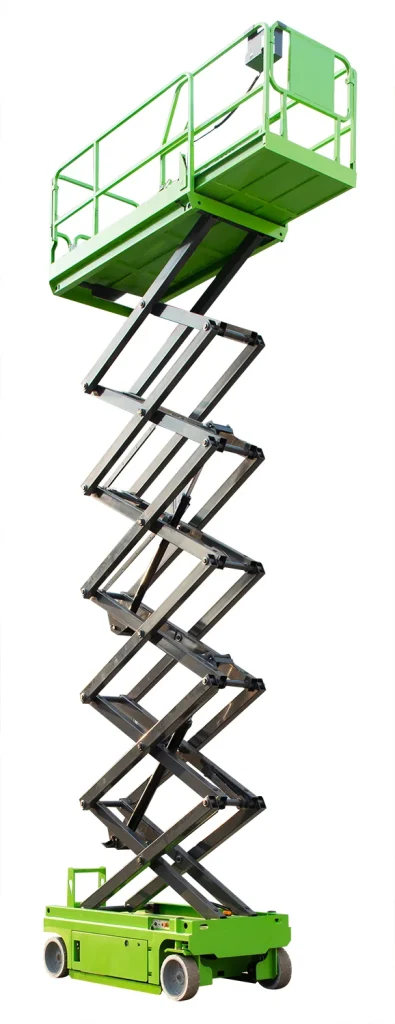
Machine weight. The MX800S weighs 2,050 kg. The ME800-2 weighs approximately 650 kg. Both machines reach 8 meters of working height. The weight difference is roughly 3:1. This single number determines whether the mezzanine floor is even an option.
Mobility. The MX series drives at full height (up to 0.80 km/h raised) and has a zero inside turning radius — it can reposition mid-bay without coming down. The ME/DM mast lifts are push-around machines with outrigger stabilization. Every repositioning means lowering, collapsing outriggers, moving, re-leveling, and going back up. On a 20-meter racking run with six lighting bays, that time cost adds up to most of a morning.
Five Scenarios — Which Machine Wins and Why
When choosing between a scissor lift and a vertical mast lift, the right answer depends entirely on where the job is, not which machine looks more capable on a spec sheet.
Scenario 1: Long racking runs in wide-aisle bays Choose the scissor lift. The MX series drives at full height with zero inside turning radius. An operator can cover 20–30 meters of overhead work without descending once. Two operators on a 2.30 × 1.15 m deck with tools staged on the platform is a legitimate working setup. A mast lift can do this job, but the repositioning cycle makes it the slower, more fatiguing option by a significant margin.
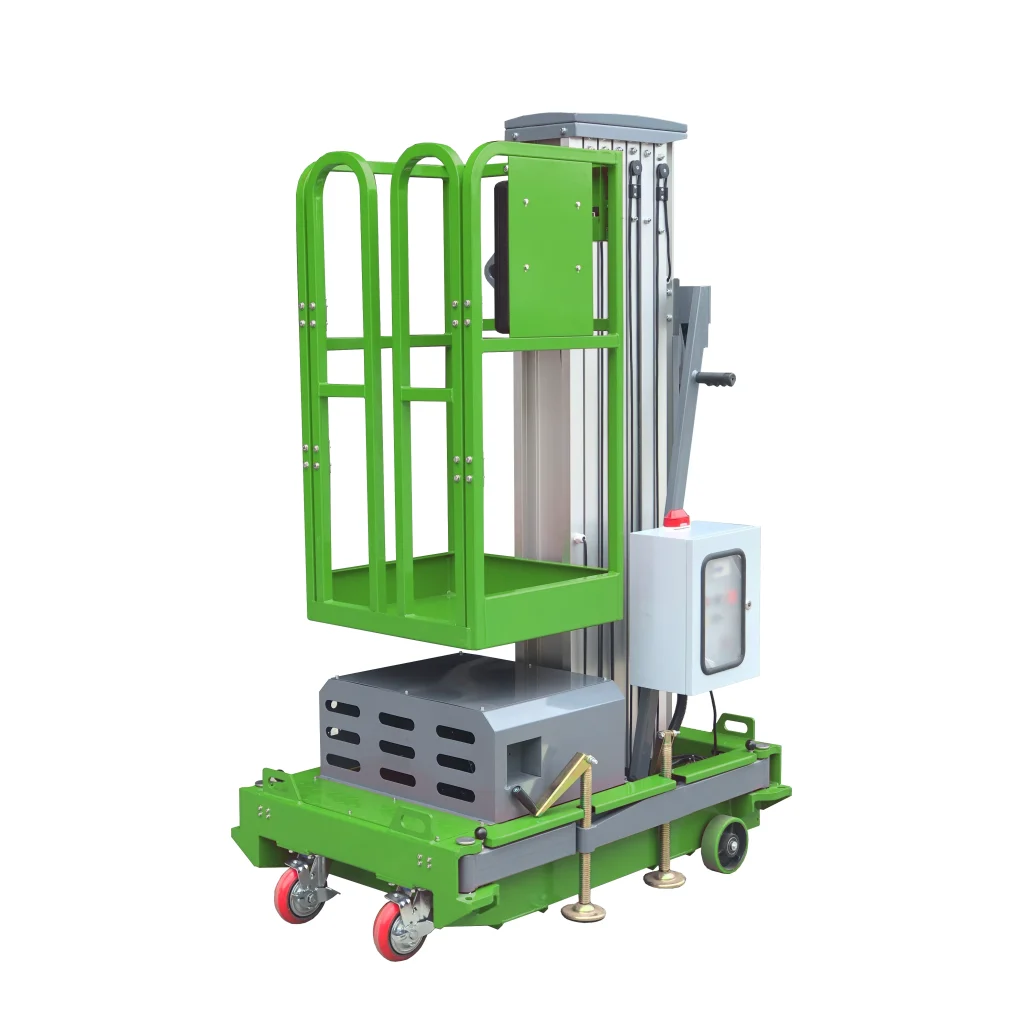
Scenario 2: Mezzanine floor with structural load limits Choose the mast lift. This is not a preference — it is often a hard constraint. A mezzanine rated at 300 kg/m² with an MX800S (2,050 kg) parked on it is a structural engineering problem, not a judgment call. The ME800-2 at ~650 kg distributes load across an outrigger footprint of 2.10 × 2.02 m. Run the math with your facility manager before shortlisting anything else. The number you need is not the machine weight alone — it’s machine weight + operator (roughly 80–100 kg) + tools, divided across the contact footprint.
Scenario 3: Narrow aisles or confined ceiling maintenance Choose the mast lift. The ME series single-mast models stow to 0.84 m wide. In a racking aisle where forklifts operate at 2.8–3.0 m clearance, a mast lift fits cleanly. An MX800S at 1.18 m wide needs a wider corridor and cannot share space with active picking operations as easily.
Scenario 4: Multi-operator jobs or heavy component work Choose the scissor lift. If the job involves two people working simultaneously — one holding, one fastening — or requires staging components at height (a motor, a duct section, a light fitting), the scissor lift’s platform capacity and deck size are not negotiable. A 200 kg single-operator mast lift platform is not a substitute for a 320 kg dual-operator deck when the job is genuinely a two-person task.
Scenario 5: Small single-site facility, budget-constrained, one operator Choose the mast lift. Lower acquisition cost, lower weight for transport, no need for a certified forklift to reposition it, smaller storage footprint. For a facility running one maintenance technician doing routine single-person tasks — lamp replacements, sensor checks, light signage work — the ME or DM series is the economical default. Don’t pay for a scissor lift’s capability if the jobs don’t need it.
The Floor Load Question: Get the Number Before You Rent
This is where decisions go wrong. Buyers focus on working height and platform capacity, confirm the machine fits in the door, and assume the floor will handle it. Often it will. On a ground-level slab over engineered fill, an MX series scissor lift is typically fine. On a steel-deck mezzanine or an older concrete upper level, the answer is not obvious.
Here’s what to actually check:
The MX800S weighs 2,050 kg. Add one operator (90 kg) and tools (30 kg). That’s 2,170 kg across four tire contact points. The ground pressure is concentrated. A mezzanine rated at 300 kg/m² — a common industrial standard — can be exceeded by a loaded scissor lift depending on how load distributes across the deck span.
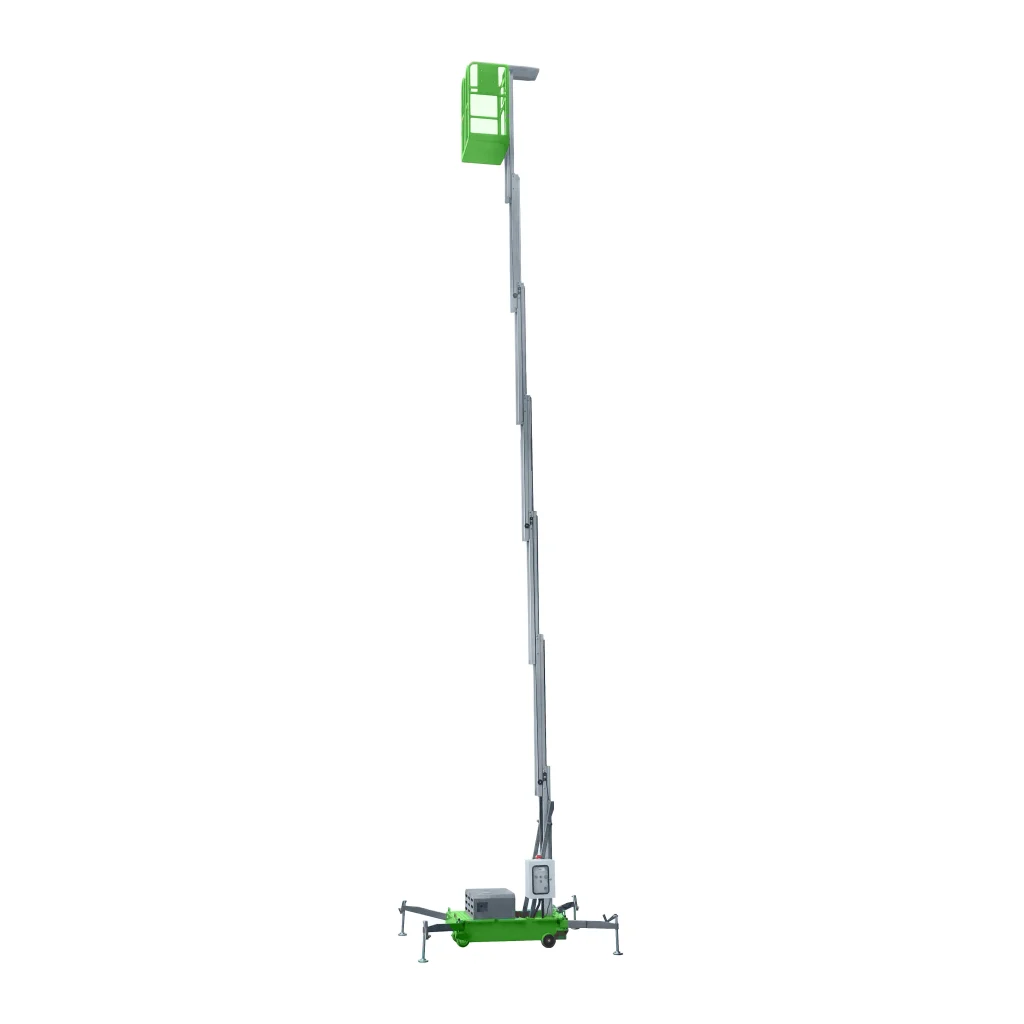
The ME800-2 weighs approximately 650 kg. Add operator and tools: ~770 kg total, distributed across an outrigger footprint of 2.10 × 2.02 m. Ground pressure per unit area is substantially lower.
A vertical mast lift at ~650–770 kg total load is a fundamentally different structural proposition from a scissor lift at 2,100+ kg.The question to ask your facility manager or structural engineer is specific: “What is the floor load rating in kg/m² at the point of use, and what is the load distribution assumption?” Get a number. Do not accept “it should be fine” as an answer when you’re putting a 2-tonne machine on a suspended floor.
What the Spec Sheet Doesn’t Show You
Stowed height matters at doorways and under beams. The MX800S stows at 1.88 m (rails folded). Many internal mezzanine access ramps and dock doors have clearances in that range. Check before the machine arrives. The ME series single-mast models stow at 2.0 m — taller than their scissor counterparts because the mast itself is vertical in transport.
Outrigger footprint limits where you set up. The ME800-2 needs 2.10 × 2.02 m of clear floor around its base when outriggers are deployed. In a congested warehouse with floor markings, racking uprights, and active traffic, finding a clean 2 × 2 m square exactly where you need it is not always straightforward. Plan the setup point, not just the work point.
Ground clearance affects ramps and transitions. Both machine types have a ground clearance of around 83–100 mm stowed. That sounds like plenty until you’re navigating a worn dock transition plate or a slightly elevated floor joint. Weight and approach angle interact — the heavier MX series is less forgiving on abrupt transitions than the lighter mast lift.
Model Reference: MX Series vs ME/DM Series at Comparable Working Heights
For buyers evaluating these two categories, the following real-specification comparison covers the most commonly requested working height range (8–12 m):
| Tabs | MX800S (Scissor) | ME800-2 (Mast) |
|---|---|---|
| Max working height | 9.80 m | 10 m |
| Platform capacity | 320 kg | 200 kg |
| Platform size | 2.30 × 1.15 m | 1.30 × 0.70 m |
| Machine weight | 2,050 kg | ~650 kg |
| Machine width (stowed) | 1.18 m | 1.03 m |
| Mobility | Self-propelled, drivable at full height | Push-around, outrigger-stabilized |
| Outrigger footprint | N/A | 2.10 × 2.02 m |
| Power | 4 × 6V/200Ah battery | AC or DC options |
| CE certified | Yes (UDEM, Annex VIII) | Yes (UDEM, Annex VIII) |
Both lines carry CE certification under EU Machinery Directive 2006/42/EC, with EMC compliance under 2014/30/EU, issued by UDEM International Certification (valid 2025–2030). For buyers requiring documentation for import or facility compliance purposes, full spec sheets are available at chinaliftplatform.com/product-catalog and PDF datasheets can be downloaded directly at chinaliftplatform.com/support/aerial-work-platform-pdf-download.
Frequently Asked Questions
Can a scissor lift be used in a warehouse with low ceilings?
Yes, but stowed height is the specification to verify before committing. The MX800S folds to 1.88 m with guardrails down. If your lowest clearance point — under a mezzanine beam, through an internal doorway, or beneath a sprinkler header — is at or below that height, the machine cannot be repositioned without risk of contact. Measure the tightest point on the route from entry to work location, not just the open floor area. Some facilities use MX Mini series models or switch to a vertical mast lift entirely for low-ceiling environments, accepting the reduced platform capacity in exchange for the ability to move freely through the building.
Is a mast lift safe for one person working alone?
Single-person mast lifts are specifically designed for solo operation when properly set up. The ME/DM series uses deployable outrigger stabilization with a level indicator — the machine will not allow platform elevation until the base is level and outriggers are correctly positioned. Both AC and DC power options eliminate the fuel handling and ventilation requirements of combustion alternatives indoors. The practical safety consideration for solo work is not the machine itself but the work environment: always confirm there is a means to summon assistance if needed, and follow site procedures for lone working at height regardless of equipment type.

What floor load do I need to check before bringing in either machine?
The number you need is the floor’s rated load capacity in kg/m², available from your facility’s structural drawings or from the mezzanine manufacturer. Calculate your total imposed load as: machine weight + operator weight + tools and materials. For a scissor lift, this load concentrates across the tire contact patches, which are relatively small. For a mast lift, the outrigger footprint distributes load across a larger area — roughly 2.1 × 2.0 m depending on the model. A mezzanine rated at 300 kg/m² that comfortably handles a 650 kg mast lift may not safely support a 2,050 kg scissor lift under the same conditions. If you’re uncertain, ask a structural engineer to confirm suitability for the specific machine and load point before use. Verbal assurances from facility staff are not a substitute for the rated specification.
The Short Version
Use a scissor lift when: you have wide aisles, a two-person team, heavy or bulky components to stage at height, or a long job that requires frequent repositioning across a large floor area — and the floor can handle the weight.
Use a mast lift when: the job is above a mezzanine or any floor with a load rating you haven’t verified, the aisle is narrow, one person can complete the task, or budget and storage footprint are genuine constraints.
The decision is not about which machine is better. It is about which machine matches the specific floor, aisle, crew, and task in front of you — and getting that answer wrong costs more than the rental fee.